


In short ⚡
Centralized Authority refers to a single governmental or regulatory body that holds exclusive power to make decisions, issue permits, and enforce compliance across a jurisdiction. In international logistics, it streamlines customs clearance, standardizes procedures, and reduces administrative complexity for importers and exporters.
Introduction
Navigating international trade often means dealing with fragmented regulations across multiple agencies. This complexity causes delays, compliance errors, and unpredictable costs.
A Centralized Authority consolidates regulatory oversight into one entity. This model is critical in customs administration, sanitary controls, and trade compliance, offering predictable processes for global supply chains.
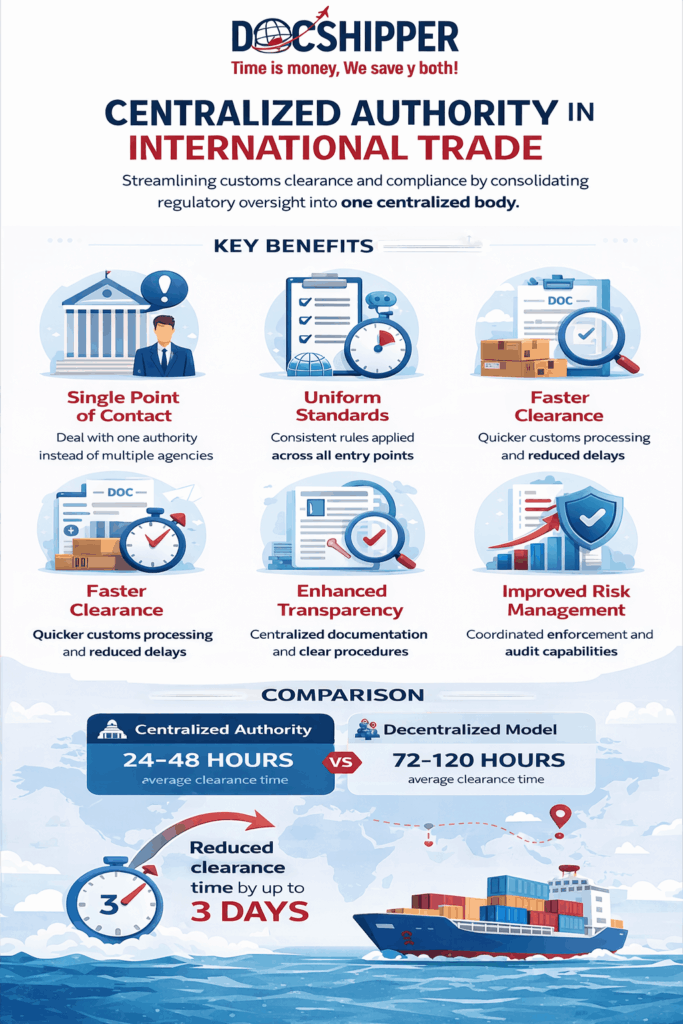
- Single point of contact: Eliminates the need to coordinate with multiple agencies.
- Uniform standards: Applies consistent rules across all entry points.
- Faster clearance: Reduces administrative bottlenecks and processing times.
- Enhanced transparency: Centralizes documentation and decision-making protocols.
- Risk management: Enables coordinated enforcement and audit capabilities.
In-Depth Analysis & Regulatory Framework
Centralized authorities operate under legislative mandates that grant them comprehensive powers over specific trade functions. These bodies manage everything from tariff classification to origin verification and sanitary inspections.
In the European Union, national customs administrations function as centralized authorities within their territories, while coordinating through the EU Customs Union framework. The European Commission Taxation and Customs Union oversees harmonization across member states.
Key operational mechanisms include:
- Authorized Economic Operator (AEO) programs: Centralized vetting for trusted traders, enabling expedited clearance.
- Single Window systems: Digital platforms where all regulatory requirements are submitted to one authority.
- Pre-arrival processing: Centralized review of documentation before goods physically arrive.
- Post-clearance audits: Unified compliance verification after goods are released.
- Binding rulings: Centralized decisions on tariff classification and origin that apply nationwide.
At DocShipper, we leverage our expertise with centralized authorities to secure advance rulings and AEO certifications, minimizing clearance times and ensuring regulatory compliance across all jurisdictions.
The legal foundation typically rests on customs codes (such as the Union Customs Code in the EU) that define the authority’s scope, appeal mechanisms, and enforcement powers. This centralization reduces interpretative conflicts that arise when multiple agencies apply different standards.
Practical Examples & Comparative Data
Understanding how centralized authorities function in practice reveals their impact on trade efficiency. Below is a comparative analysis of clearance timelines under centralized versus decentralized models:
| Model | Average Clearance Time | Document Submission Points | Compliance Predictability |
|---|---|---|---|
| Centralized Authority | 24-48 hours | Single Window | High (uniform interpretation) |
| Decentralized Model | 72-120 hours | Multiple agencies | Variable (conflicting requirements) |
Use Case: Electronics Import into France
A shipment of 5,000 smartphones arrives at Le Havre port. Under France’s centralized customs authority (Direction Générale des Douanes et Droits Indirects):
- Pre-clearance: Documentation submitted 48 hours before arrival via the EU’s ICS2 system.
- Risk assessment: Automated screening flags no issues; goods cleared for release.
- Physical inspection: Random sample inspected at port; conformity certificate verified.
- Release time: 36 hours from vessel discharge to warehouse delivery.
- Post-audit: Centralized review conducted 60 days later; no discrepancies found.
In contrast, a similar shipment to a country with fragmented oversight required separate approvals from customs, telecommunications regulators, and environmental agencies, extending clearance to 8 days.
DocShipper coordinates directly with centralized authorities to prepare compliant documentation, obtain necessary certifications, and monitor clearance status in real-time, ensuring your shipments move without delays.
Conclusion
Centralized authorities are essential for efficient international trade, providing consistency, speed, and transparency. Understanding how to engage with these bodies directly impacts your supply chain performance.
Need expert guidance navigating centralized customs authorities? Contact DocShipper for tailored support on compliance, clearance, and logistics optimization.
📚 Quiz
Testez vos connaissances : Centralized Authority
Q1 — What best defines a Centralized Authority in international trade?
Q2 — A trader believes that a Single Window system and a Centralized Authority are the same thing. Is this correct?
Q3 — A shipment of 5,000 smartphones arrives at Le Havre. Under France's centralized customs authority, what is the expected clearance time from vessel discharge to warehouse delivery?
🎯 Your Result
📞 Free Quote in 24hFAQ | Centralized Authority: Definition, Role & Practical Examples in International Trade
A centralized authority provides uniform application of regulations, reducing inconsistencies and speeding up clearance by eliminating the need to coordinate with multiple agencies.
A centralized authority is the regulatory body itself, while a Single Window is a digital platform that allows submission of all required data to that authority in one place.
Yes, centralized customs authorities typically have the power to issue binding tariff information (BTI) and binding origin information (BOI) that applies across their jurisdiction.
Most countries have a single national customs administration, but the degree of centralization varies. Some nations have regional offices with limited autonomy, while others maintain strict central control.
Centralized authorities manage AEO programs, conducting unified assessments and granting certifications that are recognized across all entry points within that jurisdiction.
It enables coordinated risk profiling, intelligence sharing, and enforcement actions, improving detection of fraud and non-compliance while facilitating legitimate trade.
Yes, most jurisdictions provide formal appeal mechanisms, allowing traders to challenge classification decisions, duty assessments, or penalty impositions through administrative or judicial review.
They typically establish formal cooperation agreements and data-sharing protocols with agencies responsible for health, safety, agriculture, and other regulatory areas.
Standard requirements include commercial invoices, packing lists, bills of lading, certificates of origin, and any product-specific permits or licenses mandated by law.
It standardizes duty calculation methods and payment procedures, often allowing deferred payment schemes or centralized accounting for authorized traders.
Yes, they oversee export declarations, verify compliance with export controls, and facilitate customs formalities for outbound shipments.
Centralized authorities implement preferential tariff treatments under trade agreements, verify origin compliance, and issue necessary certificates to access reduced duty rates.
Need Help with
Logistics or Sourcing ?
First, we secure the right products from the right suppliers at the right price by managing the sourcing process from start to finish. Then, we simplify your shipping experience - from pickup to final delivery - ensuring any product, anywhere, is delivered at highly competitive prices.


Fill the Form
Prefer email? Send us your inquiry, and we’ll get back to you as soon as possible.
Contact us




