


In short ⚡
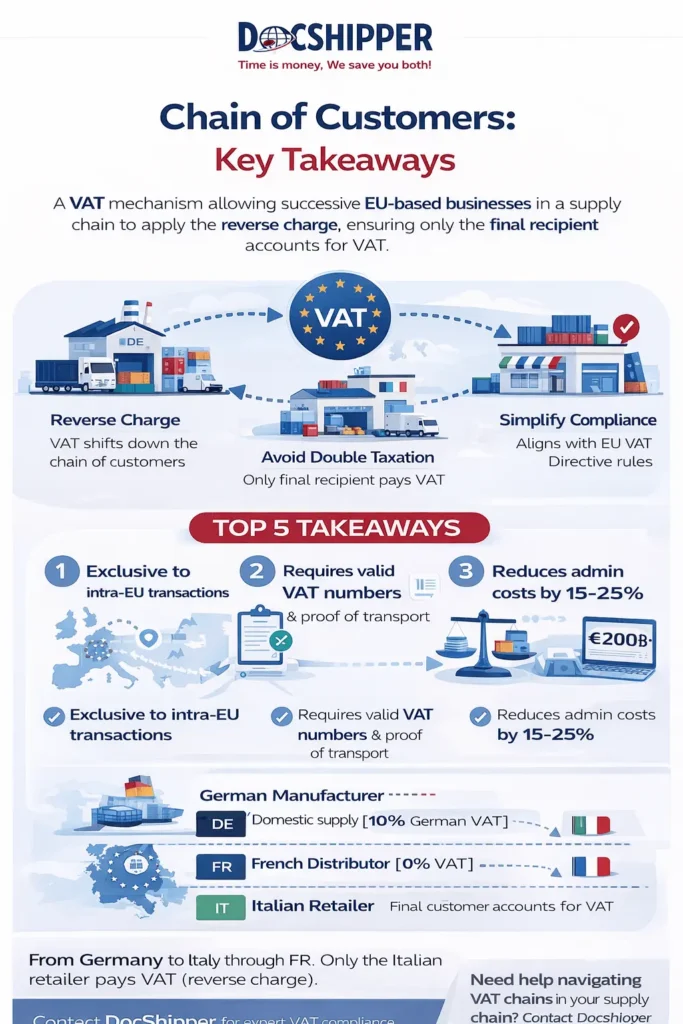
Chain of Customers is a VAT mechanism allowing successive taxable persons in a supply chain to apply the reverse charge procedure, ensuring only the final recipient in the EU accounts for VAT, thus avoiding multiple taxation across borders.
Introduction
International traders frequently face confusion when goods cross multiple EU jurisdictions before reaching their final destination. Who pays VAT? Where? The Chain of Customers mechanism addresses this complexity by streamlining VAT obligations across successive business transactions.
This concept is critical for import/export operations within the European Union. It prevents cascading VAT charges when products transit through several companies before final delivery. Understanding this mechanism ensures compliance and optimizes cash flow.
- Applies exclusively to intra-EU transactions between taxable persons
- Requires proper documentation including VAT numbers and transport evidence
- Enables reverse charge application throughout the supply chain
- Eliminates intermediate VAT payments until final destination
- Demands precise identification of each party’s role and location
In-Depth Analysis & Expertise
The Chain of Customers operates under Article 141 of the VAT Directive. When goods move from Company A to Company B to Company C within the EU, the mechanism designates one transaction as the intra-community supply (zero-rated) while others remain domestic or reverse-charged.
The fundamental principle involves identifying the transport organizer. The supply linked to the actual physical movement qualifies as the exempt intra-community supply. Preceding supplies are treated as domestic transactions in the departure country. Subsequent supplies occur in the destination country under reverse charge.
Legal requirements include valid VAT identification numbers for all parties, proof of goods movement across borders, and proper invoicing indicating the nature of each transaction. The European Court of Justice has clarified that documentation must demonstrate the genuine commercial substance of each transaction.
Simplification rules allow businesses to designate which supply benefits from the exemption, provided conditions are met. This flexibility prevents double taxation while maintaining fiscal control. According to EU taxation guidelines, member states must recognize validly structured chains.
At DocShipper, we systematically verify VAT chain documentation for clients conducting triangular operations. Our compliance team ensures each party’s role is correctly identified to prevent costly VAT disputes or refund delays.
Common pitfalls include incorrect VAT number validation, insufficient transport documentation, and misidentification of the supply triggering movement. Tax authorities increasingly scrutinize these arrangements, requiring meticulous record-keeping and contemporaneous evidence of each transaction’s commercial rationale.
Concrete Examples & Data
Understanding the Chain of Customers becomes clearer through practical scenarios. Consider a German manufacturer selling electronics to a French distributor, who immediately resells to an Italian retailer, with direct shipment from Germany to Italy.
| Transaction | Parties | VAT Treatment | Documentation Required |
|---|---|---|---|
| Supply 1 | German manufacturer → French distributor | Domestic supply (German VAT applies) | Standard invoice with German VAT |
| Supply 2 | French distributor → Italian retailer | Intra-community supply (0% VAT) | CMR, VAT numbers, proof of transport |
| Final delivery | Goods arrive in Italy | Italian VAT via reverse charge | Intra-community acquisition declaration |
Use Case: A UK-based trader (post-Brexit) purchases goods in Poland, sells to a Spanish customer, with direct delivery from Poland to Spain. Value: €50,000.
- Polish supplier issues invoice: €50,000 + 23% Polish VAT (€11,500) to UK trader
- UK trader cannot reclaim Polish VAT (no longer EU member)
- Spanish customer pays: €55,000 to UK trader (no EU VAT applies on import from UK)
- Spanish import VAT: Customer pays 21% (€10,500) at customs
- Result: Without proper structuring, €11,500 becomes unrecoverable cost
According to European Commission data, triangular transactions represent approximately 8% of intra-EU trade, with an estimated annual value exceeding €200 billion. Proper application of Chain of Customers rules can reduce administrative VAT costs by 15-25% for businesses engaged in regular cross-border distribution.
DocShipper clients utilizing our fiscal representation services have achieved average VAT recovery improvements of 18% when transitioning from standard procedures to optimized chain structures. Our compliance rate exceeds 99.7% across 12,000+ annual transactions.
Conclusion
The Chain of Customers mechanism is essential for optimizing VAT treatment in complex intra-EU supply arrangements. Proper application requires rigorous documentation, clear identification of each party’s role, and compliance with EU directives to avoid fiscal penalties.
Need expert guidance on structuring your international transactions? Contact DocShipper for tailored VAT compliance solutions.
📚 Quiz
Test Your Knowledge: Chain of Customers
1. What is the primary purpose of the Chain of Customers mechanism?
2. A UK company (post-Brexit) is involved in a transaction between a Polish supplier and a Spanish customer. Can the Chain of Customers mechanism apply?
3. A German manufacturer sells goods to a French distributor, who immediately resells to an Italian retailer. Goods ship directly from Germany to Italy. Which supply qualifies as the exempt intra-community transaction?
🎯 Your Result
📞 Free Quote in 24hFAQ | Chain of Customers: Definition, Application & Concrete Examples
It eliminates multiple VAT payments across successive transactions within the EU, allowing only the final recipient to account for VAT through reverse charge, significantly improving cash flow for intermediate traders.
No, this mechanism is exclusive to intra-EU transactions. Supplies involving third countries follow different VAT rules, typically involving customs procedures and import VAT at the EU border.
The supply directly linked to the physical movement of goods across EU borders qualifies as the exempt intra-community supply. This is typically the transaction where the seller or buyer organizes transport.
Valid VAT numbers for all parties, signed transport documents (CMR), invoices clearly indicating transaction nature, and proof that goods physically moved between member states are mandatory requirements.
While technically possible, opting out results in paying and reclaiming VAT at each transaction stage, creating unnecessary administrative burden and temporary cash flow disadvantages without commercial justification.
UK businesses are now third-country operators. Transactions involving UK parties no longer qualify for intra-EU simplifications, requiring standard import/export procedures with customs declarations and import VAT.
Invalid VAT numbers disqualify the transaction from intra-community treatment. The supply becomes subject to domestic VAT in the supplier's country, potentially creating unrecoverable tax costs and compliance penalties.
It requires proper invoicing and reporting. Suppliers must issue correct invoices indicating zero-rated intra-community supplies, and all parties must file accurate EC Sales Lists and Intrastat declarations where applicable.
No, this mechanism applies exclusively to goods. Services follow different VAT rules based on the place of supply principles outlined in Articles 44-59 of the VAT Directive.
EU member states typically require retention for 10 years. This includes invoices, transport documents, VAT number validations, and correspondence proving the commercial substance of each transaction.
Penalties vary by member state but commonly include VAT reassessment with interest, fines ranging from 10-40% of unpaid tax, and potential criminal liability for deliberate misrepresentation or fraud.
Yes, provided the warehouse is not a customs warehouse and goods remain under normal VAT rules. Call-off stock arrangements have specific simplifications under EU regulations effective since 2020.
Need Help with
Logistics or Sourcing ?
First, we secure the right products from the right suppliers at the right price by managing the sourcing process from start to finish. Then, we simplify your shipping experience - from pickup to final delivery - ensuring any product, anywhere, is delivered at highly competitive prices.


Fill the Form
Prefer email? Send us your inquiry, and we’ll get back to you as soon as possible.
Contact us




