


In short ⚡
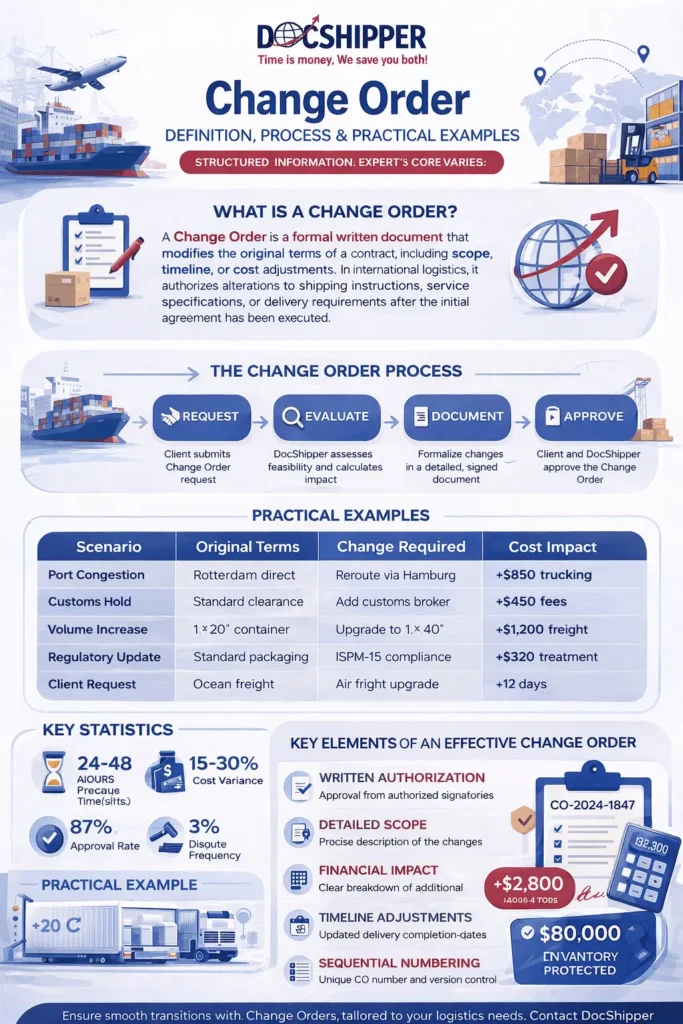
A Change Order is a formal written document that modifies the original terms of a contract, including scope, timeline, or cost adjustments. In international logistics, it authorizes alterations to shipping instructions, service specifications, or delivery requirements after the initial agreement has been executed.
Introduction
In international trade, unexpected circumstances constantly emerge. Port congestion, regulatory changes, or client requirements shift midstream. Without proper documentation, these alterations create disputes, financial losses, and operational chaos.
The Change Order serves as the contractual bridge between initial agreements and evolving realities. It protects all parties by formalizing modifications while maintaining legal enforceability throughout the supply chain.
Key characteristics of effective Change Orders include:
- Written authorization from authorized signatories on both sides
- Detailed scope description outlining exactly what changes from the original contract
- Financial impact statement specifying cost increases or decreases
- Timeline adjustments with revised delivery or completion dates
- Sequential numbering for audit trail and version control
In-Depth Analysis & Expert Insights
Change Orders operate within a precise contractual framework. The original Master Service Agreement or Sales Contract typically includes a Change Order clause that defines the modification process, approval hierarchy, and pricing mechanisms for unforeseen alterations.
Three critical elements distinguish valid Change Orders from informal requests. First, mutual consent requires documented approval from both buyer and seller. Verbal agreements or email confirmations without proper signatures create enforcement vulnerabilities. Second, consideration exchange must occur—even if one party absorbs additional costs, the modification must reflect a bargained-for exchange. Third, integration with the base contract ensures the Change Order references specific clauses being modified.
In logistics operations, common triggers include cargo reclassification after customs inspection, routing changes due to geopolitical events, packaging modifications for compliance with destination country regulations, storage extensions when consignees delay pickup, and service upgrades from standard to expedited shipping.
The International Chamber of Commerce (ICC) provides standardized frameworks for contract modifications in cross-border transactions. Their Incoterms® rules explicitly address how changes to delivery terms must be documented to maintain legal validity.
At DocShipper, we implement a three-tier approval system for Change Orders. Minor adjustments under 10% of contract value require operational manager sign-off. Modifications between 10-25% escalate to regional directors. Any change exceeding 25% or altering fundamental service parameters demands executive committee review. This structured approach prevents scope creep while maintaining operational flexibility.
The financial reconciliation process poses particular challenges. Change Orders must specify whether additional costs apply immediately, get invoiced separately, or adjust the final billing. Ambiguity here creates payment disputes that can delay cargo release or damage client relationships. Best practice dictates separate line items on invoices clearly referencing the Change Order number and date.
Practical Examples & Data
Real-world applications demonstrate how Change Orders function across different logistics scenarios. Consider a manufacturer shipping electronics from Shenzhen to Rotterdam with an original contract specifying 20-foot containers and standard ocean freight.
Scenario Comparison Table
| Scenario | Original Terms | Change Required | Cost Impact | Timeline Impact |
|---|---|---|---|---|
| Port Congestion | Rotterdam direct | Reroute via Hamburg | +$850 trucking | +5 days |
| Customs Hold | Standard clearance | Add customs broker | +$450 fees | +3 days |
| Volume Increase | 1×20′ container | Upgrade to 1×40′ | +$1,200 freight | No change |
| Regulatory Update | Standard packaging | ISPM-15 compliance | +$320 treatment | +2 days |
| Client Request | Ocean freight | Air freight upgrade | +$4,500 premium | -18 days |
Use Case: Temperature-Controlled Shipment Modification
A pharmaceutical company contracted DocShipper for standard refrigerated transport of vaccines from Lyon to Dubai at 2-8°C. Mid-transit, the client discovered certain products required frozen conditions at -20°C.
Change Order Process:
- Day 1: Client submits written request via secure portal with product specifications
- Day 1: Operations team assesses feasibility—confirms frozen containers available at transshipment hub
- Day 2: Finance calculates differential: +$2,800 for specialized equipment and handling
- Day 2: Change Order CO-2024-1847 drafted with revised terms, cost breakdown, and liability clauses
- Day 3: Client approves digitally; cargo transferred to -20°C unit during Hamburg stopover
This modification added 36 hours to transit time but prevented $180,000 in spoiled inventory. The formalized Change Order protected both parties—the client paid only documented additional costs, while DocShipper secured written authorization absolving liability for the delay.
Key Performance Indicators
Industry data reveals critical benchmarks for Change Order management:
- Average processing time: 24-48 hours for standard modifications
- Cost variance: 15-30% increase over original contract value (median: 22%)
- Approval rate: 87% of submitted Change Orders receive client authorization
- Dispute frequency: Only 3% of properly documented Change Orders result in payment disputes
- Timeline impact: 68% of Change Orders extend delivery schedules by 2-7 days
Conclusion
The Change Order transforms logistical uncertainty into contractual clarity. By formalizing modifications with proper documentation, authorization, and financial transparency, it protects supply chain integrity while accommodating inevitable operational realities.
Need expert guidance on managing contract modifications in your international shipments? Contact DocShipper for tailored logistics solutions that adapt to your evolving requirements.
📚 Quiz
Test Your Knowledge: Change Order
1. What is a Change Order in international logistics?
2. A client sends an email asking to reroute a shipment due to port congestion, but no one signs a formal document. Is this a valid Change Order?
3. A pharmaceutical company discovers mid-transit that their vaccines need to be stored at -20°C instead of the contracted 2-8°C. What is the correct course of action?
🎯 Your Result
📞 Free Quote in 24hFAQ | Change Order: Definition, Process & Practical Examples
A Change Order modifies specific operational elements (scope, timeline, cost) within the existing contract framework. A contract amendment alters fundamental terms like payment structures, liability clauses, or jurisdiction provisions, typically requiring more extensive legal review.
Authorization depends on the contract's delegation of authority clause. Typically, project managers approve minor changes, while significant modifications require director-level or C-suite approval. Both parties must have authorized signatories execute the Change Order.
Standard industry practice requires acknowledgment within 24 hours and full processing within 48-72 hours. Time-sensitive modifications (like rerouting due to port closures) may demand expedited approval within 12 hours to prevent shipment delays.
While verbal agreements may be legally binding in some jurisdictions, they create enforcement challenges and dispute risks. Best practice mandates written documentation with signatures, especially in international transactions where multiple legal systems may apply.
Refusal to authorize essential modifications may trigger force majeure clauses or contract termination provisions. The requesting party should document the refusal, outline potential consequences, and consider dispute resolution mechanisms outlined in the original contract.
Extremely common—industry surveys indicate 60-75% of international shipments experience at least one modification requiring formal documentation. Factors like customs regulations, weather events, and client requirement changes drive this frequency.
Material modifications may alter risk profiles and require insurance policy adjustments. Notify your cargo insurer immediately when Change Orders affect shipment value, routing, storage duration, or handling procedures to maintain continuous coverage.
Essential supporting documents include the original contract reference, detailed scope description, cost breakdown with calculations, revised timeline with milestones, authorization signatures, and any technical specifications or regulatory requirements driving the change.
While possible, retroactive Change Orders create legal complications and should be avoided. If work has already been performed under modified terms, document the circumstances thoroughly and obtain written acknowledgment from both parties immediately.
Implement sequential numbering systems (e.g., CO-2024-0001) that include year and unique identifiers. Maintain a centralized register linking each Change Order to the base contract, approval dates, financial impacts, and implementation status for audit trail purposes.
Additional costs from Change Orders may affect customs valuations, VAT calculations, or duty assessments. Consult with customs brokers or tax advisors when modifications alter shipment value or classification to ensure compliant declarations.
Most jurisdictions recognize digital signatures under frameworks like eIDAS (EU) or ESIGN Act (US). However, verify acceptance in destination countries and ensure your digital signature platform meets legal standards for the specific trade route involved.
Need Help with
Logistics or Sourcing ?
First, we secure the right products from the right suppliers at the right price by managing the sourcing process from start to finish. Then, we simplify your shipping experience - from pickup to final delivery - ensuring any product, anywhere, is delivered at highly competitive prices.


Fill the Form
Prefer email? Send us your inquiry, and we’ll get back to you as soon as possible.
Contact us




