


In short ⚡
Common Law is a legal system based on judicial precedents and case law rather than codified statutes. Originating in England, it relies on court decisions to establish binding rules. In international trade, Common Law jurisdictions influence contract interpretation, dispute resolution, and liability frameworks, particularly in maritime, insurance, and commercial transactions.Introduction
Many importers and exporters face confusion when contracts reference “governing law” clauses. Should disputes arise, will judges apply rigid codes or flexible precedents? This distinction fundamentally impacts risk allocation, enforcement speed, and legal predictability.
Common Law shapes how commercial relationships unfold across major trading nations like the United States, United Kingdom, Canada, Australia, and Singapore. Understanding its principles prevents costly misinterpretations during cross-border transactions.
Key characteristics include:
- Judicial Precedent (Stare Decisis): Courts follow previous rulings to ensure consistency.
- Case-by-Case Evolution: Law develops through specific disputes rather than legislative updates.
- Flexibility in Interpretation: Judges adapt principles to unique factual contexts.
- Adversarial Proceedings: Parties present evidence and arguments; judges remain neutral arbiters.
- Emphasis on Contractual Freedom: Parties enjoy broad latitude in negotiating terms, subject to public policy limits.
Legal Foundations & Mechanisms
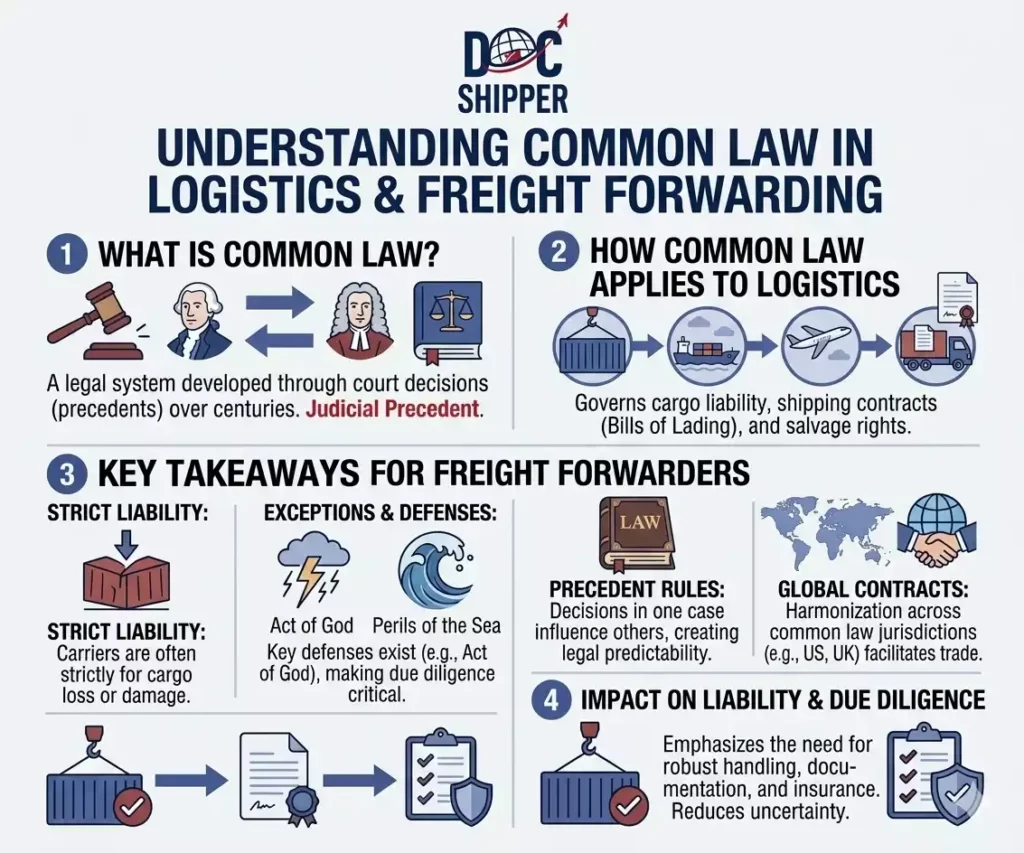
Common Law distinguishes itself from Civil Law systems (prevalent in Continental Europe, Latin America, and parts of Asia) through its reliance on judicial decisions rather than comprehensive legal codes. Courts examine prior rulings—binding precedents—to resolve current disputes. This doctrine, called stare decisis, ensures predictability while allowing incremental legal refinement.
In international logistics, Common Law governs critical areas:
- Contract Law: Interpretation focuses on parties’ intentions, often derived from correspondence, conduct, and prior dealings. Terms are enforced unless unconscionable or contrary to statute.
- Tort Liability: Negligence claims in cargo damage or personal injury follow precedent-based duty-of-care standards established through landmark cases.
- Maritime Law: Admiralty courts in Common Law jurisdictions apply centuries of case law governing bills of lading, charter parties, and salvage rights.
- Agency Relationships: Freight forwarders, customs brokers, and carriers operate under principles refined through judicial decisions on authority, fiduciary duties, and vicarious liability.
The Uniform Commercial Code (UCC) in the United States exemplifies hybrid codification: while statutory, it incorporates Common Law principles and courts interpret its provisions through precedent. Similarly, the Sale of Goods Act 1979 in the UK codifies commercial practices but remains subject to judicial interpretation.
External authoritative resources include the UK Legislation Database and the Legal Information Institute (Cornell Law School), which provide searchable case law and statutory texts.
At DocShipper, we routinely advise clients on jurisdiction selection in international contracts. Choosing a Common Law forum often accelerates dispute resolution through established arbitration frameworks like those of the London Court of International Arbitration (LCIA).
Practical Examples & Data
Understanding Common Law application requires examining real-world scenarios where precedent shapes outcomes. The following comparisons and case studies illustrate practical implications for traders.
Comparative Analysis: Common Law vs. Civil Law Jurisdictions
| Aspect | Common Law (UK, US, Singapore) | Civil Law (France, Germany, China) |
|---|---|---|
| Primary Source | Judicial precedents + statutes | Comprehensive legal codes |
| Judge’s Role | Interprets law; creates precedent | Applies codified rules; limited interpretation |
| Contract Flexibility | High—parties define terms broadly | Moderate—codes impose mandatory provisions |
| Litigation Duration | Variable; discovery phase extends timelines | Generally faster; limited discovery |
| Precedent Binding | Yes—lower courts follow higher court rulings | No—decisions guide but don’t bind |
Use Case: Cargo Damage Dispute
Scenario: A UK importer receives electronics damaged during ocean transit from China. The bill of lading contains a Himalaya Clause extending carrier liability protections to stevedores.
Common Law Resolution:
- Court examines the landmark case Scruttons Ltd v Midland Silicones Ltd [1962], establishing third-party beneficiary rights under bills of lading.
- Judge applies stare decisis, ruling the stevedore enjoys limited liability despite not being a signatory.
- Outcome: Importer’s claim capped at SDR 2 per kilogram (Hague-Visby Rules), upheld through precedent.
- Timeline: 8–12 months including appeals.
Key Data Points
- 60% of international arbitration cases worldwide choose Common Law jurisdictions (ICC 2023 statistics).
- New York Convention signatories recognize arbitral awards from Common Law courts in 172 countries.
- English law governs 40% of global maritime contracts due to precedent clarity and enforceability.
- Discovery costs in US Common Law litigation average 50–70% of total legal expenses, compared to 20–30% in Civil Law systems.
- Singapore International Arbitration Centre (SIAC) reported 1,080 cases in 2022, with 85% involving Common Law principles.
DocShipper assists clients in drafting jurisdiction clauses that leverage Common Law advantages—particularly when dealing with complex multi-party logistics chains involving carriers, insurers, and freight forwarders across multiple territories.
Conclusion
Common Law provides a flexible, precedent-driven framework essential for navigating international trade disputes. Its emphasis on contractual freedom and judicial consistency makes it the preferred choice for cross-border commerce.
Need guidance on jurisdiction selection or contract drafting? Contact DocShipper for expert support tailored to your logistics needs.
📚 Quizz
Test Your Knowledge: Common Law
Q1. What is the primary source of law in a Common Law legal system?
Q2. A common misconception about Common Law is that judges simply apply fixed rules without interpretation. What does the doctrine of stare decisis actually mean in practice?
Q3. A French exporter and a Chinese importer are drafting an international sales contract. Neither party is based in a Common Law country. Can they choose English law as the governing law of their contract?
🎯 Your Result
📞 Free Quote in 24hFAQ | Common Law: Definition, Application & Practical Examples in International Trade
Common Law relies on judicial precedents and case-by-case rulings, while Civil Law uses comprehensive statutory codes drafted by legislatures. Judges in Common Law systems create binding precedents; Civil Law judges apply existing codes.
Major Common Law jurisdictions include the United Kingdom, United States, Canada, Australia, New Zealand, India, Singapore, Hong Kong, and many former British colonies. These nations share legal traditions rooted in English jurisprudence.
Common Law governs bill of lading interpretation, carrier liability limits, and dispute resolution mechanisms. Contracts often specify English or New York law due to extensive maritime precedents and predictable enforcement through arbitration.
Yes. Parties may select any governing law in their contract, subject to public policy exceptions. Many international agreements choose English or New York law for neutrality and well-developed commercial jurisprudence.
Stare decisis ("to stand by things decided") requires courts to follow precedents set by higher courts in the same jurisdiction. This doctrine ensures legal consistency and predictability across similar cases.
Generally, yes. Common Law emphasizes freedom of contract, allowing parties to negotiate terms broadly. Civil Law systems impose more mandatory provisions through codes, limiting contractual autonomy in certain areas like consumer protection.
Judges examine surrounding circumstances, prior dealings, industry customs, and parties' conduct to determine intent. The "parol evidence rule" limits external evidence but allows context when terms are genuinely ambiguous.
Statutes supplement case law by codifying specific areas (e.g., UCC in the US, Sale of Goods Act in the UK). Courts interpret statutes through precedent, blending legislative intent with judicial reasoning.
Not necessarily. While arbitration avoids lengthy court procedures, Common Law discovery phases (document exchange, depositions) can extend timelines. However, institutional rules (ICC, LCIA) streamline processes regardless of governing law.
Courts interpret force majeure clauses strictly, requiring proof that events were unforeseeable, unavoidable, and directly prevented performance. Precedents like Tandrin Aviation Holdings v Aero Toy Store (2010) establish high thresholds for invoking such defenses.
Yes. Higher courts may overrule previous decisions when societal conditions or legal reasoning evolves. However, such changes occur gradually to maintain stability. Landmark reversals are rare but reshape entire legal areas.
Extensive case law on risk allocation, subrogation rights, and policy interpretation provides clarity. English marine insurance law, codified in the Marine Insurance Act 1906 yet interpreted through precedent, remains globally influential.
Need Help with
Logistics or Sourcing ?
First, we secure the right products from the right suppliers at the right price by managing the sourcing process from start to finish. Then, we simplify your shipping experience - from pickup to final delivery - ensuring any product, anywhere, is delivered at highly competitive prices.


Fill the Form
Prefer email? Send us your inquiry, and we’ll get back to you as soon as possible.
Contact us




