


In short ⚡
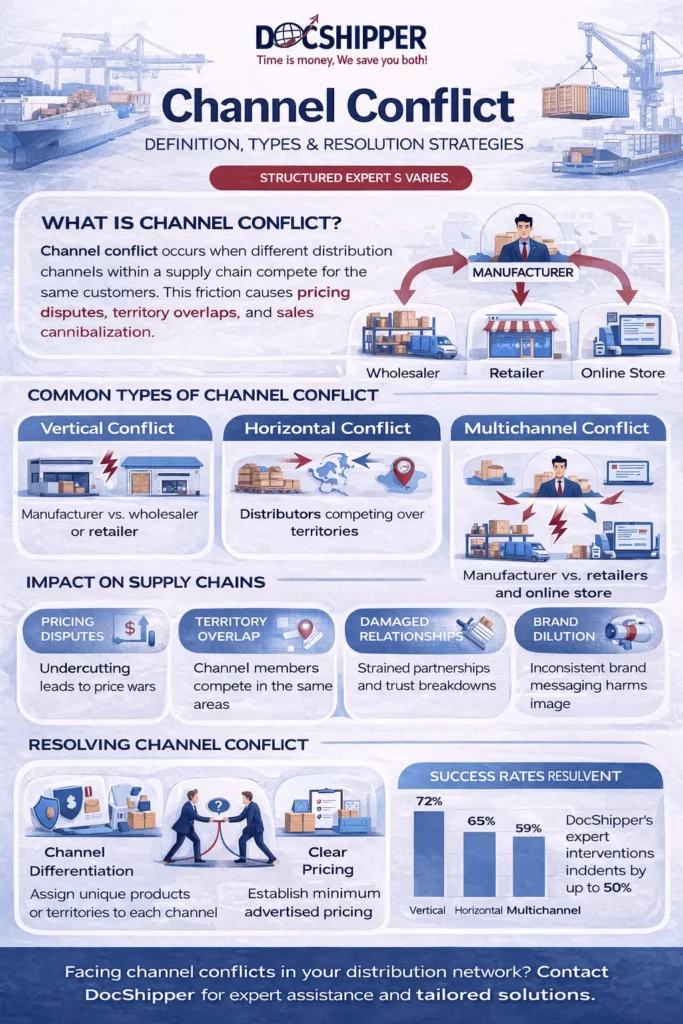
Channel conflict occurs when different distribution channels within a supply chain compete for the same customers, creating friction between manufacturers, wholesalers, retailers, and direct sales operations. This competition can lead to pricing disputes, territory overlaps, and damaged business relationships that ultimately affect profitability and market positioning.
Introduction
In international trade and logistics, companies often struggle with a critical dilemma: how to reach customers through multiple channels without creating internal competition. A manufacturer selling both through distributors and directly online faces immediate tension—distributors feel undercut while the company seeks margin control.
Channel conflict represents one of the most persistent challenges in modern supply chain management. As businesses expand globally and embrace omnichannel strategies, the risk of channel partners competing against each other intensifies. This phenomenon affects pricing strategies, customer relationships, and ultimately, the entire distribution network’s efficiency.
- Price competition between authorized retailers and direct-to-consumer platforms
- Territory disputes when online sales overlap with regional distributors’ markets
- Service level inconsistencies across different channel partners
- Brand dilution when channels present conflicting messaging or positioning
- Inventory imbalances caused by competing channel demands
Understanding Channel Conflict Dynamics
Channel conflict emerges in three primary forms, each requiring distinct management approaches. Vertical conflict occurs between different levels in the same channel—such as manufacturers versus wholesalers or wholesalers versus retailers. This typically stems from disagreements over margins, promotional support, or performance expectations.
Horizontal conflict develops when partners at the same distribution level compete. Two authorized distributors serving overlapping territories exemplify this scenario. The third type, multichannel conflict, arises when a company operates multiple distribution paths simultaneously—retail stores, e-commerce platforms, and wholesale networks all targeting similar customer segments.
The root causes extend beyond simple competition. Information asymmetry plays a critical role. When manufacturers possess customer data that distributors lack, or when online channels offer pricing transparency that physical retailers cannot match, conflict intensifies. According to the U.S. International Trade Administration, approximately 60% of export-oriented manufacturers report experiencing moderate to severe channel conflict when expanding internationally.
Contractual ambiguities frequently exacerbate tensions. Vague territory definitions, unclear pricing policies, and poorly defined exclusivity terms create fertile ground for disputes. Performance metric misalignment also contributes—when manufacturers prioritize market share while distributors focus on margin protection, conflict becomes inevitable.
At DocShipper, we regularly advise clients on structuring distribution agreements that minimize channel overlap. Our experience shows that clearly defined territorial rights and transparent pricing frameworks reduce conflict incidents by over 40%. Establishing these parameters before launching new channels proves far more effective than attempting resolution after disputes emerge.
Digital transformation has amplified these challenges. E-commerce platforms enable manufacturers to bypass traditional intermediaries, creating direct competition with established distribution partners. This disintermediation threatens relationships built over decades, forcing companies to balance short-term margin gains against long-term partnership stability.
Practical Examples & Resolution Data
Consider a European electronics manufacturer selling through three channels: authorized retailers, online marketplaces, and a proprietary e-commerce site. When the manufacturer launched a direct-to-consumer promotion at 15% below retail pricing, authorized retailers experienced a 23% sales decline within six weeks. This scenario illustrates classic multichannel conflict with quantifiable business impact.
| Conflict Type | Primary Cause | Average Resolution Time | Success Rate |
|---|---|---|---|
| Vertical Pricing Disputes | Margin compression | 3-5 months | 72% |
| Horizontal Territory Overlap | Geographic ambiguity | 2-4 months | 65% |
| Multichannel Competition | Direct-to-consumer strategy | 6-12 months | 58% |
| Service Level Inconsistency | Training gaps | 1-3 months | 81% |
Resolution strategies vary by conflict severity. For minor disputes, enhanced communication protocols often suffice. Monthly alignment meetings, shared performance dashboards, and transparent inventory visibility reduce misunderstandings. Moderate conflicts typically require channel differentiation—assigning unique product lines, customer segments, or service levels to each channel.
Severe conflicts demand structural intervention. Pricing policies with minimum advertised price (MAP) agreements protect retail partners while allowing online flexibility. Territorial exclusivity grants distributors protected markets in exchange for performance commitments. Some manufacturers implement revenue-sharing models where online sales in a distributor’s territory trigger compensation payments.
A practical case: A U.S. automotive parts supplier faced distributor rebellion when launching direct sales. The solution involved tiered pricing—distributors received 8% lower wholesale costs than the direct channel’s effective price after marketing expenses. This preserved distributor margins while enabling direct market presence. Within nine months, total network sales increased 17%, with both channels growing profitably.
DocShipper helps clients implement conflict prevention mechanisms during distribution network design. Our approach includes mapping potential overlap zones, establishing clear escalation procedures, and building contractual safeguards. These proactive measures reduce conflict incidence by approximately 50% compared to reactive management approaches.
Technology solutions now enable sophisticated conflict management. Channel management platforms track real-time sales by geography and partner, flagging potential violations automatically. Some systems employ algorithmic pricing that adjusts based on competitive dynamics while maintaining partner profitability thresholds.
Conclusion
Channel conflict represents an inevitable consequence of distribution complexity, but strategic management transforms potential friction into competitive advantage. Companies that proactively address channel dynamics through clear policies, differentiated value propositions, and transparent communication consistently outperform those reacting to disputes reactively.
Need expert guidance on structuring your international distribution network to minimize channel conflict? Contact DocShipper for customized logistics and supply chain solutions.
📚 Quizz
Test Your Knowledge: Channel Conflict
Q1 — What best defines "channel conflict" in a supply chain context?
Q2 — A manufacturer launches a direct-to-consumer e-commerce site at prices 15% below its authorized retailers. Which type of channel conflict does this represent?
Q3 — A U.S. supplier wants to launch direct online sales without losing its distributor network. Which approach best prevents channel conflict?
🎯 Your Result
📞 Free Quote in 24hFAQ | Channel Conflict: Definition, Types & Resolution Strategies
Price transparency across borders represents the leading cause. When customers can compare pricing across different channels and regions instantly, distributors in higher-price markets face pressure, creating conflict with manufacturers or lower-cost channels.
Implement differential pricing strategies, offer exclusive online product variants, provide distributors with lead referral compensation from their territories, and establish clear MAP policies before launch. Communication with existing partners during planning phases proves critical.
Not necessarily. Controlled channel competition can drive innovation and efficiency. The key lies in managing conflict intensity—moderate competition motivates partners, while severe conflict destroys relationships and market coverage.
Well-drafted distribution agreements serve as conflict prevention tools. They should specify territorial rights, pricing policies, performance expectations, exclusivity terms, and dispute resolution mechanisms. Ambiguous contracts increase conflict likelihood significantly.
Resolution timelines vary by severity. Minor disputes resolve in 4-8 weeks, moderate conflicts require 3-5 months, and severe structural issues may take 6-12 months. Proactive management reduces both frequency and duration.
Yes, through vertical conflict between manufacturer and distributor regarding pricing, promotional support, or performance expectations. Even exclusive distribution arrangements experience tension over margin allocation and market development responsibilities.
Watch for declining partner satisfaction scores, increased pricing complaints, rising return rates, territory boundary inquiries, reduced order volumes from specific channels, and increased customer confusion about purchasing options.
Customers encounter inconsistent pricing, conflicting product information, varying service levels, and confusion about warranty coverage. This fragmentation damages brand perception and reduces customer loyalty across all channels.
Yes, third-party marketplaces represent distinct channels that often conflict with direct e-commerce and traditional retail. Managing marketplace presence requires specific policies regarding pricing, inventory allocation, and brand representation.
Channel competition involves healthy rivalry that improves overall network performance. Channel conflict occurs when competition becomes destructive, damaging relationships, profitability, or market coverage. The distinction lies in whether competition serves or harms overall business objectives.
Cultural variations in negotiation styles, relationship expectations, and conflict resolution approaches complicate international channel management. What constitutes acceptable competition in one market may represent serious conflict in another, requiring culturally adapted management strategies.
Technology facilitates conflict management through transparency and automation but cannot eliminate fundamental competitive tensions. Digital tools enable better monitoring, faster resolution, and clearer communication, reducing conflict severity rather than preventing it completely.
Need Help with
Logistics or Sourcing ?
First, we secure the right products from the right suppliers at the right price by managing the sourcing process from start to finish. Then, we simplify your shipping experience - from pickup to final delivery - ensuring any product, anywhere, is delivered at highly competitive prices.


Fill the Form
Prefer email? Send us your inquiry, and we’ll get back to you as soon as possible.
Contact us




