



In short ⚡
Chargeable weight is the weight used by carriers to calculate shipping costs, determined by comparing actual weight and volumetric weight, then selecting the higher value. This metric ensures fair pricing for both dense and bulky shipments in international logistics.Introduction
Every importer faces a common dilemma: why does shipping a box of pillows cost more than shipping a box of books of the same weight? The answer lies in chargeable weight, a pricing mechanism that balances the economic realities of freight transportation.
In international logistics, carriers must optimize cargo space while ensuring profitability. A shipment occupying significant volume but weighing little creates inefficiency. Conversely, heavy but compact cargo maximizes space utilization. Chargeable weight reconciles these extremes by establishing a fair billing standard.
Understanding this concept is critical for cost control in import/export operations. Key characteristics include:
- Dual calculation method: compares actual gross weight versus dimensional weight
- Mode-specific formulas: air freight uses different divisors than ocean LCL
- Direct cost impact: determines final freight charges on invoices
- Optimization potential: proper packaging can reduce billable weight significantly
- Universal application: used by all major carriers worldwide (DHL, FedEx, Maersk, etc.)
Technical Breakdown & Industry Standards
Chargeable weight determination follows a systematic process. Carriers first measure the actual weight (gross weight including packaging) using calibrated scales. Simultaneously, they calculate volumetric weight (also called dimensional weight) by applying standardized formulas to the shipment’s dimensions.
The volumetric weight formula varies by transport mode. For air freight, the IATA standard divides the volume in cubic centimeters by 6,000 (or cubic inches by 366). The formula is: (Length × Width × Height in cm) ÷ 6,000 = Volumetric Weight in kg. Ocean LCL typically uses 1,000 as the divisor instead of 6,000, reflecting different space economics.
After calculating both values, carriers apply the greater of the two as the chargeable weight. This ensures that bulky low-density cargo (like furniture) pays for the space it consumes, while dense cargo (like machinery) pays for its actual mass. The billing rate per kilogram then multiplies against this chargeable weight.
Regulatory frameworks support this practice. The International Air Transport Association (IATA) publishes Resolution 600b, which standardizes dimensional weight rules for air cargo globally. Maritime conventions similarly recognize volumetric calculations in International Maritime Organization guidelines, though ocean carriers retain more flexibility in divisor selection.
At DocShipper, we systematically calculate both weights before booking shipments to provide accurate cost estimates and prevent billing surprises. Our logistics specialists optimize packaging dimensions to minimize chargeable weight whenever feasible, particularly for low-density goods where dimensional weight typically exceeds actual weight.
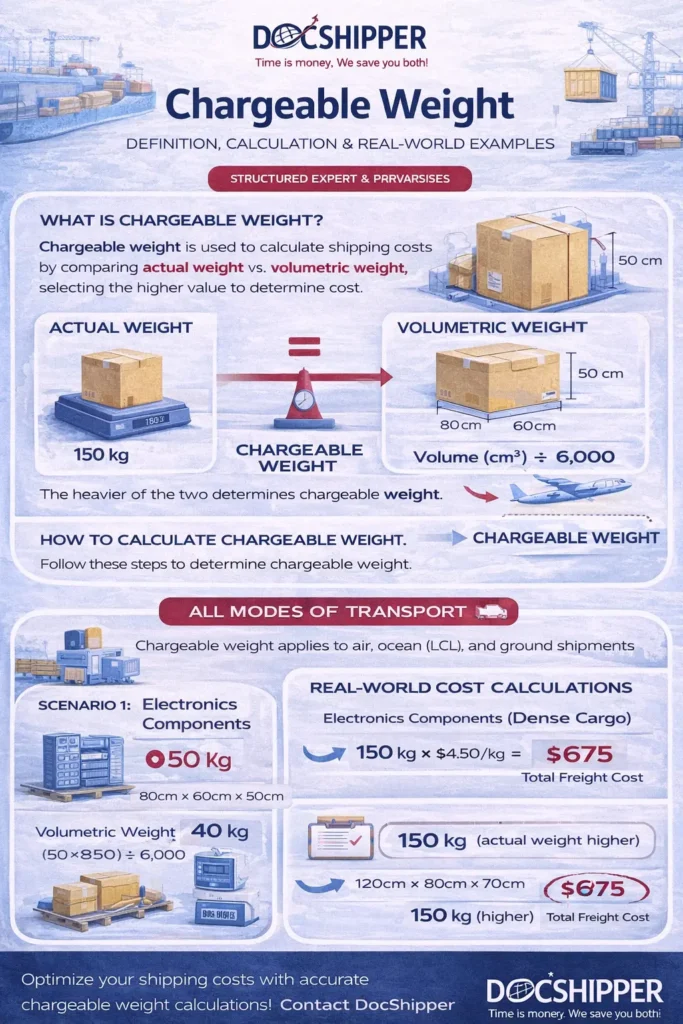
Practical Examples & Cost Calculations
Real-world scenarios illustrate how chargeable weight impacts shipping costs. Consider two common import situations with different weight-to-volume ratios.
Scenario 1: Electronics Components (Dense Cargo)
| Measurement | Value |
|---|---|
| Actual Weight | 150 kg |
| Dimensions | 80cm × 60cm × 50cm |
| Volumetric Weight | (80×60×50) ÷ 6,000 = 40 kg |
| Chargeable Weight | 150 kg (actual weight higher) |
| Rate per kg | $4.50 |
| Total Freight Cost | $675 |
Scenario 2: Textile Goods (Bulky Cargo)
| Measurement | Value |
|---|---|
| Actual Weight | 45 kg |
| Dimensions | 120cm × 80cm × 70cm |
| Volumetric Weight | (120×80×70) ÷ 6,000 = 112 kg |
| Chargeable Weight | 112 kg (volumetric weight higher) |
| Rate per kg | $4.50 |
| Total Freight Cost | $504 |
These examples demonstrate critical cost optimization opportunities. In Scenario 2, the importer pays for 112 kg despite the shipment weighing only 45 kg. Vacuum-packing the textiles to reduce dimensions by 30% would lower volumetric weight to approximately 78 kg, saving $153 per shipment.
Industry data reveals that volumetric weight exceeds actual weight in 60-70% of air freight shipments, particularly for consumer goods, apparel, and home furnishings. Conversely, industrial machinery, metals, and electronics typically bill at actual weight. Understanding your product category’s density profile enables strategic packaging decisions that directly reduce landed costs.
Conclusion
Chargeable weight represents the economic equilibrium between cargo mass and volume, directly determining freight costs in international trade. Mastering its calculation enables importers to optimize packaging, negotiate better rates, and forecast logistics expenses accurately.
Need expert guidance on reducing your chargeable weight and overall shipping costs? Contact DocShipper for a comprehensive logistics audit tailored to your supply chain.
📚 Quiz
Test Your Knowledge: Chargeable Weight
Q1 — What is chargeable weight in international freight?
Q2 — A shipment of textiles weighs 45 kg but has a volumetric weight of 112 kg. What is the chargeable weight, and why?
Q3 — Which of the following shipments would NOT be subject to chargeable weight calculations?
🎯 Your Result
📞 Free Quote in 24hFAQ | Chargeable Weight: Definition, Calculation & Real-World Examples
Gross weight is the actual physical weight of the shipment including packaging. Chargeable weight is the billing weight, determined by comparing gross weight to volumetric weight and selecting the higher value.
Air cargo space is more expensive per cubic meter, so airlines use a lower divisor (6,000) to charge more for bulky items. Ocean carriers use higher divisors (typically 1,000) reflecting lower space costs per unit volume.
The divisor itself is standardized by IATA and industry conventions, but high-volume shippers may negotiate discounted rates per kilogram or minimum chargeable weight thresholds with carriers.
Carriers measure the longest, widest, and highest points of the package to create a rectangular "bounding box." Some use automated dimensioning systems with laser scanners for accuracy.
No. FCL shipments are charged per container regardless of weight or volume, as you pay for exclusive container use. Chargeable weight applies only to LCL (less-than-container-load) and parcel shipments.
Carriers conduct physical verification. If discrepancies exceed tolerance thresholds, they will re-bill at corrected chargeable weight plus potential penalty fees. Repeated violations may result in account suspension.
Optimize packaging by using appropriately sized boxes, vacuum-sealing compressible goods, disassembling items when possible, and avoiding excessive void fill. Even small dimension reductions can significantly lower volumetric weight.
Yes, major couriers (DHL, FedEx, UPS) use the standard 6,000 divisor for international shipments, though some domestic services may use 5,000. Always verify the specific divisor in your carrier's terms.
Many carriers impose minimum chargeable weights (often 1 kg for air, 1 CBM for ocean LCL). Shipments below this threshold are billed at the minimum rate, making very small shipments proportionally expensive.
Customs duties are calculated on declared value and HS code classification, not chargeable weight. However, accurate weight declarations are required on customs documents to match commercial invoices and avoid clearance delays.
Refrigerated cargo often incurs additional surcharges beyond standard chargeable weight calculations, but the base weight determination method remains the same. The temperature control premium is typically a percentage added to the base rate.
The Air Waybill (AWB) or Bill of Lading (B/L) displays both actual and chargeable weights. Freight invoices itemize the calculation, showing dimensions, volumetric weight formula, and the final billable weight used for pricing.
Need Help with
Logistics or Sourcing ?
First, we secure the right products from the right suppliers at the right price by managing the sourcing process from start to finish. Then, we simplify your shipping experience - from pickup to final delivery - ensuring any product, anywhere, is delivered at highly competitive prices.


Fill the Form
Prefer email? Send us your inquiry, and we’ll get back to you as soon as possible.
Contact us




