


In short ⚡
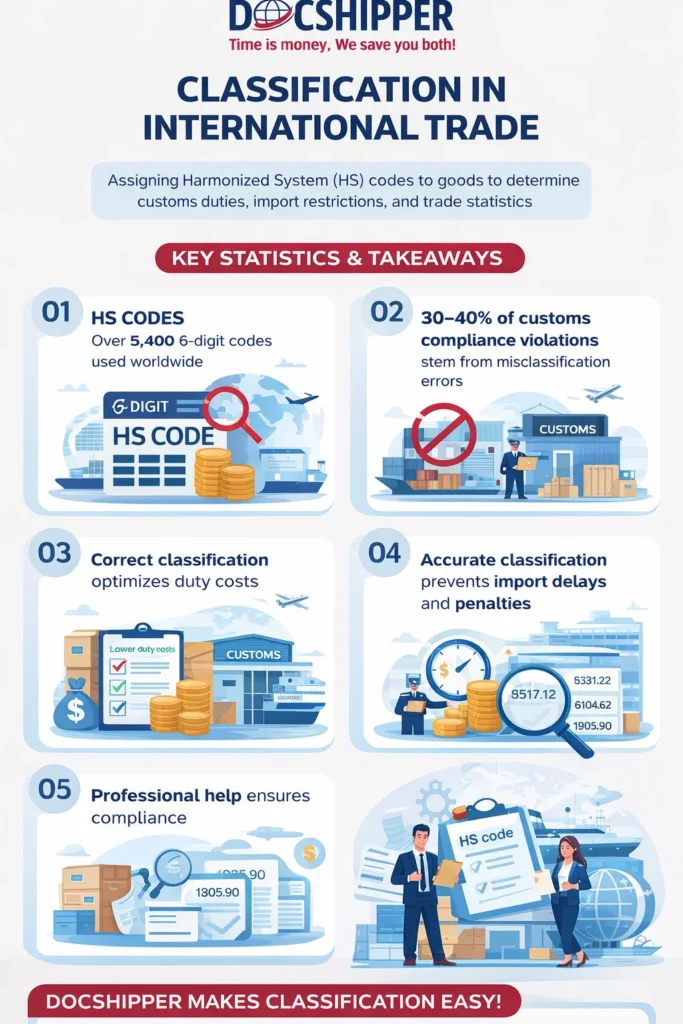
Classification is the systematic process of assigning a specific tariff code (HS code) to goods based on their nature, composition, and intended use. This code determines applicable customs duties, regulations, and trade statistics. Accurate classification is mandatory for international trade compliance and directly impacts import costs and customs clearance speed.
Introduction
Misclassifying goods ranks among the most common—and costly—errors in international logistics. A single incorrect digit in an HS code can trigger customs penalties, shipment delays, or unexpected duty rates exceeding 20% of cargo value.
Classification forms the backbone of global trade regulation. Every product crossing borders must be assigned a Harmonized System (HS) code that governments use to apply tariffs, enforce quotas, and compile trade statistics. This standardized nomenclature enables 200+ countries to speak the same commercial language.
Understanding classification is essential because it determines:
- Duty rates: Different codes carry vastly different tariff percentages
- Import restrictions: Some codes trigger licensing requirements or prohibitions
- Origin rules: Free trade agreements depend on accurate classification
- Statistical reporting: Governments track trade flows by HS code
- Compliance risk: Incorrect classification exposes companies to audits and fines
Classification Framework & Regulatory Foundations
The Harmonized System was developed by the World Customs Organization (WCO) and implemented in 1988. It uses a six-digit code structure universally recognized, with countries adding digits for national specifications (8-10 digits in most jurisdictions).
Classification follows the General Rules of Interpretation (GRI), a hierarchical decision tree that customs authorities worldwide apply. GRI 1 states that classification is determined by headings and section notes. When goods could fit multiple headings, GRI 2-6 provide tiebreaker logic based on specificity, essential character, and alphabetical order.
The system divides all tradable goods into 21 sections and 97 chapters. Each chapter covers a product category (e.g., Chapter 84 for machinery, Chapter 61 for knitted apparel). Chapters subdivide into headings (4 digits), subheadings (6 digits), and national tariff lines (8-10 digits).
Material composition often drives classification. A product containing multiple materials is typically classified by the material giving it essential character. For example, a leather handbag with metal fittings classifies under leather goods, not metal articles, because leather provides the essential character.
At DocShipper, we maintain a classification database cross-referenced with customs rulings from major markets. Our specialists verify HS codes before shipment to prevent clearance issues and optimize duty liability within legal boundaries.
For authoritative guidance, consult the WCO Harmonized System Database, which provides official explanatory notes and classification opinions.
Practical Examples & Data Analysis
Classification complexity varies dramatically by product type. Consider these real-world scenarios illustrating the decision process:
| Product | Possible Codes | Correct Classification | Duty Impact (EU) |
|---|---|---|---|
| Smartphone | 8517.12 (phones) vs 8471.30 (computers) | 8517.12.00 | 0% (both) |
| Yoga pants (90% cotton, 10% elastane) | 6104.63 (synthetic) vs 6104.62 (cotton) | 6104.62.00 | 12% vs 8% |
| Electric bicycle (250W motor) | 8711.60 (motorcycles) vs 8712.00 (bicycles) | 8711.60.10 | 6% vs 14% |
| Frozen pizza | 1902.20 (pasta) vs 1905.90 (bread) | 1905.90.90 | 9.7% + €24.6/100kg |
Use Case: A U.S. electronics importer classified smartwatches under 9102 (wristwatches) instead of 8517 (telecommunication devices). This error resulted in 4.5% duty instead of 0%, costing $67,500 on a $1.5M shipment. Customs discovered the misclassification during a routine audit three years later, triggering retroactive duties plus 15% penalties—a total liability exceeding $300,000.
Key classification principles in practice:
- Function over form: A device that primarily communicates classifies as telecom equipment regardless of appearance
- Percentage thresholds: Textile blends classify by the predominant fiber if it exceeds 50% by weight
- Power specifications: Electric bicycles with motors ≤250W classify differently than those exceeding this threshold
- Processing level: Food products classify differently based on preparation (raw, cooked, frozen, preserved)
- Set rules: Goods presented together for retail sale may classify as sets under a single code
Statistical data reveals that classification errors account for 30-40% of customs compliance violations in the EU and U.S. The average correction period extends 3-5 years backward, exposing companies to significant retroactive liabilities.
Conclusion
Classification represents the foundational decision point in every international shipment. Mastering HS code assignment protects your business from financial penalties while optimizing duty costs through legitimate tariff engineering.
Need expert classification support for your products? Contact DocShipper for compliant customs solutions tailored to your supply chain.
📚 Quiz
Test Your Knowledge: Classification
Q1 — What is the primary purpose of customs classification in international trade?
Q2 — A U.S. importer uses a customs broker to classify their goods. Who bears legal responsibility if the classification is incorrect?
Q3 — A yoga pant made of 90% cotton and 10% elastane could be classified under either a cotton or a synthetic fiber heading. Which classification principle applies here?
🎯 Your Result
📞 Free Quote in 24hFAQ | Classification: Definition, Process & Concrete Examples
HS codes are the 6-digit international standard. HTS (Harmonized Tariff Schedule) codes extend to 8-10 digits for national use. The first 6 digits remain identical worldwide; additional digits vary by country.
The importer of record bears legal responsibility for correct classification, even when using customs brokers. Brokers assist but cannot assume liability for classification decisions.
Yes. Most customs authorities offer binding tariff information (BTI) or advance rulings. These provide legal certainty and protection from reclassification for 3-6 years depending on jurisdiction.
The WCO updates the Harmonized System every five years. The latest revision (HS 2022) introduced 351 amendments. Countries implement changes on their own schedules, typically within 1-2 years of WCO publication.
Penalties vary by jurisdiction and intent. Negligent errors typically incur 10-20% of underpaid duties. Intentional misclassification (fraud) can trigger penalties of 100-400% plus criminal prosecution in severe cases.
FTAs require correct classification to claim preferential duty rates. The same product must be classified identically in both origin and destination countries to qualify for tariff reductions.
Apply GRI 3: classify by the component giving essential character. If unclear, use the heading occurring last in numerical order among equally valid options.
The WCO publishes the official HS database. National customs agencies provide searchable tariff tools (e.g., TARIC for EU, HTS Search for U.S.). Commercial databases offer enhanced search and ruling libraries.
Essential data includes material composition (with percentages), manufacturing process, intended use, technical specifications, and any relevant standards or certifications. Detailed product descriptions enable accurate classification.
Yes. Certain HS codes trigger mandatory testing, certification, or labeling requirements. Medical devices, toys, electronics, and food products face particularly strict compliance obligations based on classification.
HS codes determine not only customs duties but also VAT rates and excise tax applicability. Some products face reduced VAT rates or additional excise duties (alcohol, tobacco, fuel) based on classification.
Prototypes classify according to their finished product equivalent. Samples may qualify for duty exemptions under specific codes (9801-9803 in U.S.), but the underlying product classification still determines applicable regulations.
Need Help with
Logistics or Sourcing ?
First, we secure the right products from the right suppliers at the right price by managing the sourcing process from start to finish. Then, we simplify your shipping experience - from pickup to final delivery - ensuring any product, anywhere, is delivered at highly competitive prices.


Fill the Form
Prefer email? Send us your inquiry, and we’ll get back to you as soon as possible.
Contact us




