


In short ⚡
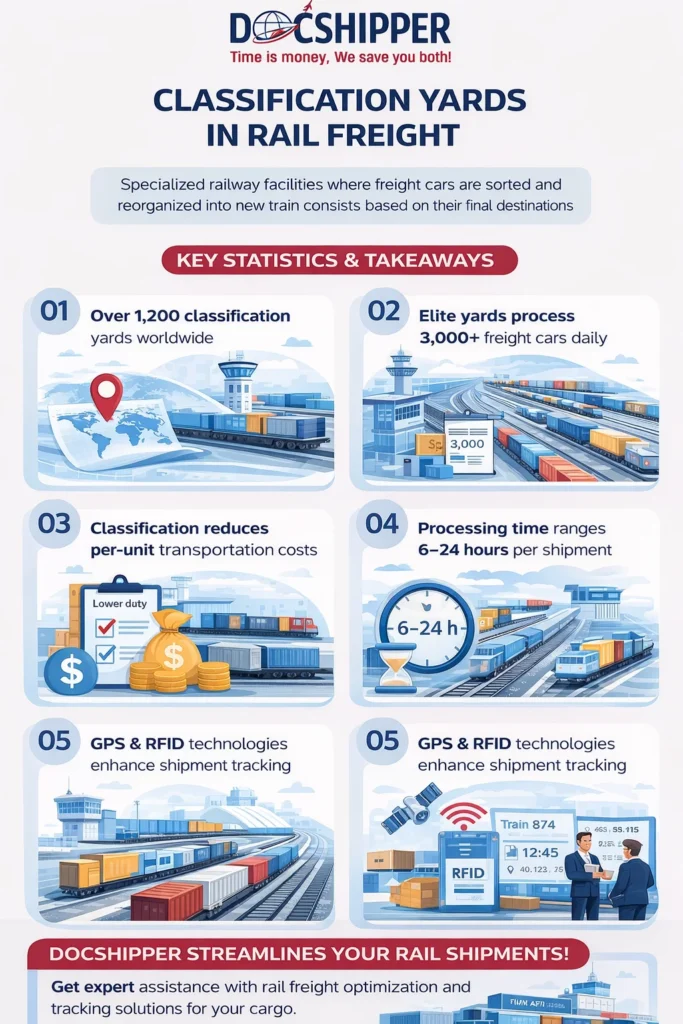
A classification yard (or marshalling yard) is a specialized railway facility where freight cars are sorted and reorganized into new train consists according to their final destinations. This sorting process, called "classification," enables efficient rail freight transportation by consolidating shipments heading to similar locations, optimizing network capacity and reducing transit times across continental logistics networks.
Introduction
Many importers and logistics professionals underestimate the critical role classification yards play in international freight movement. When a container arrives at a port and transitions to rail transport, it rarely travels directly to its final destination on the same train.
Instead, it passes through one or more classification yards where rail cars are systematically sorted, combined, and dispatched. This hub-and-spoke model is fundamental to rail freight economics, enabling carriers to maximize asset utilization while serving diverse destinations across vast geographic networks.
Understanding classification yard operations is essential for:
- Transit time accuracy: Yard processing adds 6-24 hours to shipment schedules
- Cost optimization: Efficient classification reduces per-unit transportation costs
- Supply chain visibility: Tracking shipments through multiple classification points
- Damage prevention: Proper handling protocols minimize cargo loss during sorting
- Intermodal coordination: Seamless transfer between ocean, rail, and truck modes
Classification Yard Operations & Technical Expertise
Classification yards operate on three primary systems: flat-shunted yards (locomotives move cars across level tracks), hump yards (gravity-assisted sorting over an artificial hill), and automated hump yards (computer-controlled retarders manage car speed). The hump yard design dominates modern operations due to superior throughput capacity.
The classification process follows five distinct phases. Reception tracks receive incoming trains, where yard crews inspect equipment and documentation. Cars then move to the classification bowl via the hump, where they’re uncoupled and roll by gravity into designated tracks based on destination. Retarders—hydraulic or pneumatic braking systems—control descent speed to prevent collisions. Once sorted, cars accumulate on departure tracks until sufficient volume justifies dispatching a new train. Finally, locomotives pull assembled consists to departure yards for final inspection and release.
Operational efficiency depends on track capacity (typically 40-120 classification tracks per yard), processing speed (elite facilities classify 3,000+ cars daily), and information systems that track each car’s location, contents, and routing instructions in real-time. Modern yards integrate GPS, RFID tags, and automated identification systems (AIS) to maintain visibility.
Regulatory compliance adds complexity. The Federal Railroad Administration (FRA) mandates safety inspections, while customs authorities require documentation verification for international shipments. According to the U.S. Department of Transportation, classification yards must maintain detailed records of hazardous materials handling and implement specific protocols for refrigerated cargo, oversized loads, and high-value shipments.
At DocShipper, we coordinate directly with classification yard operators to monitor your shipments through sorting processes, ensuring documentation accuracy and minimizing dwell time. Our rail freight specialists provide real-time updates as cargo transitions through each classification phase, maintaining supply chain transparency from origin to final delivery.
Practical Examples & Performance Data
Classification yard performance varies significantly based on technology level, traffic volume, and operational practices. Understanding these differences helps logistics planners set realistic expectations and optimize routing decisions.
| Yard Type | Daily Capacity | Avg Dwell Time | Classification Tracks | Automation Level |
|---|---|---|---|---|
| Flat-Shunted Yard | 500-800 cars | 18-24 hours | 20-40 tracks | Manual |
| Conventional Hump Yard | 1,500-2,500 cars | 12-18 hours | 60-80 tracks | Semi-automated |
| Automated Hump Yard | 3,000-4,000 cars | 6-12 hours | 80-120 tracks | Fully automated |
Use Case: Trans-Continental Container Shipment
A 40-foot container arrives at the Port of Los Angeles destined for Chicago. The intermodal shipment travels 2,200 miles via Union Pacific Railroad, passing through two major classification yards: Yuma (Arizona) and North Platte (Nebraska).
- Yuma Yard Processing: Container arrives at 14:00, undergoes initial classification (4 hours), departs at 22:00 on westbound manifest train
- North Platte Bailey Yard: Arrival at 08:00 (Day 2), automated hump classification (6 hours), final consist assembly (2 hours), departure at 18:00
- Total Classification Time: 12 hours across two facilities
- Overall Transit Time: 72 hours port-to-destination, with classification representing 16.7% of total time
- Cost Impact: Classification processing adds $85-120 per container to base rail rate
Industry benchmarks reveal that reducing classification dwell time by just 2 hours can decrease overall supply chain costs by 3-5% for long-haul shipments. Leading carriers invest heavily in yard automation, predictive analytics, and dynamic routing algorithms to minimize processing delays while maintaining sorting accuracy above 99.7%.
Conclusion
Classification yards form the operational backbone of continental rail freight networks, enabling efficient cargo sorting and train assembly across complex logistics systems. Mastering their function is essential for accurate transit planning and cost management in international trade.
Need expert guidance on rail freight routing and classification yard coordination? Contact DocShipper for comprehensive logistics support tailored to your supply chain requirements.
📚 Quiz
Test Your Knowledge: Classification Yard
Q1 — What is the primary purpose of a classification yard (also called a marshalling yard)?
Q2 — A common misconception is that all rail freight shipments must pass through a classification yard. Which statement is actually correct?
Q3 — A 40-foot container ships from Los Angeles to Chicago via rail and passes through two classification yards. Total transit time is 72 hours. Approximately how much of that time is spent in classification processing?
🎯 Your Result
📞 Free Quote in 24hFAQ | Classification Yard: Definition, Operations & Practical Examples
Classification yards specialize in sorting and reorganizing freight cars by destination, while regular rail yards focus on loading/unloading, maintenance, or storage. Classification yards feature specialized infrastructure like humps and multiple sorting tracks.
Dwell time ranges from 6-24 hours depending on yard type, traffic volume, and operational efficiency. Automated hump yards process shipments fastest (6-12 hours), while flat-shunted facilities may require 18-24 hours.
Yes. Modern classification yards use GPS, RFID, and automated identification systems. Rail carriers provide tracking updates showing when containers enter/exit classification facilities, though real-time location within the yard may have limited precision.
No. Unit trains carrying single commodities (coal, grain, automobiles) often bypass classification yards entirely. However, intermodal containers and mixed freight typically require classification at one or more yards during transit.
Common delay factors include high traffic volume, equipment failures, weather conditions, crew shortages, documentation errors, and prioritization of time-sensitive shipments. Customs inspections can add 4-12 hours for international cargo.
Hazmat cars receive special handling with segregated tracks, enhanced inspections, and dedicated crews. Federal regulations mandate specific positioning within trains and documentation protocols. Processing time increases 20-30% for hazardous cargo.
A hump yard uses an artificial hill (hump) where freight cars are pushed over the crest and roll by gravity into classification tracks. Computer-controlled retarders regulate descent speed, enabling rapid sorting of 150-200 cars per hour.
Rarely. Passenger trains follow fixed schedules and routes, eliminating the need for classification. However, some facilities handle both freight classification and passenger train servicing in separate sections of the yard complex.
Extreme cold reduces retarder efficiency and increases coupling/uncoupling time. Heavy snow requires track clearing. Ice affects hump operations. Heat can cause track deformation. Severe weather may reduce processing capacity by 30-50%.
Union Pacific's Bailey Yard in North Platte, Nebraska spans 2,850 acres with 315 miles of track and 120 classification tracks. It processes 10,000+ rail cars daily, making it the world's largest railroad classification facility.
Yes. Carriers use dynamic routing algorithms that consider yard congestion, train schedules, and destination patterns. Shippers can request expedited service that minimizes classification stops, though this increases costs by 15-25%.
Essential documents include the waybill (routing instructions), bill of lading, customs declarations (international shipments), hazmat placards (if applicable), and weight/dimension certificates. Electronic data interchange (EDI) systems transmit this information digitally to yard operators.
Need Help with
Logistics or Sourcing ?
First, we secure the right products from the right suppliers at the right price by managing the sourcing process from start to finish. Then, we simplify your shipping experience - from pickup to final delivery - ensuring any product, anywhere, is delivered at highly competitive prices.


Fill the Form
Prefer email? Send us your inquiry, and we’ll get back to you as soon as possible.
Contact us




