


In short ⚡
A clearinghouse is a financial intermediary that facilitates the settlement of transactions between buyers and sellers by acting as the central counterparty. It guarantees trade execution, reduces counterparty risk, and ensures the smooth transfer of funds and securities in international commerce and financial markets.
Introduction
In international trade and finance, the risk of one party defaulting on payment or delivery creates significant uncertainty. This is where clearinghouses become essential—they eliminate bilateral risk by standing between trading parties.
Whether you’re dealing with commodity futures, foreign exchange transactions, or securities settlements, clearinghouses ensure that both parties fulfill their obligations. They operate as trusted third parties that guarantee completion even if one counterparty fails.
Key characteristics of clearinghouses include:
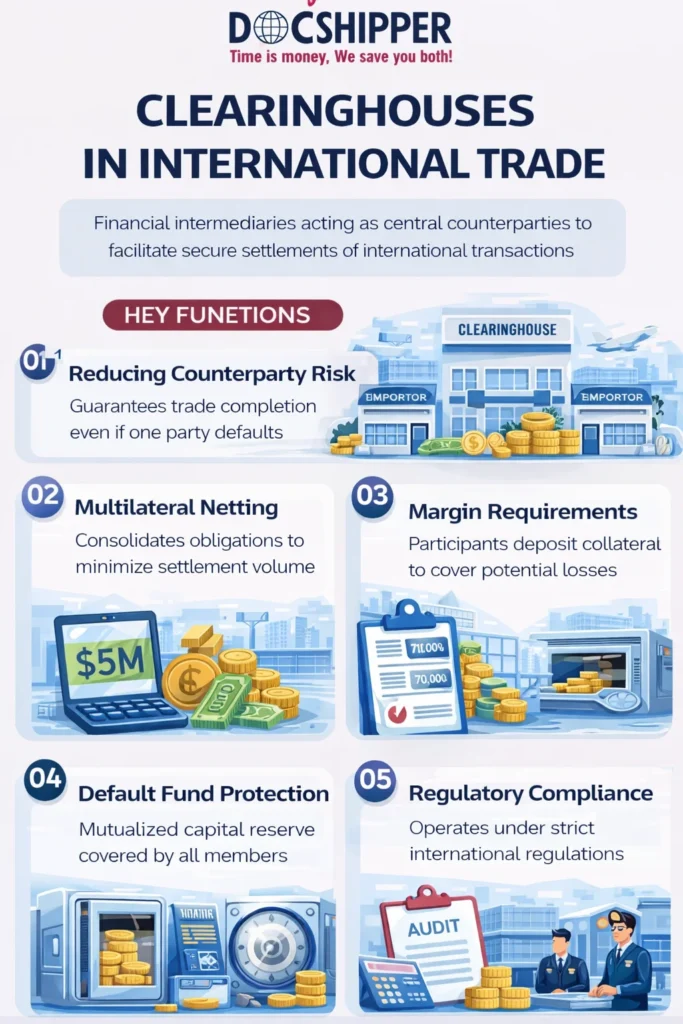
- Risk mitigation through centralized guarantee mechanisms
- Multilateral netting that reduces the number of required settlements
- Margin requirements to protect against default scenarios
- Regulatory compliance ensuring transparent market operations
- Operational efficiency by standardizing settlement procedures
Clearinghouse Mechanisms & Operational Framework
Clearinghouses operate through a sophisticated system of novation, where the original contract between two parties is replaced by two new contracts—one between the buyer and the clearinghouse, and another between the clearinghouse and the seller. This process transforms the clearinghouse into the legal counterparty for both sides.
The margin system forms the backbone of risk management. Participants must deposit initial margin based on position size and volatility. Daily mark-to-market calculations determine variation margin requirements, ensuring that losses are covered in real-time. This prevents the accumulation of unsustainable risk exposure.
Multilateral netting significantly reduces settlement volumes. Instead of settling each transaction individually, the clearinghouse calculates net positions across all participants. A trader with 100 buy orders and 95 sell orders only settles the net difference of 5 contracts, dramatically reducing capital requirements and operational complexity.
The default fund provides an additional layer of protection. Clearinghouses maintain substantial capital reserves contributed by members. If a participant defaults and their margin proves insufficient, the clearinghouse taps into this mutualized fund to complete settlements. According to the Bank for International Settlements, major clearinghouses maintain default funds exceeding several billion dollars.
Regulatory oversight ensures clearinghouses maintain strict operational standards. Bodies like the European Securities and Markets Authority (ESMA) and the Commodity Futures Trading Commission (CFTC) impose capital requirements, stress testing protocols, and transparency obligations. At DocShipper, we work closely with regulated clearinghouses to ensure all international payment settlements meet compliance standards, protecting our clients from counterparty exposure.
Practical Applications & Industry Data
Clearinghouses serve diverse markets with varying operational models. Understanding their practical application helps businesses optimize their international trade strategies.
| Market Type | Clearinghouse Example | Daily Volume | Primary Function |
|---|---|---|---|
| Derivatives | CME Clearing | $1+ trillion | Futures and options settlement |
| Securities | DTCC (US) | $2.5 trillion | Stock and bond clearing |
| Foreign Exchange | CLS Group | $6 trillion | Multi-currency settlement |
| Commodities | ICE Clear Europe | $500 billion | Energy and agricultural products |
Use Case: International Coffee Trade
A European coffee roaster enters a futures contract to purchase 10,000 bags of Brazilian coffee at $200 per bag through ICE Futures Europe. The clearinghouse immediately becomes the counterparty to both the roaster and the Brazilian exporter.
Initial margin requirement: $150,000 (7.5% of contract value). If coffee prices rise to $210, the roaster’s position gains $100,000 in value, while the seller’s position loses equivalently. The clearinghouse collects variation margin from the seller daily and credits the roaster’s account, ensuring neither party faces settlement risk at contract expiration.
Key operational benefits in this scenario:
- Price transparency: Centralized pricing eliminates bilateral negotiation complexity
- Credit risk elimination: Neither party worries about counterparty default
- Liquidity enhancement: Standardized contracts attract more market participants
- Regulatory compliance: Automated reporting satisfies international trade documentation requirements
- Operational efficiency: Settlement occurs through established banking channels without bilateral arrangements
Conclusion
Clearinghouses represent critical infrastructure in modern international trade, transforming risky bilateral transactions into secure, standardized settlements. Their role in mitigating counterparty risk and ensuring market stability cannot be overstated.
Need assistance navigating clearinghouse requirements for your international transactions? Contact DocShipper for expert guidance on payment settlements, trade finance, and compliance management.
📚 Quiz
Test Your Knowledge: Clearinghouse
Q1. What is the primary role of a clearinghouse in financial and international trade transactions?
Q2. A trader has 100 buy orders and 95 sell orders processed through a clearinghouse. How many contracts does the trader actually need to settle?
Q3. A small import business wants to benefit from clearinghouse protections for its commodity purchases. How can it typically access these services?
🎯 Your Result
📞 Free Quote in 24hFAQ | Clearinghouse: Definition, Role & Practical Examples in International Trade
A clearinghouse acts as an intermediary that guarantees trade settlement by becoming the buyer to every seller and the seller to every buyer, eliminating counterparty default risk.
Clearinghouses generate revenue through transaction fees, margin interest on deposited funds, membership fees, and data services provided to market participants.
The clearinghouse uses the defaulting member's margin deposits first, then taps into the mutualized default fund, and if necessary, employs additional capital resources to fulfill all obligations.
No. Regulatory mandates vary by jurisdiction and asset class. Many over-the-counter derivatives now require central clearing under post-2008 financial reforms, but bilateral settlements remain common in certain markets.
Clearing involves calculating obligations and managing risk between trade execution and settlement. Settlement is the actual transfer of securities and funds to complete the transaction.
Initial and variation margins ensure participants maintain sufficient collateral to cover potential losses. Daily mark-to-market adjustments prevent risk accumulation that could threaten the clearinghouse's solvency.
Typically, clearinghouse membership requires substantial capital and operational infrastructure. Small businesses access these services indirectly through brokers, banks, or trading platforms that are direct members.
Multilateral netting consolidates all buy and sell positions across participants to calculate net obligations, reducing the number of individual settlements and improving capital efficiency.
Yes. Clearinghouses face strict oversight from financial regulators who impose capital requirements, risk management standards, stress testing protocols, and transparency obligations to protect financial system stability.
Novation replaces the original contract between two parties with two new contracts—one between each party and the clearinghouse—making the clearinghouse the legal counterparty to both sides.
In international trade, clearinghouses facilitate secure payment settlements, manage currency exchange risks, standardize transaction processes, and provide regulatory compliance infrastructure for cross-border commerce.
Specialized clearinghouses like CLS Group operate payment-versus-payment systems that simultaneously settle multiple currency legs of foreign exchange transactions, eliminating settlement risk across time zones.
Need Help with
Logistics or Sourcing ?
First, we secure the right products from the right suppliers at the right price by managing the sourcing process from start to finish. Then, we simplify your shipping experience - from pickup to final delivery - ensuring any product, anywhere, is delivered at highly competitive prices.


Fill the Form
Prefer email? Send us your inquiry, and we’ll get back to you as soon as possible.
Contact us




