


In short ⚡
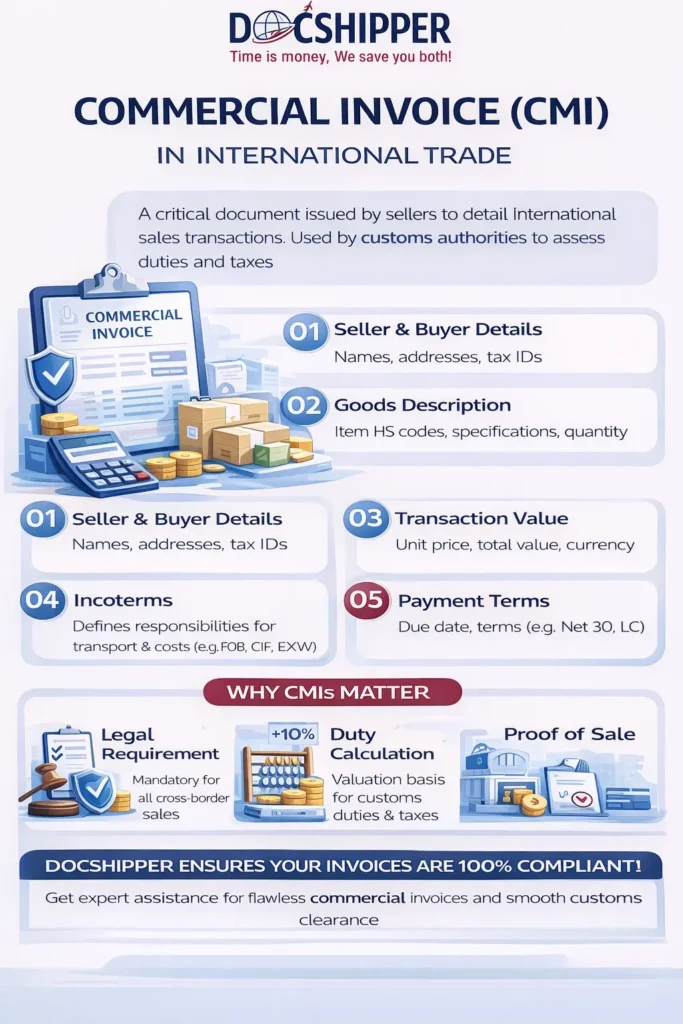
The CMI (Commercial Invoice) is a fundamental customs and accounting document issued by the seller that details the transaction between exporter and importer. It specifies goods description, quantity, unit price, total value, payment terms, and Incoterms. This document serves as proof of sale and determines customs duties and taxes.
Introduction
Many businesses struggle with customs clearance because they underestimate the importance of the commercial invoice. A single error in valuation or product description can trigger inspections, delays, or penalties.
The CMI is the cornerstone of international trade documentation. Customs authorities worldwide use it to calculate import duties, verify compliance, and assess transaction legitimacy. Without an accurate commercial invoice, shipments face rejection or indefinite holds.
- Legal requirement: Mandatory for all cross-border commercial shipments
- Valuation basis: Determines customs duty calculation and VAT assessment
- Proof of transaction: Establishes seller-buyer relationship and payment obligations
- Risk mitigation: Reduces fraud detection flags and compliance issues
- Multi-purpose document: Used by customs, banks, freight forwarders, and insurers
Deep Dive & Expert Analysis
The commercial invoice must comply with both national customs regulations and international trade standards. The WTO Valuation Agreement requires that the declared value reflects the actual transaction price paid or payable.
Every CMI must contain specific mandatory elements. The seller and buyer details include full legal names, addresses, and tax identification numbers. The goods description must be precise enough for customs classification under the Harmonized System (HS) codes. Vague descriptions like “machine parts” are insufficient and trigger verification procedures.
The declared value follows the FOB, CIF, or other Incoterms specified in the sales contract. Undervaluation constitutes customs fraud and can result in penalties up to 400% of the duty owed in many jurisdictions. According to World Customs Organization guidelines, the invoice value must include all costs up to the point of export specified by the Incoterm.
The currency declaration impacts both customs valuation and payment processing. Most customs authorities apply official exchange rates from the shipment date. The payment terms section specifies whether the transaction is prepaid, on credit, or uses documentary collection methods.
At DocShipper, we systematically verify commercial invoices against purchase orders and packing lists before customs submission. This cross-verification prevents 90% of common discrepancies that cause clearance delays. Our compliance team ensures HS code accuracy and value declaration alignment with regulatory requirements across 50+ countries.
Practical Examples & Data
Understanding how the CMI impacts duty calculation is essential for cost forecasting. The following table illustrates three common scenarios with different Incoterms:
| Scenario | Incoterm | Invoice Value | Customs Value | Duty (10%) |
|---|---|---|---|---|
| Electronics Import | FOB Shanghai | $50,000 | $50,000 + freight + insurance | $5,500 |
| Textile Shipment | CIF Hamburg | $30,000 | $30,000 | $3,000 |
| Machinery Parts | EXW Shenzhen | $25,000 | $25,000 + all transport costs | $3,200 |
Use Case: A European importer purchasing 10,000 units of LED bulbs from China at $2.50 per unit under CIF Rotterdam terms. The commercial invoice shows:
- Product value: $25,000 (10,000 × $2.50)
- Freight cost: $1,200 (included in CIF)
- Insurance: $300 (included in CIF)
- Total CMI value: $26,500
- Customs duty (5%): $1,325
The CMI must show the breakdown clearly. If the importer only declares $25,000 and omits freight/insurance, customs will adjust the value upward and may impose penalties for incomplete declaration.
According to trade compliance data, 68% of customs delays stem from invoice discrepancies. The most common errors include mismatched quantities between invoice and packing list, incorrect HS code declarations, and currency conversion mistakes. Proper CMI preparation reduces clearance time from 5-7 days to 24-48 hours in major ports.
Conclusion
The commercial invoice is not merely an accounting formality but a strategic compliance tool that determines duty costs, clearance speed, and legal risk exposure. Mastering its requirements protects your supply chain from costly disruptions.
Need expert guidance on invoice preparation and customs compliance? Contact DocShipper for comprehensive support across all documentation requirements.
📚 Quizz
Test Your Knowledge: Commercial Invoice (CMI)
1. What is the primary purpose of a Commercial Invoice (CMI) in international trade?
2. An importer ships goods under FOB (Free On Board) terms but only declares the product value on the CMI, omitting freight and insurance costs. What is the most likely consequence?
3. A European company imports 10,000 LED bulbs from China at $2.50/unit under CIF Rotterdam terms. Freight is $1,200 and insurance is $300. What is the correct total value to declare on the CMI, and what duty applies at a 5% rate?
🎯 Your Result
📞 Free Quote in 24hFAQ | CMI (Commercial Invoice): Definition, Calculation & Practical Examples
A commercial invoice is a final billing document for completed sales, while a proforma invoice is a preliminary quotation without legal binding. Only commercial invoices are accepted for customs clearance and duty calculation.
No. Each shipment requires a unique commercial invoice with specific shipment details, quantities, and values. Reusing invoices violates customs regulations and causes clearance rejection.
Declare a nominal value (typically $1-10) with clear marking "Sample - No Commercial Value." Include a statement explaining the purpose. Zero-value declarations often trigger scrutiny and delays.
Customs authorities may investigate for undervaluation fraud. The invoice must reflect the true transaction price. Discrepancies require supporting documentation like payment receipts or contracts to avoid penalties.
While not always mandatory, including accurate HS codes accelerates clearance and reduces misclassification risk. Many countries require HS codes for electronic customs submissions. Always verify local requirements.
Incoterms determine which costs are included in the invoice value. FOB includes only goods cost, while CIF includes freight and insurance. The CMI must clearly state the Incoterm used to avoid valuation disputes.
Yes, but customs will convert it using official exchange rates from the declaration date. Using the destination country's currency simplifies processing. Always specify the currency clearly on the invoice.
Essential elements include seller/buyer details, invoice number and date, goods description, quantity, unit price, total value, currency, Incoterm, and country of origin. Omitting any element causes clearance issues.
Most jurisdictions require retention for 5-7 years for tax and audit purposes. Some countries mandate 10 years. Digital copies are acceptable if they meet legal archiving standards.
Amendments are possible but require formal correction procedures and may trigger re-inspection. Submit amendments immediately upon discovering errors. Repeated corrections raise fraud suspicion flags.
Yes. FTA shipments require additional certification (Certificate of Origin) and specific invoice declarations proving preferential origin. The CMI must reference the FTA and include origin statements to claim duty reductions.
In LC transactions, banks verify the commercial invoice against LC terms before releasing payment. The invoice must exactly match LC specifications for goods description, quantity, value, and shipment dates to avoid discrepancies and payment delays.
Need Help with
Logistics or Sourcing ?
First, we secure the right products from the right suppliers at the right price by managing the sourcing process from start to finish. Then, we simplify your shipping experience - from pickup to final delivery - ensuring any product, anywhere, is delivered at highly competitive prices.


Fill the Form
Prefer email? Send us your inquiry, and we’ll get back to you as soon as possible.
Contact us




:%20Definition%20&%20Guide%20for%202026)