


In short ⚡
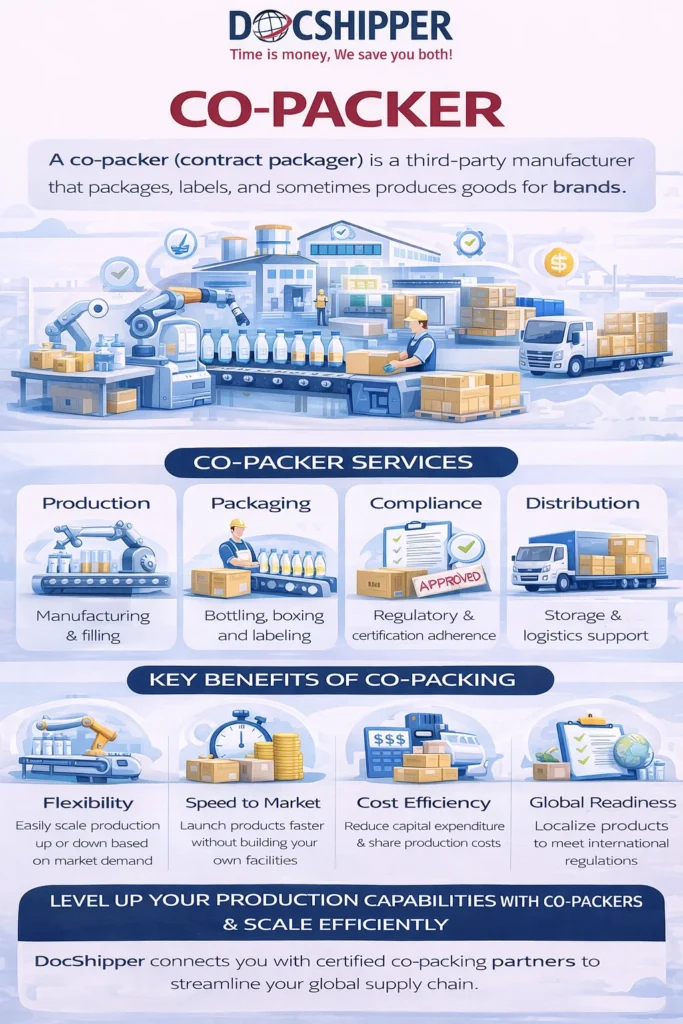
A co-packer (contract packager) is a third-party manufacturer that packages, labels, and sometimes produces goods on behalf of brands. Co-packers enable companies to scale production without investing in facilities, equipment, or labor, offering flexibility in packaging design, regulatory compliance, and distribution readiness for international markets.
Introduction
Many brands struggle with the dilemma: invest millions in production facilities or outsource to maintain agility? The co-packer solves this challenge by providing turnkey packaging and manufacturing services without capital expenditure.
In international trade, co-packers play a critical role in adapting products to local regulations, languages, and consumer preferences. They bridge the gap between bulk manufacturing and market-ready products.
- Flexibility: Scale production up or down based on demand without fixed costs
- Compliance expertise: Navigate FDA, EU, or country-specific labeling requirements
- Speed to market: Launch products faster without building infrastructure
- Specialized equipment: Access to advanced packaging technologies (aseptic, vacuum, blister)
- Cost efficiency: Share production costs across multiple clients
In-Depth Analysis & Expertise
Co-packers operate across a spectrum of services, from simple primary packaging (filling bottles, sealing pouches) to complete turnkey manufacturing including formulation, production, and secondary packaging. The relationship is governed by detailed contracts specifying quality standards, lead times, and intellectual property protections.
The regulatory dimension is critical in international logistics. Co-packers must comply with destination market requirements—nutritional labeling formats, allergen declarations, language translations, and barcode standards. For example, EU Regulation 1169/2011 mandates specific font sizes and ingredient order, while FDA 21 CFR Part 101 governs U.S. food labeling. A qualified co-packer maintains certifications like BRC (Brand Reputation Compliance), SQF (Safe Quality Food), or ISO 22000 to ensure supply chain integrity.
From a logistics perspective, co-packers provide kitting services—bundling multiple SKUs into promotional packs or market-specific configurations. This is particularly valuable for e-commerce brands entering new regions where consumer preferences differ. At DocShipper, we coordinate directly with co-packers to ensure packaging specifications align with shipping requirements and customs documentation, preventing delays at borders.
The intellectual property aspect requires careful management. Brands must protect formulas, designs, and proprietary processes through NDAs and exclusivity clauses. Co-packers typically operate on a minimum order quantity (MOQ) basis, which can range from 5,000 to 50,000 units depending on complexity. Understanding these thresholds is essential for cost planning.
For more information on international food safety standards, consult the FDA Food Labeling Guidelines or the European Commission Food Labeling Regulations.
Practical Examples & Data
Understanding co-packer services becomes clearer through real-world scenarios and comparative data. The following examples illustrate typical applications across industries.
Use Case: Beverage Brand Expansion
A U.S.-based organic juice company wants to enter the European market. Building a facility in Germany would cost €2.5 million. Instead, they partner with a German co-packer:
- Initial investment: €15,000 for mold development and first production run
- Per-unit cost: €0.85 (including filling, labeling, EU-compliant packaging)
- MOQ: 10,000 units per SKU
- Lead time: 4 weeks from formula approval to finished goods
- Compliance: Co-packer handles EU nutritional labeling, organic certification verification, and multilingual labels (German, French, Dutch)
Result: The brand launches in three EU countries within 8 weeks, tests market response, and scales production based on actual demand rather than projected forecasts.
Comparative Table: In-House vs. Co-Packer Production
| Factor | In-House Production | Co-Packer Partnership |
|---|---|---|
| Initial Capital | $500K–$5M (equipment, facility) | $10K–$50K (setup, molds) |
| Time to Market | 12–24 months | 4–8 weeks |
| Flexibility | Low (fixed capacity) | High (scale on demand) |
| Regulatory Burden | Brand responsibility | Shared/co-packer expertise |
| Quality Control | Direct oversight | Contract-based audits |
Key Data Points
- Market size: The global contract packaging market reached $58.3 billion in 2023, growing at 6.2% annually
- Average MOQ: Food products: 5,000–15,000 units | Cosmetics: 3,000–10,000 units | Pharmaceuticals: 10,000–50,000 units
- Lead times: Standard packaging: 3–6 weeks | Custom formulation: 8–12 weeks | Regulatory approval: Add 4–8 weeks
- Cost savings: Brands typically save 30–50% on production costs compared to building in-house facilities
- Failure rate: 15% of co-packer relationships fail due to unclear quality specifications or communication gaps
Conclusion
Co-packers provide strategic flexibility for brands navigating international markets, eliminating capital barriers while ensuring regulatory compliance and production quality. Selecting the right partner requires due diligence on certifications, capacity, and communication protocols.
Need assistance coordinating with co-packers or managing international packaging logistics? Contact DocShipper for expert guidance on sourcing, compliance, and supply chain optimization.
📚 Quiz
Test Your Knowledge: Co-Packer
Q1. What best defines a co-packer?
Q2. A brand assumes that hiring a co-packer means the co-packer will fully own and manage all regulatory compliance responsibilities, with no involvement required from the brand. Is this correct?
Q3. A U.S. organic juice brand wants to enter three European markets within 2 months, without spending millions on a new facility. Which approach best fits this scenario?
🎯 Your Result
📞 Free Quote in 24hFAQ | Co-Packer: Definition, Services & Practical Examples
A co-packer focuses primarily on packaging and labeling finished or semi-finished products, while a contract manufacturer handles the entire production process from raw materials to finished goods. Co-packers specialize in packaging expertise; contract manufacturers offer broader manufacturing capabilities.
Start by verifying certifications (BRC, SQF, ISO 22000), requesting client references, and conducting facility audits. Use industry directories like the Contract Packaging Association or trade shows. Ensure they have experience with your destination market's regulatory requirements.
MOQs vary by industry and complexity: food products typically require 5,000–15,000 units, cosmetics 3,000–10,000 units, and pharmaceuticals 10,000–50,000 units. Custom formulations or specialized packaging may have higher minimums to justify setup costs.
Yes, experienced co-packers maintain expertise in multi-market compliance, including FDA (USA), EU regulations, Health Canada, and other regional requirements. They can adapt labeling, nutritional panels, and ingredient declarations to meet destination market standards.
Essential elements include quality specifications, MOQs, lead times, pricing structure, intellectual property protections, liability clauses, termination conditions, and audit rights. Include clear definitions of acceptable defect rates and dispute resolution mechanisms.
Standard products with existing packaging can launch in 3–6 weeks. Custom formulations or new packaging designs require 8–12 weeks. Add 4–8 weeks if regulatory approvals are needed for new markets. Timeline depends on complexity and co-packer capacity.
Key risks include quality inconsistencies, intellectual property theft, production delays, and miscommunication on specifications. Mitigate these through detailed contracts, regular audits, clear quality benchmarks, and maintaining backup co-packer relationships for critical products.
Many co-packers offer integrated services including short-term warehousing, kitting, and direct-to-retailer shipping. However, specialized 3PL providers typically handle long-term storage and complex fulfillment. Clarify these capabilities during partner selection.
Co-packers typically cost 30–50% less than building in-house facilities when considering capital expenditure, labor, and overhead. However, per-unit costs may be higher than mature in-house operations. The break-even point depends on production volume and product complexity.
Yes, but transitions require careful planning. Ensure your contract includes reasonable termination clauses (typically 90–180 days notice). Transfer specifications, quality standards, and artwork to the new partner. Maintain inventory buffers during the transition to avoid supply disruptions.
Essential certifications include BRC (Global Standard for Food Safety), SQF (Safe Quality Food), ISO 22000 (Food Safety Management), and HACCP (Hazard Analysis Critical Control Points). For organic products, verify USDA Organic or EU Organic certification. Pharmaceutical co-packers need GMP (Good Manufacturing Practice) compliance.
Reputable co-packers maintain traceability systems that track ingredients and production batches. In recalls, they provide lot codes, production dates, and distribution records. Contracts should clearly define liability and recall procedures, including cost responsibilities and communication protocols.
Need Help with
Logistics or Sourcing ?
First, we secure the right products from the right suppliers at the right price by managing the sourcing process from start to finish. Then, we simplify your shipping experience - from pickup to final delivery - ensuring any product, anywhere, is delivered at highly competitive prices.


Fill the Form
Prefer email? Send us your inquiry, and we’ll get back to you as soon as possible.
Contact us




