


In short ⚡
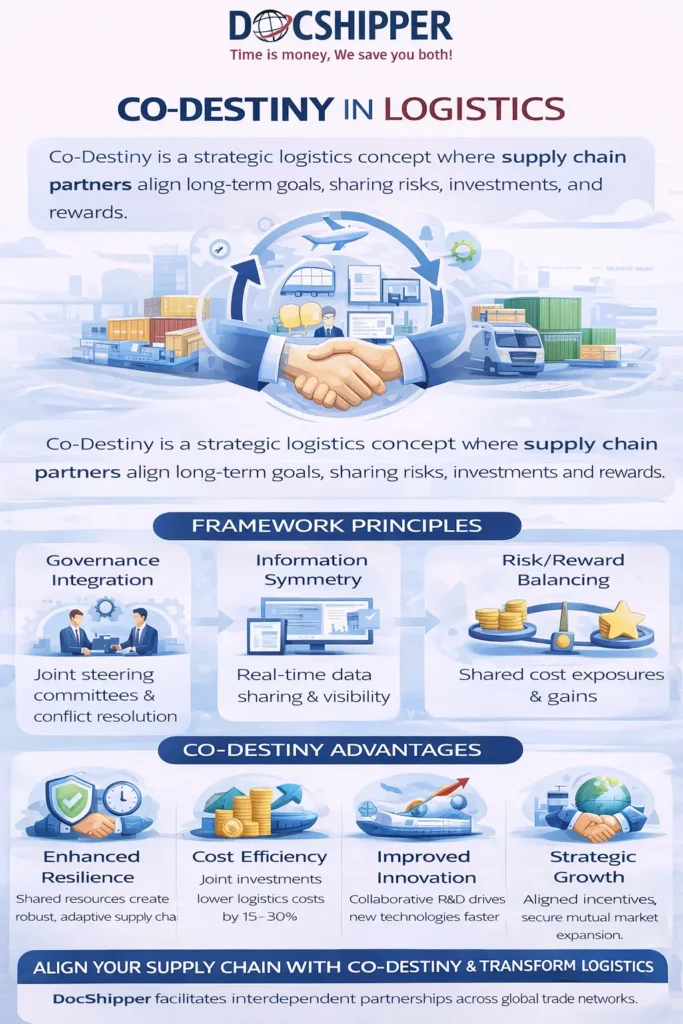
Co-Destiny is a strategic logistics concept where multiple supply chain partners align their long-term objectives, sharing risks, investments, and benefits to create mutual value. This collaborative framework transcends traditional transactional relationships, establishing interdependent partnerships that enhance resilience, innovation, and competitive advantage across international trade operations.
Introduction
Many importers and exporters struggle with supply chain volatility, treating logistics providers as replaceable vendors rather than strategic partners. This transactional mindset creates fragmentation, information silos, and missed opportunities for optimization.
Co-Destiny addresses this challenge by establishing synchronized partnerships where all parties succeed or fail together. In global logistics, this approach transforms how companies manage freight forwarding, customs compliance, warehousing, and last-mile delivery.
Key characteristics of Co-Destiny partnerships include:
- Shared investment in technology platforms and infrastructure development
- Transparent data exchange across inventory, demand forecasts, and capacity planning
- Joint risk management protocols for disruptions and market fluctuations
- Aligned KPIs that measure collective performance rather than isolated metrics
- Long-term contractual commitments with mutual growth incentives
Strategic Framework & Implementation Principles
Implementing Co-Destiny requires fundamental shifts in governance, communication, and value distribution. The framework operates on five interconnected principles that distinguish it from conventional supplier relationships.
Governance Integration establishes joint steering committees where partners co-design processes, resolve conflicts collaboratively, and make strategic decisions together. This eliminates the traditional buyer-supplier power imbalance, creating equal representation in operational planning.
Information Symmetry mandates real-time data sharing through integrated systems. Partners gain visibility into each other’s capacity constraints, cost structures, and strategic priorities. This transparency enables proactive problem-solving rather than reactive firefighting.
Risk-Reward Balancing distributes both financial exposure and gains proportionally. When fuel prices surge or customs regulations change, cost impacts are absorbed collectively through pre-agreed formulas. Conversely, efficiency improvements generate shared savings.
Innovation Co-Development pools resources for technological advancement. Partners jointly invest in automation, predictive analytics, or sustainability initiatives that neither could afford independently. Intellectual property rights are negotiated upfront to protect contributions.
Cultural Alignment ensures compatible organizational values and operational philosophies. Mismatched corporate cultures undermine even well-structured partnerships. Due diligence must assess behavioral compatibility beyond financial metrics.
At DocShipper, we structure Co-Destiny agreements by mapping interdependencies across our clients’ supply chains, identifying where strategic partnerships deliver maximum leverage compared to transactional arrangements.
Legal frameworks supporting Co-Destiny often reference WTO Trade Facilitation Agreement principles that encourage customs cooperation and information sharing between private entities and regulatory authorities.
Practical Applications & Performance Metrics
Co-Destiny manifests differently across logistics segments, but all implementations share measurable outcomes tied to collective performance. The following scenarios illustrate practical applications with quantifiable impacts.
| Partnership Model | Key Mechanism | Measured Outcome |
|---|---|---|
| Shipper-Carrier Alliance | Dedicated vessel capacity with volume guarantees | 18% freight cost reduction over 3 years |
| Manufacturer-3PL Integration | Co-located warehouse with shared inventory management | 42% decrease in order-to-delivery cycle time |
| Importer-Customs Broker Collaboration | Joint compliance platform with automated classification | 95% reduction in clearance delays |
| Retailer-Logistics Provider Synergy | Shared demand forecasting with dynamic routing | 31% improvement in on-time delivery rates |
Use Case: Electronics Importer & Freight Forwarder Partnership
A European electronics distributor established a Co-Destiny agreement with their Asian freight forwarder. The partnership involved:
- Joint investment in IoT-enabled container tracking ($240,000 shared cost)
- Quarterly business reviews with transparent P&L sharing
- Flexible payment terms linked to inventory turnover metrics
- Co-branded customer service for end-client visibility
After 18 months, the partnership achieved:
- 27% reduction in total landed costs through optimized routing
- 63% fewer documentation errors due to integrated systems
- $1.8M additional revenue from improved stock availability
- 89% partner satisfaction score versus 54% industry average
Critical success factors included monthly performance dashboards tracking joint KPIs, conflict resolution protocols with 48-hour response commitments, and innovation budgets allocated at 3% of annual contract value.
DocShipper facilitates Co-Destiny frameworks by conducting compatibility assessments, drafting balanced governance structures, and implementing integrated technology platforms that enable seamless collaboration across borders and regulatory environments.
Conclusion
Co-Destiny represents the evolution from transactional logistics to strategic partnership ecosystems. By aligning incentives and sharing both risks and rewards, companies unlock resilience and innovation impossible through conventional vendor relationships.
Need guidance structuring strategic partnerships in your supply chain? Contact DocShipper to explore how Co-Destiny frameworks can transform your logistics operations.
📚 Quiz
Test Your Knowledge: Co-Destiny
Q1 — What best defines Co-Destiny in a logistics context?
Q2 — A common misconception about Co-Destiny is that it simply means outsourcing logistics to a single provider. What actually sets it apart from a standard outsourcing contract?
Q3 — A European electronics distributor and an Asian freight forwarder jointly invest in IoT container tracking, share quarterly P&L reviews, and link payment terms to inventory turnover. Which concept does this scenario best illustrate?
🎯 Your Result
📞 Free Quote in 24hFAQ | Co-Destiny in Logistics: Definition, Strategic Framework & Real-World Applications
Co-Destiny involves shared governance, transparent data exchange, and proportional risk-reward distribution, whereas standard contracts maintain buyer-supplier separation with fixed pricing and limited information sharing.
Typical implementation spans 6-12 months, including partner selection, legal framework development, technology integration, and cultural alignment processes before full operational synchronization.
Primary risks include partner dependency, intellectual property disputes, unequal contribution perceptions, and exit complexity. Mitigation requires clear governance structures and predefined dissolution protocols.
Yes, scaled appropriately. Small importers often establish Co-Destiny relationships with regional carriers or customs brokers, focusing on simplified governance and technology-light collaboration frameworks.
Compliance obligations remain legally separate, but Co-Destiny partners often implement joint audit processes, shared compliance training, and coordinated documentation systems to reduce regulatory risks collectively.
Cloud-based TMS systems with API integration, blockchain for transparent documentation, IoT for real-time tracking, and collaborative forecasting tools enable the data transparency Co-Destiny requires.
Governance agreements typically mandate tiered escalation: operational teams resolve issues first, then joint steering committees, finally independent mediation before litigation as a last resort.
Yes, but implementation differs. Ocean partnerships emphasize capacity planning and long-term contracts, while air freight Co-Destiny focuses on priority access during peak seasons and dynamic pricing adjustments.
Open-book accounting with cost-plus arrangements, gain-sharing formulas for efficiency improvements, and risk-pooling mechanisms for market volatility create balanced financial alignment.
Key metrics include total supply chain cost reduction, service level improvements, innovation project completions, partner satisfaction scores, and resilience during disruptions compared to industry benchmarks.
Multi-party Co-Destiny networks exist, particularly in complex supply chains involving manufacturers, freight forwarders, and distributors, though governance complexity increases significantly with each additional partner.
Jurisdictions with strong commercial law frameworks like Singapore, UK, and Netherlands offer favorable environments. International arbitration clauses under ICC or UNCITRAL rules provide neutral dispute resolution.
Need Help with
Logistics or Sourcing ?
First, we secure the right products from the right suppliers at the right price by managing the sourcing process from start to finish. Then, we simplify your shipping experience - from pickup to final delivery - ensuring any product, anywhere, is delivered at highly competitive prices.


Fill the Form
Prefer email? Send us your inquiry, and we’ll get back to you as soon as possible.
Contact us




