


In short ⚡
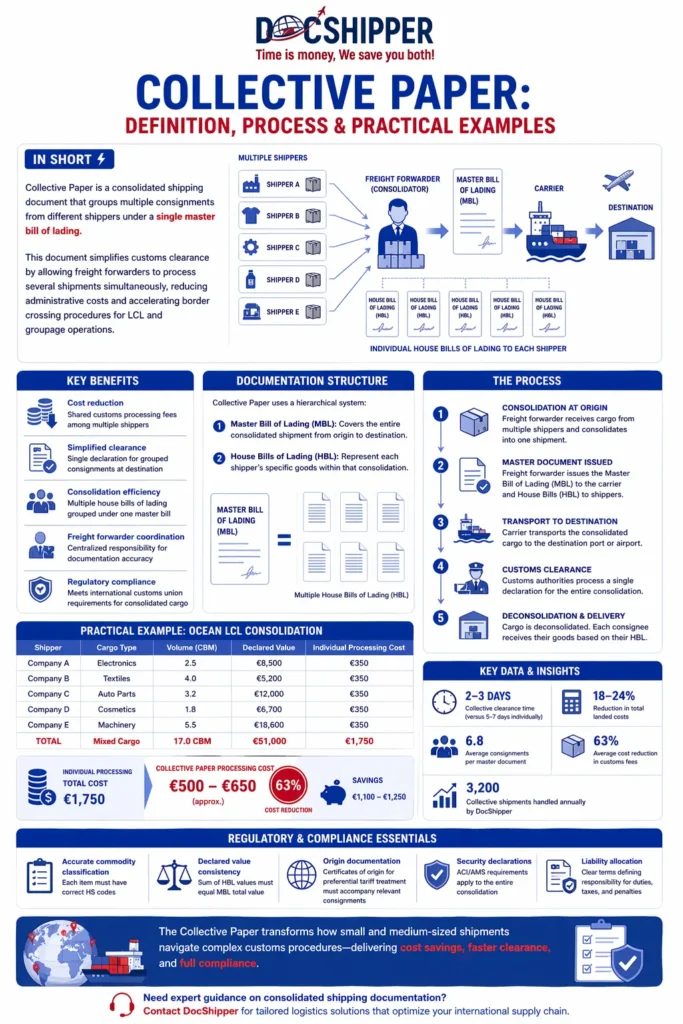
Collective Paper is a consolidated shipping document that groups multiple consignments from different shippers under a single master bill of lading. This document simplifies customs clearance by allowing freight forwarders to process several shipments simultaneously, reducing administrative costs and accelerating border crossing procedures for less-than-container-load (LCL) and groupage operations.
Introduction
Many small and medium-sized businesses face a common challenge: shipping goods internationally without filling an entire container. Paying for full container loads (FCL) becomes economically unfeasible, yet individual LCL shipments incur disproportionate documentation and customs fees.
The Collective Paper addresses this inefficiency by consolidating multiple shipments into one administrative unit. This mechanism proves essential in international logistics, particularly for air freight groupage and ocean LCL services where cargo from various shippers shares transport space.
Key characteristics of Collective Paper include:
- Consolidation efficiency: Multiple house bills of lading grouped under one master bill
- Cost reduction: Shared customs processing fees among multiple shippers
- Simplified clearance: Single declaration for grouped consignments at destination
- Freight forwarder coordination: Centralized responsibility for documentation accuracy
- Regulatory compliance: Meets international customs union requirements for consolidated cargo
In-Depth Understanding & Regulatory Framework
The Collective Paper operates within a hierarchical documentation structure. The master bill of lading (MBL) covers the entire consolidated shipment from origin to destination port, while individual house bills of lading (HBL) represent each shipper’s specific goods within that consolidation.
Freight forwarders assume legal responsibility as the consolidator. They issue the master document to the carrier while providing house bills to individual shippers. This dual-layer system allows customs authorities to process the entire consolidation under unified procedures while maintaining traceability for each consignment.
The deconsolidation process at destination requires precise coordination. Customs authorities may inspect the collective shipment before releasing individual consignments to their respective consignees. At DocShipper, we systematically verify all house bills match the master declaration to prevent clearance delays and ensure seamless cargo distribution.
International regulations governing Collective Paper vary by jurisdiction. The World Customs Organization (WCO) provides guidelines through the Revised Kyoto Convention, which standardizes procedures for grouped cargo. The European Union’s Union Customs Code explicitly recognizes consolidated declarations under Article 141, allowing authorized freight forwarders to submit collective entries.
Critical compliance elements include:
- Accurate commodity classification: Each item within the consolidation must have correct HS codes
- Declared value consistency: Sum of house bills must equal master bill total value
- Origin documentation: Certificates of origin for preferential tariff treatment must accompany relevant consignments
- Security declarations: Advanced cargo information requirements (ACI/AMS) apply to the entire consolidation
- Liability allocation: Clear contractual terms defining responsibility for duties, taxes, and potential penalties
Practical Examples & Data Insights
Understanding Collective Paper mechanics becomes clearer through real-world scenarios. Consider a freight forwarder consolidating shipments from five European exporters to a single destination in Vietnam.
| Shipper | Cargo Type | Volume (CBM) | Declared Value | Individual Processing Cost |
|---|---|---|---|---|
| Company A | Electronics | 2.5 | €8,500 | €350 |
| Company B | Textiles | 4.0 | €5,200 | €350 |
| Company C | Auto Parts | 3.2 | €12,000 | €350 |
| Company D | Cosmetics | 1.8 | €6,700 | €350 |
| Company E | Machinery | 5.5 | €18,600 | €350 |
| TOTAL | Mixed Cargo | 17.0 CBM | €51,000 | €1,750 |
Cost Analysis: If processed individually, total customs clearance fees would reach €1,750. Using Collective Paper, the freight forwarder submits one master declaration with a processing fee of approximately €500–€650, representing a 63% cost reduction. Each shipper pays a proportional share based on their cargo’s declared value.
Time Efficiency: Individual clearance for five shipments typically requires 5–7 business days per consignment. Collective processing reduces total clearance time to 2–3 days for the entire consolidation, accelerating delivery schedules significantly.
Another practical scenario involves air freight groupage from multiple Asian suppliers to a European distribution center:
- Scenario: 12 suppliers shipping garments, accessories, and footwear from Guangzhou to Rotterdam
- Total weight: 2,450 kg across 87 cartons
- Documentation: One master air waybill (MAWB) with 12 house air waybills (HAWB)
- Customs processing: Single entry declaration covering all consignments
- Cost savings: €4,200 in avoided individual clearance fees and reduced demurrage charges
At DocShipper, we handle approximately 3,200 collective shipments annually, with an average consolidation ratio of 6.8 consignments per master document. Our data shows that Collective Paper implementation reduces total landed costs by 18–24% for small to medium shipments compared to individual processing.
Conclusion
The Collective Paper represents a cornerstone of efficient international logistics, transforming how small and medium-sized shipments navigate complex customs procedures. By consolidating documentation and processing, businesses access cost structures previously available only to large-volume shippers while maintaining full traceability and regulatory compliance.
Need expert guidance on consolidated shipping documentation? Contact DocShipper for tailored logistics solutions that optimize your international supply chain.
📚 Quiz
Test Your Knowledge: Collective Paper
Q1 — What is a Collective Paper in international logistics?
Q2 — What happens if one consignment in a Collective Paper consolidation has a documentation error?
Q3 — A freight forwarder consolidates shipments from 5 European exporters to Vietnam. Which document structure correctly describes a Collective Paper operation?
🎯 Your Result
📞 Free Quote in 24hFAQ | Collective Paper: Definition, Process & Practical Examples
The master bill of lading covers the entire consolidated shipment issued by the carrier to the freight forwarder. House bills are individual documents issued by the forwarder to each shipper, representing their specific cargo within the consolidation. The master bill governs carrier liability while house bills define forwarder-shipper relationships.
Not all forwarders qualify. Most jurisdictions require freight forwarders to hold specific customs broker licenses or authorized economic operator (AEO) status to submit collective declarations. Forwarders must demonstrate financial solvency, proven compliance records, and adequate liability insurance before customs authorities grant consolidation privileges.
Duties apply individually to each consignment based on its declared value, commodity classification, and origin. The freight forwarder calculates total duties for the entire consolidation, then allocates specific amounts to each shipper according to their house bill details. Preferential tariff treatments apply only to qualifying consignments with proper origin documentation.
Customs authorities may hold the entire consolidation until discrepancies resolve, affecting all shippers. Experienced forwarders implement pre-clearance verification to identify issues before submission. If problems arise, forwarders can sometimes request partial release for compliant consignments while resolving problematic shipments separately, though this increases processing costs.
Yes. Dangerous goods (IMDG/IATA restricted items), perishables requiring specialized temperature control, high-value goods exceeding insurance thresholds, and cargo subject to import quotas typically cannot join standard consolidations. Customs-bonded goods, tobacco, alcohol, and pharmaceuticals often require dedicated processing outside collective procedures.
Individual shippers maintain separate insurance policies covering their specific goods. The freight forwarder typically carries cargo liability insurance for the entire consolidation during transit. Clear contractual terms must define where forwarder liability ends and individual shipper coverage begins, particularly during deconsolidation and final delivery stages.
No strict minimum exists, but economic viability typically requires shipments between 0.5 and 10 cubic meters for ocean freight, or 50–500 kg for air freight. Smaller shipments may not justify consolidation fees, while larger volumes often warrant dedicated container or aircraft space with individual documentation.
Yes, but each consignment requiring preferential tariff treatment must include valid certificates of origin. The freight forwarder must clearly identify qualifying shipments in the collective declaration and ensure origin documentation matches house bill details. Customs authorities may request separate verification for preferential claims within consolidations.
Standard collective clearance requires 24–72 hours at major ports with efficient customs systems. Complex consolidations with multiple commodity types or high-risk goods may extend to 5–7 days. Electronic pre-clearance systems like ACI (Advance Commercial Information) can reduce processing time to same-day release for low-risk consolidations.
Shippers can claim damages through the forwarder's professional liability insurance if errors cause financial loss. Contractual terms typically define liability limits and dispute resolution procedures. Industry standard FIATA documentation includes liability clauses capping forwarder responsibility at specified amounts per kilogram unless declared value coverage is purchased.
Progressive digitalization is occurring through platforms like Bolero, essDOCS, and CargoX blockchain systems. However, full digital adoption faces regulatory hurdles as not all countries recognize electronic bills of lading with equal legal standing. Hybrid systems combining digital master documents with paper house bills remain common during this transition period.
Consolidation adds 2–4 days to total transit time due to cargo gathering at origin and deconsolidation at destination. However, this delay is offset by faster customs clearance and reduced documentation processing. For non-urgent shipments, the cost savings typically justify the modest time extension compared to expedited individual processing.
Need Help with
Logistics or Sourcing ?
First, we secure the right products from the right suppliers at the right price by managing the sourcing process from start to finish. Then, we simplify your shipping experience - from pickup to final delivery - ensuring any product, anywhere, is delivered at highly competitive prices.


Fill the Form
Prefer email? Send us your inquiry, and we’ll get back to you as soon as possible.
Contact us




