


In short ⚡
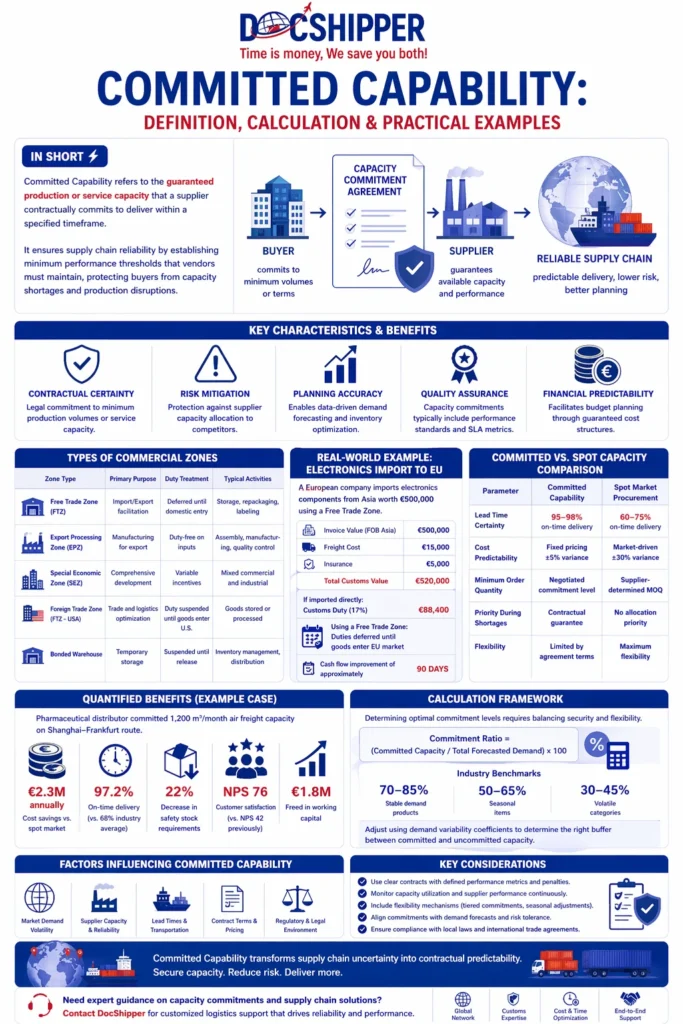
Committed Capability refers to the guaranteed production or service capacity that a supplier contractually commits to deliver within a specified timeframe. This metric ensures supply chain reliability by establishing minimum performance thresholds that vendors must maintain, protecting buyers from capacity shortages and production disruptions in international logistics operations.
Introduction
Supply chain disruptions cost global businesses billions annually, often stemming from unclear capacity agreements between buyers and suppliers. Committed Capability addresses this vulnerability by establishing contractual guarantees around production volume, lead times, and service levels.
In international trade, this concept becomes critical when coordinating multi-tier supply chains across continents. A manufacturer in Vietnam committing specific production capacity to a European retailer creates predictability that enables accurate inventory planning and customer fulfillment.
- Contractual certainty: Legal commitment to minimum production volumes or service capacity
- Risk mitigation: Protection against supplier capacity allocation to competitors
- Planning accuracy: Enables data-driven demand forecasting and inventory optimization
- Quality assurance: Capacity commitments typically include performance standards and SLA metrics
- Financial predictability: Facilitates budget planning through guaranteed cost structures
Technical Framework & Strategic Implications
Committed Capability operates through formal agreements that specify measurable performance parameters. These contracts define minimum capacity thresholds, typically expressed as units per period or service hours available. The commitment creates bilateral obligations: suppliers guarantee capacity availability while buyers often commit to minimum order volumes.
The capacity reservation mechanism functions similarly to financial options. Buyers secure production slots in advance, sometimes paying reservation fees to guarantee access during peak seasons. This becomes particularly valuable in industries with long lead times like electronics manufacturing or specialized freight services.
Performance measurement frameworks accompany these commitments. Key metrics include capacity utilization rates, order fulfillment percentages, and lead time adherence. International standards like ISO 9001 provide quality management structures that support capability commitments through documented processes and continuous improvement mechanisms.
Legal enforceability varies by jurisdiction. The International Chamber of Commerce provides arbitration frameworks for cross-border capacity disputes. Contracts typically include penalty clauses for non-performance, with remedies ranging from price adjustments to contract termination rights.
Dynamic capacity management allows adjustments based on market conditions. Modern agreements incorporate flexibility mechanisms like tiered commitments (minimum, target, maximum) or seasonal variations. At DocShipper, we structure supplier agreements with built-in capacity buffers to accommodate demand fluctuations while maintaining cost efficiency.
The financial implications extend beyond direct costs. Committed capacity affects working capital requirements, inventory carrying costs, and cash flow predictability. Companies must balance the security of guaranteed capacity against the flexibility costs of uncommitted procurement strategies.
Practical Applications & Data Analysis
Real-world implementation reveals how committed capability transforms supply chain performance. Consider a consumer electronics company sourcing from Asian manufacturers while serving European markets.
Comparative Analysis: Committed vs. Spot Capacity
| Parameter | Committed Capability | Spot Market Procurement |
|---|---|---|
| Lead Time Certainty | 95-98% on-time delivery | 60-75% on-time delivery |
| Cost Predictability | Fixed pricing ±5% variance | Market-driven, ±30% variance |
| Minimum Order Quantity | Negotiated commitment level | Supplier-determined MOQ |
| Priority During Shortages | Contractual guarantee | No allocation priority |
| Flexibility | Limited by agreement terms | Maximum flexibility |
Case Study: Freight Forwarding Capacity
A pharmaceutical distributor committed 1,200 cubic meters monthly air freight capacity on the Shanghai-Frankfurt route. During the 2020 logistics crisis, spot rates increased 340% while their committed rate remained stable with only contractual 8% escalation.
Quantified outcomes:
- Cost savings: €2.3M annually compared to spot market procurement
- Service reliability: 97.2% on-time delivery vs. industry average 68%
- Inventory reduction: 22% decrease in safety stock requirements
- Customer satisfaction: NPS score improved from 42 to 76
- Working capital optimization: €1.8M freed through predictable lead times
Calculation Framework
Determining optimal commitment levels requires balancing security and flexibility. The capacity commitment ratio formula:
Commitment Ratio = (Committed Capacity / Total Forecasted Demand) × 100
Industry benchmarks suggest 70-85% commitment for stable demand products, 50-65% for seasonal items, and 30-45% for volatile categories. DocShipper analyzes historical shipment data and demand patterns to optimize these ratios for each client’s risk profile.
Risk-adjusted capacity planning incorporates demand variability coefficients. A product with 15% demand standard deviation requires proportionally higher uncommitted capacity buffer than one with 5% variability. This statistical approach prevents both capacity shortages and excessive commitment costs.
Conclusion
Committed Capability transforms supply chain uncertainty into contractual predictability, enabling strategic planning while mitigating operational risks. The balance between commitment security and procurement flexibility defines competitive advantage in global logistics.
Need expert guidance structuring capacity commitments with your suppliers? Contact DocShipper for customized supply chain solutions that optimize your logistics performance.
📚 Quiz
Test Your Knowledge: Committed Capability
Q1 — What does Committed Capability primarily refer to in a supply chain context?
Q2 — A buyer is choosing between Committed Capability and spot market procurement. Which statement correctly describes a key trade-off?
Q3 — A seasonal retailer wants to structure a capacity commitment contract. Which approach best reflects industry best practice?
🎯 Your Result
📞 Free Quote in 24hFAQ | Committed Capability: Definition, Calculation & Practical Examples
Committed capability represents contractual obligations with performance guarantees and penalties, while reserved capacity typically involves advance booking without binding commitments. Committed arrangements offer stronger legal protection but require minimum volume obligations.
Penalties typically apply bidirectionally: suppliers face financial consequences for underdelivery, while buyers may incur charges for failing to meet minimum order commitments. Standard penalties range from 5-15% of contract value, though specific terms vary by industry and negotiation leverage.
Yes, comprehensive agreements integrate quality metrics like defect rates, inspection pass rates, and compliance certifications. These performance standards become contractual obligations alongside capacity volumes, creating holistic supplier accountability frameworks.
Manufacturing commitments usually span 12-36 months, while logistics capacity agreements range from 6-24 months. Longer terms secure better pricing but reduce flexibility. Many contracts include annual review clauses allowing adjustments based on market conditions.
These agreements foster strategic partnerships through mutual investment and risk-sharing. Suppliers gain revenue predictability enabling capacity investments, while buyers receive priority treatment and collaborative problem-solving. However, they reduce supplier diversification flexibility.
Enforceability depends on contract jurisdiction clauses and applicable trade law. International commercial arbitration through ICC or UNCITRAL provides dispute resolution mechanisms. Including force majeure clauses protects both parties from uncontrollable disruptions like natural disasters or regulatory changes.
Essential KPIs include capacity utilization rate, order fulfillment percentage, lead time variance, quality defect rate, and cost per unit versus baseline. Monthly scorecards tracking these metrics enable proactive issue resolution and continuous improvement initiatives.
Seasonal operations use tiered commitment structures with baseline minimums year-round and elevated capacity during peak periods. Contracts specify advance notice periods (typically 60-90 days) for activating higher capacity tiers, balancing supplier planning needs with demand flexibility.
Transfer provisions vary by contract. Some agreements allow capacity rights assignment with supplier approval, useful during business acquisitions or strategic partnerships. Others prohibit transfer to maintain supplier relationship control and prevent capacity speculation.
Excess commitments create sunk costs through minimum purchase obligations, increased inventory carrying expenses, and reduced procurement agility. Companies typically experience 12-18% higher total landed costs when commitment levels exceed 90% of actual demand due to these inefficiencies.
Supply chain management platforms provide real-time capacity visibility, automated performance tracking, and predictive analytics for demand forecasting. Integration with supplier systems enables dynamic capacity adjustments and early warning systems for potential shortfalls.
High-value, time-sensitive sectors like pharmaceuticals, automotive, electronics, and perishable goods gain maximum advantage. Industries with long lead times, complex manufacturing processes, or regulatory compliance requirements particularly benefit from the predictability committed capability provides.
Need Help with
Logistics or Sourcing ?
First, we secure the right products from the right suppliers at the right price by managing the sourcing process from start to finish. Then, we simplify your shipping experience - from pickup to final delivery - ensuring any product, anywhere, is delivered at highly competitive prices.


Fill the Form
Prefer email? Send us your inquiry, and we’ll get back to you as soon as possible.
Contact us




