


In short ⚡
Commodity buying is the strategic procurement of raw materials and standardized goods traded on global markets. It involves purchasing bulk products like metals, grains, oil, or textiles at optimal prices through market analysis, supplier negotiation, and risk management to ensure supply chain continuity and cost efficiency.
Introduction
Many businesses struggle with volatile raw material costs that directly impact profit margins. Price fluctuations in commodities like copper, cotton, or crude oil can make or break quarterly financial results. Understanding commodity buying transforms this challenge into competitive advantage.
In international trade, commodity buying represents the foundation of manufacturing and distribution chains. Whether sourcing steel for automotive production or coffee beans for retail, mastering this procurement discipline determines operational resilience and market positioning.
- Price volatility management: Commodities experience daily price swings based on geopolitical events, weather patterns, and market speculation
- Quality standardization: Unlike finished goods, commodities follow international grading systems (ISO, ASTM) ensuring consistent specifications
- Volume requirements: Bulk purchasing demands precise forecasting to balance inventory costs against supply security
- Supplier diversification: Geographic and political risks necessitate multi-source strategies across different producing regions
- Contract structures: Spot purchases versus futures contracts create different financial exposures and hedging opportunities
Procurement Mechanisms & Risk Management
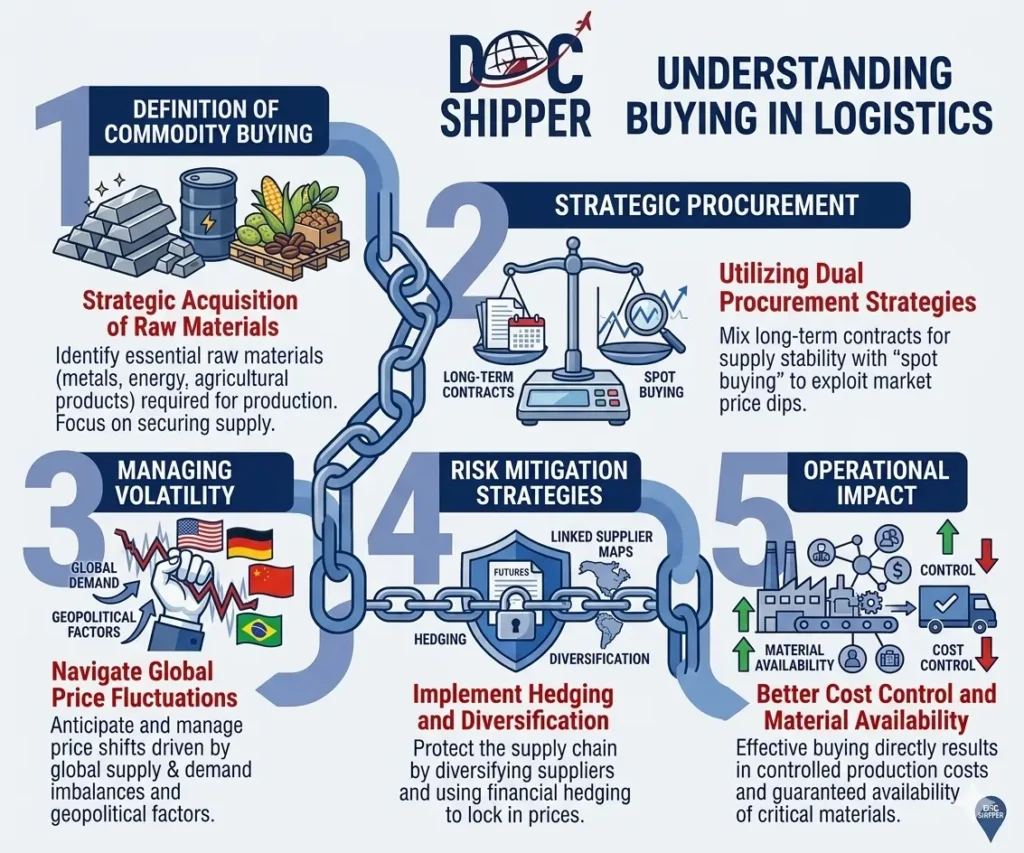
Commodity buying operates through distinct market mechanisms. Spot markets enable immediate purchase at current prices, ideal for urgent needs but exposing buyers to maximum volatility. Futures contracts lock prices for delivery months ahead, providing budget certainty while requiring sophisticated financial understanding.
The procurement process involves market intelligence gathering from exchanges like the London Metal Exchange (LME) or Chicago Board of Trade (CBOT). Professional buyers monitor supply-demand indicators, harvest forecasts, mining outputs, and currency fluctuations. This data informs timing decisions that can save millions on large-volume contracts.
Quality verification protocols differ fundamentally from manufactured goods. Commodities require independent inspection agencies like SGS or Bureau Veritas to certify grade, purity, moisture content, or chemical composition. Letters of credit typically mandate third-party inspection reports before payment release, as outlined in ICC Incoterms regulations.
Risk mitigation extends beyond price hedging. Supply chain disruption planning addresses port congestion, transportation bottlenecks, and force majeure events. Experienced buyers maintain relationships with multiple suppliers across continents, balancing cost advantages against geopolitical stability and logistics complexity.
At DocShipper, we assist clients in coordinating commodity inspections at origin, managing documentation compliance, and optimizing shipping routes to reduce landed costs. Our expertise in customs procedures ensures smooth clearance for bulk shipments requiring specific import licenses or phytosanitary certificates.
Market Data & Concrete Case Studies
Real-world commodity buying reveals significant cost variations based on strategy execution. Consider these comparative scenarios across different procurement approaches:
| Commodity Type | Spot Purchase | 3-Month Future | Annual Contract |
|---|---|---|---|
| Copper (per ton) | $9,200 (current market) | $9,450 (locked price) | $9,100 (volume discount) |
| Arabica Coffee (per lb) | $2.35 (daily volatility) | $2.42 (harvest hedge) | $2.28 (direct farmer) |
| Crude Oil (per barrel) | $82 (geopolitical risk) | $85 (storage costs) | $79 (refinery direct) |
Case Study: Electronics Manufacturer — A European electronics producer needed 500 tons of aluminum monthly. Initial spot buying at $2,400/ton created budget unpredictability. Switching to quarterly futures contracts at $2,450/ton added $25,000 upfront but eliminated $180,000 in unexpected cost overruns when prices spiked to $2,800/ton during supply chain disruptions.
Textile Industry Example: A fashion brand sourcing organic cotton faced 40% price increases during harvest failures. Implementing a dual strategy—60% annual contracts with certified farms and 40% spot market purchases—reduced average costs by 22% while maintaining supply continuity. Quality consistency improved through direct supplier relationships and pre-shipment inspections.
Key performance indicators for commodity buying success include:
- Price variance: Actual purchase cost versus market average over 12 months
- Supply reliability: On-time delivery rate and quality rejection percentage
- Inventory turnover: Days of stock held versus carrying costs
- Hedging effectiveness: Savings from futures contracts versus spot market exposure
- Supplier concentration risk: Percentage of total volume from single sources
Digital platforms now enable smaller buyers to access commodity markets previously reserved for major corporations. Blockchain-based verification systems provide transparent provenance tracking, particularly valuable for conflict minerals compliance and sustainability certifications required by EU regulations.
Conclusion
Commodity buying combines financial acumen, market timing, and supply chain expertise to secure raw materials at competitive prices. Mastering this discipline protects margins while ensuring production continuity in volatile global markets.
Need expert guidance on commodity procurement strategies or import logistics? Contact DocShipper for tailored solutions that optimize your sourcing operations.
📚 Quiz
Test Your Knowledge: Commodity Buying
1. Which of the following best defines commodity buying?
2. A buyer locks in a copper price three months before delivery to protect against market spikes. This is an example of a spot purchase — true or false?
3. A fashion brand faces a 40% price surge in organic cotton due to harvest failures. Which commodity buying strategy best reduces cost exposure while maintaining supply continuity?
🎯 Your Result
📞 Free Quote in 24hFAQ | Commodity Buying: Definition, Strategies & Practical Examples
Commodities are standardized, interchangeable goods traded on exchanges with transparent pricing. Regular procurement involves differentiated products with supplier-specific features and negotiated pricing structures.
Futures lock purchase prices months in advance, eliminating uncertainty. If market prices rise, you benefit from lower contracted rates. If prices fall, you pay the agreed premium for budget certainty.
Exchange-traded commodities have standard contract sizes (e.g., 25 tons copper, 37,500 pounds coffee). Smaller buyers can access markets through brokers or pooled purchasing cooperatives.
Energy products (crude oil, natural gas), precious metals (gold, silver), and agricultural goods (coffee, cocoa) experience significant swings due to weather, geopolitics, and currency fluctuations.
Independent inspection companies conduct sampling and testing at origin, issuing certificates of analysis. These reports verify grade, purity, and compliance with international standards before shipment.
Price volatility, supply disruptions, quality inconsistencies, currency fluctuations, and geopolitical events affecting production regions. Diversification and hedging strategies mitigate these exposures.
Yes, through commodity brokers, online trading platforms, or purchasing cooperatives. Minimum investment thresholds vary, but digital marketplaces have lowered barriers significantly.
Agricultural commodities follow harvest cycles with predictable price patterns. Strategic buyers purchase during surplus periods and store inventory, or use futures to lock favorable pre-harvest pricing.
Commercial invoices, bills of lading, certificates of origin, quality inspection reports, phytosanitary certificates (agricultural goods), and import licenses depending on commodity type and destination country regulations.
Most commodities trade in USD. Currency fluctuations between your local currency and the dollar add hidden costs or savings. Hedging currency exposure through forward contracts stabilizes total landed costs.
Exchanges like LME, CBOT, and ICE provide transparent price discovery through supply-demand matching. These benchmark prices inform private negotiations and contract pricing worldwide.
Monthly market analysis is standard, with quarterly strategy adjustments based on price trends, inventory levels, and production forecasts. Major geopolitical events may trigger immediate reassessment.
Need Help with
Logistics or Sourcing ?
First, we secure the right products from the right suppliers at the right price by managing the sourcing process from start to finish. Then, we simplify your shipping experience - from pickup to final delivery - ensuring any product, anywhere, is delivered at highly competitive prices.


Fill the Form
Prefer email? Send us your inquiry, and we’ll get back to you as soon as possible.
Contact us




