


In short ⚡
Common Carrier Duties refer to the legal obligations imposed on transportation providers who offer their services to the general public without discrimination. These duties include the obligation to transport goods or passengers safely, charge reasonable rates, deliver within agreed timeframes, and maintain liability for loss or damage during transit.
Introduction
Understanding common carrier duties is critical for anyone involved in international logistics. Many shippers mistakenly assume carriers have unlimited liability or no responsibility at all. This confusion leads to disputes, financial losses, and shipment delays.
Common carriers operate under strict legal frameworks that balance public service obligations with commercial viability. These duties evolved from maritime law and now govern road, rail, air, and ocean freight worldwide.
Key characteristics of common carrier duties include:
- Non-discrimination obligation: Carriers must serve all customers equally without unjust preference
- Duty to deliver: Legal responsibility to transport goods safely to the agreed destination
- Limited liability provisions: Statutory caps on compensation for loss or damage
- Rate regulation: Obligation to charge reasonable and published tariffs
- Continuous service requirement: Commitment to maintain regular operations
These obligations protect shippers while allowing carriers to operate profitably. The balance varies by jurisdiction and transport mode, creating complexity in cross-border operations.
Legal Framework & Carrier Obligations
Common carrier duties originate from centuries-old legal principles designed to
prevent monopolistic practices and ensure public access to transportation. Modern frameworks incorporateinternational conventions, national statutes, and commercial regulations.
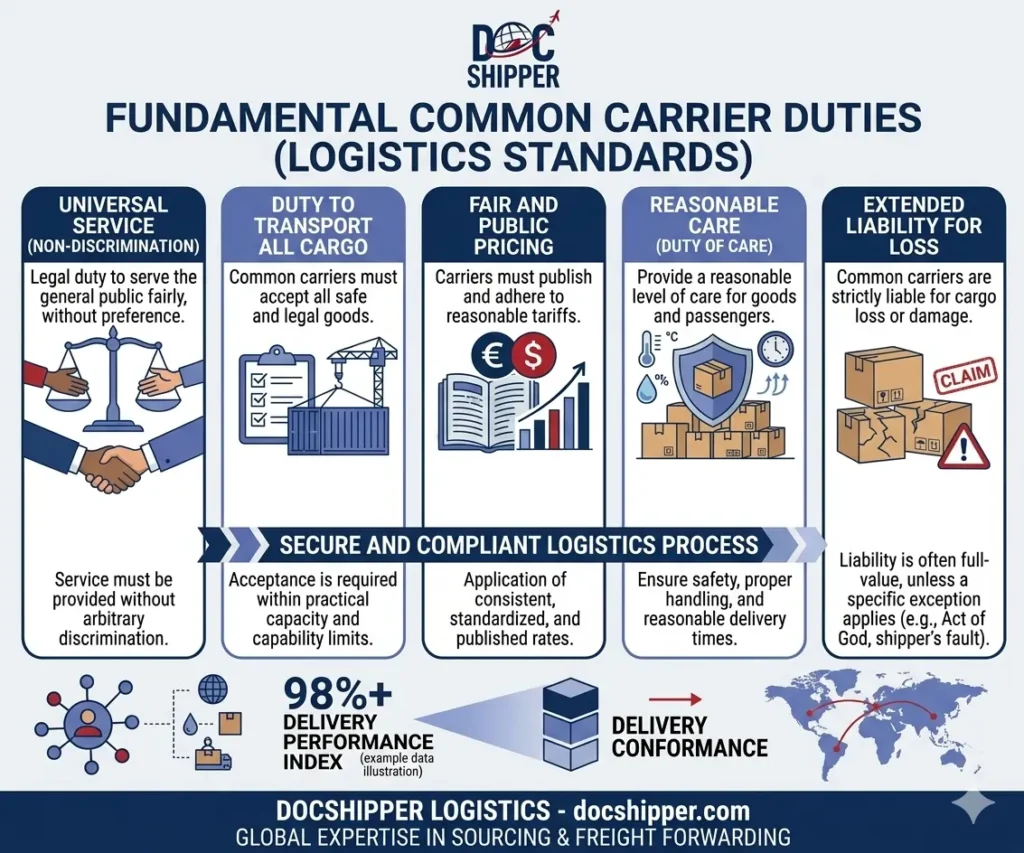
The duty to accept cargo requires carriers to transport goods for any customer willing to pay published rates, subject to capacity and safety limitations. Carriers cannot arbitrarily refuse shipments based on customer identity or cargo type (excluding hazardous materials requiring special licensing).
The duty of reasonable care mandates carriers exercise professional diligence in handling cargo. This includes proper loading, securing, climate control, and protection from theft or damage. Negligence breaches this fundamental obligation.
The liability framework varies by transport mode. Ocean carriers follow the Hague-Visby Rules, limiting liability to approximately $500 per package unless higher value is declared. Air carriers operate under the Montreal Convention with different thresholds.
The tariff publication requirement ensures rate transparency. Carriers must publish freight charges and cannot charge beyond filed rates without justification. This prevents discriminatory pricing and protects smaller shippers from exploitation.
At DocShipper, we navigate these complex legal frameworks daily. Our expertise ensures your shipments comply with carrier obligations while maximizing protection under applicable liability limits. We verify documentation and insurance coverage to prevent costly disputes.
Practical Examples & Liability Scenarios
Understanding how common carrier duties apply in real situations helps shippers protect their interests. The following scenarios illustrate typical liability situations and carrier obligations.
| Scenario | Carrier Duty | Liability Outcome |
|---|---|---|
| Container damaged during loading | Duty of reasonable care violated | Full liability up to declared value |
| Shipment delayed by 5 days (no force majeure) | Duty to deliver within reasonable time | Compensation for documented losses |
| Cargo stolen from unlocked container | Negligence in securing cargo | Carrier liable unless proves proper security |
| Water damage from storm at sea | Act of God exception applies | Limited/no liability if properly documented |
| Refrigerated goods spoiled (equipment failure) | Duty to maintain proper equipment | Full liability for equipment malfunction |
Case Study: Electronics Shipment Loss
A shipper sent $50,000 worth of electronics via ocean freight without declaring the full value. The container was damaged during handling. The carrier’s liability was capped at $500 per package under Hague-Visby Rules (approximately $5,000 total for 10 packages). The shipper lost $45,000 because they failed to declare higher value and purchase additional insurance.
Key Data Points:
- Ocean freight default liability: ~$500 per package or $2.50 per kilogram (whichever is higher)
- Air cargo liability: ~22 SDR per kilogram (approximately $30 USD per kg)
- Road transport (CMR Convention): 8.33 SDR per kilogram (approximately $11 USD per kg)
- Average claim settlement time: 90-180 days for documented cases
- Insurance cost: typically 0.3-1.5% of declared cargo value
DocShipper systematically reviews cargo values and recommends appropriate insurance coverage. We ensure proper value declaration on bills of lading to maximize protection under carrier liability frameworks while keeping insurance costs competitive.
Conclusion
Common carrier duties establish the legal foundation for safe, reliable international logistics. Understanding these obligations protects shippers from unexpected losses and ensures carriers maintain professional standards.
Need expert guidance on carrier liability and cargo protection? Contact DocShipper for comprehensive logistics support tailored to your shipping needs.
📚 Quiz
Test Your Knowledge: Common Carrier Duties
Q1 — Which of the following best defines "Common Carrier Duties"?
Q2 — A shipper sends $50,000 worth of electronics via ocean freight without declaring the full cargo value. The container is damaged during handling. Under the Hague-Visby Rules, what is the carrier's maximum liability for 10 packages?
Q3 — A refrigerated shipment of perishable goods spoils because the carrier's cooling equipment malfunctions mid-transit. Under common carrier duties, which outcome correctly applies?
🎯 Your Result
📞 Free Quote in 24hFAQ | Common Carrier Duties: Definition, Legal Framework & Practical Examples
A common carrier offers transportation services to the general public under published rates and terms, with legal obligations to serve without discrimination. A private carrier transports goods only for specific customers under private contracts, with fewer regulatory obligations.
Carriers can refuse shipments only for legitimate reasons: lack of capacity, hazardous materials without proper documentation, prohibited goods, or failure to pay applicable charges. Arbitrary refusal violates common carrier duties.
Liability depends on transport mode and applicable conventions. Ocean freight typically limits liability to $500 per package under Hague-Visby Rules, while air cargo follows Montreal Convention limits of approximately $22 per kilogram unless higher value is declared.
Carriers have a duty to deliver within a reasonable timeframe. Unjustified delays may result in compensation for documented losses, though many bills of lading exclude consequential damages. Force majeure events typically exempt carriers from delay liability.
Freight forwarders are generally not common carriers unless they operate their own transportation equipment. They typically act as agents arranging transportation, though some operate as NVOCCs (Non-Vessel Operating Common Carriers) with similar obligations.
Document cargo condition at origin with photos, maintain proper packaging records, note any visible damage on delivery receipts, and preserve all shipping documents. Survey reports from independent inspectors strengthen negligence claims significantly.
No. Shippers have a duty to package goods adequately for the intended transport mode. Carriers are not liable for damage resulting from insufficient packaging, though they may be liable if they accepted cargo they knew was improperly packaged.
Time limits vary by jurisdiction and transport mode. Ocean freight typically allows 9-12 months under international conventions, while air cargo claims must be filed within 18-24 months. Domestic road transport often has shorter periods (6-12 months).
Carriers can include limitation clauses in bills of lading and contracts, but these must comply with applicable laws and international conventions. Unreasonable limitations may be unenforceable, particularly if they violate mandatory legal protections.
Yes. Carriers remain responsible for cargo during transshipment unless they properly transfer custody to connecting carriers. Documentation must clearly establish when responsibility transfers between carriers in multimodal transport chains.
Cargo insurance provides broader protection than carrier liability limits. Insurers pay claims first, then may pursue subrogation against negligent carriers. Comprehensive insurance covers risks excluded from carrier liability, including war, strikes, and inherent vice.
Essential documents include the original bill of lading, commercial invoice, packing list, proof of loss or damage (photos, survey reports), delivery receipt noting discrepancies, and correspondence with the carrier. Claims must be filed in writing within specified timeframes.
Need Help with
Logistics or Sourcing ?
First, we secure the right products from the right suppliers at the right price by managing the sourcing process from start to finish. Then, we simplify your shipping experience - from pickup to final delivery - ensuring any product, anywhere, is delivered at highly competitive prices.


Fill the Form
Prefer email? Send us your inquiry, and we’ll get back to you as soon as possible.
Contact us

Lorem ipsum dolor sit amet, consectetur adipiscing elit. Ut elit tellus, luctus nec ullamcorper mattis, pulvinar dapibus leo.



