


In short ⚡
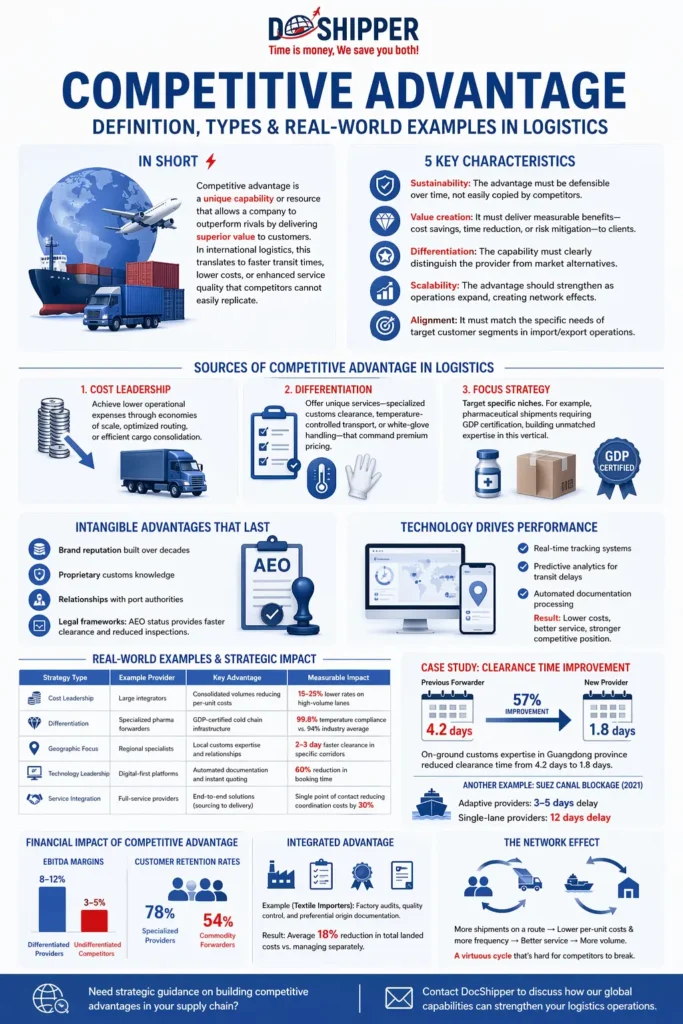
Competitive advantage is a unique capability or resource that allows a company to outperform rivals by delivering superior value to customers. In international logistics, this translates to faster transit times, lower costs, or enhanced service quality that competitors cannot easily replicate.Introduction
In today’s globalized supply chain, countless freight forwarders promise “competitive rates” and “reliable service.” Yet only a handful consistently win contracts from major importers and exporters. What separates market leaders from the rest?
The answer lies in competitive advantage—the strategic edge that makes a logistics provider irreplaceable. Whether through proprietary technology, exclusive carrier partnerships, or specialized expertise, this advantage determines long-term profitability and market position.
Key characteristics of competitive advantage in international logistics include:
- Sustainability: The advantage must be defensible over time, not easily copied by competitors.
- Value creation: It must deliver measurable benefits—cost savings, time reduction, or risk mitigation—to clients.
- Differentiation: The capability must clearly distinguish the provider from market alternatives.
- Scalability: The advantage should strengthen as operations expand, creating network effects.
- Alignment: It must match the specific needs of target customer segments in import/export operations.
Understanding Competitive Advantage in Logistics
Competitive advantage in freight forwarding stems from two fundamental sources: cost leadership and differentiation. Cost leaders achieve lower operational expenses through economies of scale, optimized routing, or efficient cargo consolidation. Differentiated providers offer unique services—specialized customs clearance, temperature-controlled transport, or white-glove handling—that command premium pricing.
A third category, focus strategy, targets specific niches. For example, a forwarder might specialize exclusively in pharmaceutical shipments requiring GDP certification, building unmatched expertise in this vertical. This specialization creates barriers to entry that generalist competitors cannot overcome without significant investment.
The resource-based view explains why some advantages persist. Tangible resources—warehouses, vehicles, technology platforms—can be acquired by competitors. Intangible assets prove more durable: brand reputation built over decades, proprietary customs knowledge, or relationships with port authorities. At DocShipper, we leverage our global network of local experts to navigate complex regulatory environments, an advantage accumulated through years of operational experience across 50+ countries.
Legal frameworks also create competitive moats. Authorized Economic Operator (AEO) status, granted by customs authorities like the European Commission, provides faster clearance and reduced inspections. According to EU regulations (Union Customs Code Article 38), AEO certification requires demonstrating compliance history, financial solvency, and security standards—criteria that exclude many smaller operators.
Technology increasingly determines competitive positioning. Real-time tracking systems, predictive analytics for transit delays, and automated documentation processing reduce operational costs while improving service quality. However, technology alone rarely creates lasting advantage unless paired with organizational capabilities to exploit it effectively.
For authoritative guidance on building sustainable competitive advantages in international trade, the World Trade Organization’s Trade Facilitation resources provide comprehensive frameworks aligned with global best practices.
Real-World Examples & Strategic Data
Understanding competitive advantage requires examining concrete applications across different logistics models. The following comparative analysis illustrates how various strategies translate into operational outcomes:
| Strategy Type | Example Provider | Key Advantage | Measurable Impact |
|---|---|---|---|
| Cost Leadership | Large integrators | Consolidated volumes reducing per-unit costs | 15-25% lower rates on high-volume lanes |
| Differentiation | Specialized pharma forwarders | GDP-certified cold chain infrastructure | 99.8% temperature compliance vs. 94% industry average |
| Geographic Focus | Regional specialists | Local customs expertise and relationships | 2-3 day faster clearance in specific corridors |
| Technology Leadership | Digital-first platforms | Automated documentation and instant quoting | 60% reduction in booking time |
| Service Integration | Full-service providers | End-to-end solutions (sourcing to delivery) | Single point of contact reducing coordination costs by 30% |
Case Study: A European electronics importer faced chronic delays when shipping from Shenzhen to Rotterdam. Their previous forwarder offered competitive pricing but lacked direct relationships with Chinese export authorities. After switching to a provider with on-ground customs expertise in Guangdong province, clearance time decreased from 4.2 days to 1.8 days—a 57% improvement. This advantage stemmed from the forwarder’s decade-long relationship with local officials and pre-classification agreements for common electronics HS codes.
Another dimension of competitive advantage involves risk management capabilities. During the 2021 Suez Canal blockage, forwarders with diversified routing options and real-time rerouting algorithms minimized client disruptions. Those relying on single-lane strategies faced average delays of 12 days, while adaptive providers limited delays to 3-5 days through immediate Pacific routing.
Financial metrics reveal the value of sustainable advantages. According to industry benchmarks, logistics providers with clear differentiation achieve EBITDA margins of 8-12%, compared to 3-5% for undifferentiated competitors competing solely on price. Customer retention rates similarly diverge: specialized providers retain 78% of clients annually versus 54% for commodity forwarders.
At DocShipper, our competitive advantage combines geographic coverage with vertical expertise. For textile importers, we provide factory audits, quality control, and preferential origin documentation—services that generic forwarders cannot economically offer. This integrated approach reduces our clients’ total landed costs by an average of 18% compared to managing logistics and sourcing separately.
The network effect represents a particularly durable advantage. As a forwarder consolidates more shipments on a route, per-unit costs decline and service frequency increases. This creates a virtuous cycle where superior service attracts more volume, further strengthening the cost position. Breaking this cycle requires competitors to operate at a loss until reaching comparable scale—a barrier few can overcome.
Conclusion
Competitive advantage in international logistics determines which providers thrive and which merely survive. Whether through cost efficiency, specialized expertise, or technological innovation, sustainable differentiation creates value that clients recognize and competitors struggle to replicate.
Need strategic guidance on building competitive advantages in your supply chain? Contact DocShipper to discuss how our global capabilities can strengthen your logistics operations.
📚 Quiz
Test Your Knowledge: Competitive Advantage
1. What best defines a competitive advantage in international logistics?
2. According to the resource-based view, which type of asset creates the most durable competitive advantage in freight forwarding?
3. A small freight forwarder wants to compete against large global integrators. Which approach best leverages competitive advantage theory?
🎯 Your Result
📞 Free Quote in 24hFAQ | Competitive Advantage: Definition, Types & Real-World Examples in Logistics
Competitive advantage is the outcome—the superior position achieved in the market. Competitive strategy is the plan to create that advantage through specific actions like cost reduction, service differentiation, or market focus.
Tangible advantages (equipment, technology) last 2-5 years before competitors replicate them. Intangible advantages (relationships, expertise, brand reputation) can endure 10+ years if continuously reinforced through consistent performance.
Yes, through focus strategies. Small forwarders succeed by specializing in specific trade lanes, cargo types, or industries where personalized service and niche expertise outweigh the scale advantages of larger competitors.
AEO status provides faster customs clearance, reduced inspections, and priority treatment during disruptions. It signals reliability to clients and creates operational efficiencies that non-certified competitors cannot match without significant compliance investment.
Digital platforms reduce transaction costs, provide instant visibility, and enable data-driven optimization. However, technology alone is insufficient—the advantage comes from integrating platforms with operational expertise and customer service capabilities.
Relationship-based advantages prove most durable. Long-term partnerships with carriers, customs authorities, and clients create switching costs and knowledge asymmetries that competitors cannot quickly overcome, even with superior technology or pricing.
Deep knowledge of local regulations, languages, and business practices in specific corridors enables faster problem resolution and lower error rates. Building this expertise requires years of operational presence that competitors cannot replicate through remote management.
Yes, through metrics like transit time variance, customs clearance speed, cost per TEU, customer retention rates, and EBITDA margins. Providers with clear advantages typically outperform industry averages by 15-30% on key performance indicators.
Porter's model analyzes industry structure: supplier power (carriers), buyer power (shippers), competitive rivalry, threat of substitutes (alternative modes), and barriers to entry. Understanding these forces helps identify where sustainable advantages can be built.
Expert customs brokers reduce clearance delays, minimize duty payments through proper classification, and navigate complex regulatory requirements. This expertise becomes particularly valuable for high-compliance industries like pharmaceuticals, food, or electronics.
This theory states that competitive advantage stems from valuable, rare, inimitable, and non-substitutable (VRIN) resources. In logistics, examples include proprietary routing algorithms, exclusive carrier contracts, or specialized handling certifications.
Owning warehouses, customs facilities, or last-mile delivery networks provides cost control, service consistency, and capacity guarantees during peak periods. However, it requires significant capital investment and may reduce flexibility compared to asset-light models.
Need Help with
Logistics or Sourcing ?
First, we secure the right products from the right suppliers at the right price by managing the sourcing process from start to finish. Then, we simplify your shipping experience - from pickup to final delivery - ensuring any product, anywhere, is delivered at highly competitive prices.


Fill the Form
Prefer email? Send us your inquiry, and we’ll get back to you as soon as possible.
Contact us




