



In short ⚡
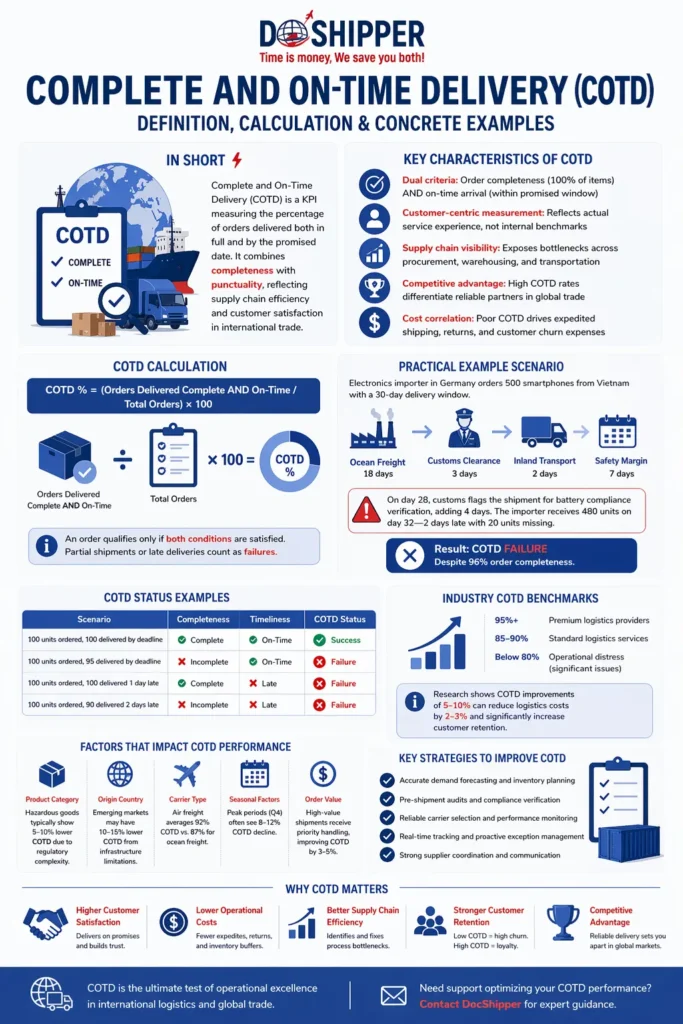
Complete and On-Time Delivery (COTD) is a key performance indicator (KPI) measuring the percentage of orders delivered both in full and by the promised date. It combines completeness (all items shipped) with punctuality (delivered on schedule), reflecting supply chain efficiency and customer satisfaction. COTD directly impacts logistics performance, operational costs, and client retention in international trade.
Introduction
Many companies track delivery times or order accuracy separately, missing the critical connection between these metrics. A shipment arriving on time but incomplete frustrates customers as much as a complete order delivered late. This disconnect creates blind spots in supply chain management.
Complete and On-Time Delivery addresses this gap by measuring both dimensions simultaneously. In international logistics, where delays cascade through customs, freight transfers, and last-mile delivery, COTD serves as the ultimate test of operational excellence.
Key characteristics of COTD include:
- Dual criteria: Order completeness (100% of items) AND on-time arrival (within promised window)
- Customer-centric measurement: Reflects actual service experience, not internal benchmarks
- Supply chain visibility: Exposes bottlenecks across procurement, warehousing, and transportation
- Competitive advantage: High COTD rates differentiate reliable partners in global trade
- Cost correlation: Poor COTD drives expedited shipping, returns, and customer churn expenses
COTD Fundamentals & Strategic Impact
COTD operates as a composite metric, requiring both conditions to be met for a successful delivery. A single missing item or one-day delay disqualifies the shipment from the COTD count. This strict standard aligns with customer expectations in B2B and B2C environments.
The metric’s strategic value lies in its ability to diagnose systemic weaknesses. Low COTD scores often indicate problems beyond transportation—inventory inaccuracies, poor demand forecasting, or inadequate supplier coordination. In international logistics, customs documentation errors or freight consolidation delays frequently undermine COTD performance.
From a regulatory perspective, trade compliance directly affects COTD. According to the European Commission’s Customs Union guidelines, incorrect HS codes or incomplete certificates of origin trigger inspections that delay clearance. At DocShipper, we integrate compliance checks into shipment planning to protect COTD targets before goods leave origin ports.
The financial implications are substantial. Research shows that COTD improvements of 5-10% can reduce logistics costs by 2-3% through fewer expedited shipments and lower inventory buffers. Conversely, COTD rates below 85% typically correlate with customer churn rates exceeding 15% annually in competitive markets.
Leading organizations differentiate between internal COTD (warehouse to carrier handoff) and external COTD (final customer receipt). This distinction helps isolate carrier performance from internal operations. Multi-modal shipments—combining ocean, air, and ground transport—require segmented COTD tracking at each handoff point to identify failure zones.
Technology enablers include real-time tracking systems, predictive analytics for transit times, and automated exception management. DocShipper leverages these tools to monitor COTD across 1,200+ monthly shipments, intervening proactively when delays threaten delivery windows or when inventory shortages risk incomplete orders.
Calculation Methods & Practical Examples
The standard COTD formula is straightforward:
COTD % = (Orders Delivered Complete AND On-Time / Total Orders) × 100
An order qualifies only if both conditions are satisfied. Partial shipments or late deliveries—even by hours—count as failures. This binary approach maintains measurement integrity and customer perspective.
| Scenario | Completeness | Timeliness | COTD Status |
|---|---|---|---|
| 100 units ordered, 100 delivered by deadline | ✓ Complete | ✓ On-Time | Success |
| 100 units ordered, 95 delivered by deadline | ✗ Incomplete | ✓ On-Time | Failure |
| 100 units ordered, 100 delivered 1 day late | ✓ Complete | ✗ Late | Failure |
| 100 units ordered, 90 delivered 2 days late | ✗ Incomplete | ✗ Late | Failure |
Practical Case Study: An electronics importer in Germany orders 500 smartphones from Vietnam with a 30-day delivery window. The shipment plan includes:
- Ocean freight: 18 days (Ho Chi Minh to Hamburg)
- Customs clearance: 3 days (buffer for inspections)
- Inland transport: 2 days (Hamburg to Munich warehouse)
- Safety margin: 7 days
On day 28, customs flags the shipment for battery compliance verification, adding 4 days. The importer receives 480 units on day 32—2 days late with 20 units missing (held for additional testing). Result: COTD failure despite 96% order completeness.
If the same importer processes 200 orders monthly with 170 meeting COTD criteria, their performance is: (170/200) × 100 = 85% COTD. Industry benchmarks suggest 95%+ for premium logistics providers, 85-90% for standard services, and below 80% signals operational distress.
Advanced COTD tracking segments performance by:
- Product category: Hazardous goods typically show 5-10% lower COTD due to regulatory complexity
- Origin country: Emerging markets may have 10-15% lower COTD from infrastructure limitations
- Carrier type: Air freight averages 92% COTD vs. 87% for ocean freight
- Seasonal factors: Peak periods (Q4) often see 8-12% COTD decline
- Order value: High-value shipments receive priority handling, improving COTD by 3-5%
At DocShipper, we maintain a 94% COTD rate across mixed cargo by implementing pre-shipment audits, carrier performance scorecards, and contingency routing for time-sensitive deliveries. Our clients receive weekly COTD dashboards with root-cause analysis for any failures.
Conclusion
Complete and On-Time Delivery represents the intersection of operational precision and customer satisfaction in global logistics. Mastering COTD requires integrated planning across sourcing, compliance, transportation, and inventory management—each link equally critical to the final outcome.
Need support optimizing your COTD performance or managing complex international shipments? Contact DocShipper for expert guidance tailored to your supply chain challenges.
📚 Quiz
Complete and On-Time Delivery (COTD)
Q1 — What does Complete and On-Time Delivery (COTD) measure?
Q2 — A shipment of 100 units arrives on time, but only 95 units are delivered. What is the COTD outcome?
Q3 — A company processes 200 orders in a month. 170 are delivered complete and on time. What is their COTD rate, and how does it compare to industry benchmarks?
🎯 Your Result
📞 Free Quote in 24hFAQ | Complete and On-Time Delivery (COTD): Definition, Calculation & Concrete Examples
OTD measures only punctuality, while COTD requires both timeliness and 100% order completeness. A shipment arriving on schedule with missing items passes OTD but fails COTD, making COTD the more stringent customer-focused metric.
Customs inspections, documentation errors, or duty disputes can add 1-10 days to transit times, directly undermining COTD. Proactive compliance checks and pre-clearance programs mitigate these risks by resolving issues before shipments arrive at borders.
Top-tier logistics providers maintain 95-98% COTD rates. Standard service levels range from 85-92%, while rates below 80% indicate systemic problems requiring immediate operational review and corrective action.
No. COTD requires 100% of ordered items delivered by the deadline. Split shipments where the first batch arrives on time but subsequent batches are late fail COTD, even if the total quantity eventually arrives complete.
B2B COTD often uses agreed delivery windows (e.g., "week of March 15"), while B2C uses specific dates. B2B tolerances may allow same-day flexibility, whereas B2C e-commerce typically enforces strict cutoff times for COTD qualification.
Inventory discrepancies cause 30-40% of COTD failures. If warehouse systems show stock availability but physical counts reveal shortages, orders ship incomplete. Real-time inventory synchronization and cycle counting programs are essential for COTD reliability.
Most companies exclude documented force majeure (natural disasters, strikes, pandemics) from COTD calculations to avoid penalizing uncontrollable events. However, clear policies defining qualifying events and notification procedures must be established with customers beforehand.
IoT sensors provide real-time location tracking, AI predicts delays based on historical patterns, and automated alerts trigger contingency plans. Integrated TMS (Transportation Management Systems) coordinate multi-carrier networks to optimize COTD outcomes across complex routes.
Conduct root-cause analysis using Pareto charts to identify top failure drivers. Common remedies include carrier diversification, safety stock adjustments, lead time renegotiation, and process automation to eliminate manual errors causing delays or incomplete picks.
Yes, but accountability splits between retailer and supplier. Clear contractual terms must define who owns COTD responsibility—typically the party controlling shipment timing and inventory. Third-party logistics providers often guarantee COTD as part of drop-ship service agreements.
Perfect Order Rate is broader, encompassing COTD plus additional criteria like damage-free delivery, accurate invoicing, and correct documentation. COTD forms the core component but represents only 40-50% of Perfect Order measurement in comprehensive supply chain scorecards.
Peak seasons (holidays, sales events) typically reduce COTD by 8-15% due to capacity constraints and volume surges. Leading companies adjust COTD targets seasonally and invest in flex capacity (temporary warehousing, backup carriers) to minimize performance degradation during high-demand periods.
Need Help with
Logistics or Sourcing ?
First, we secure the right products from the right suppliers at the right price by managing the sourcing process from start to finish. Then, we simplify your shipping experience - from pickup to final delivery - ensuring any product, anywhere, is delivered at highly competitive prices.


Fill the Form
Prefer email? Send us your inquiry, and we’ll get back to you as soon as possible.
Contact us




:%20Guide%20for%202026)