


In short ⚡
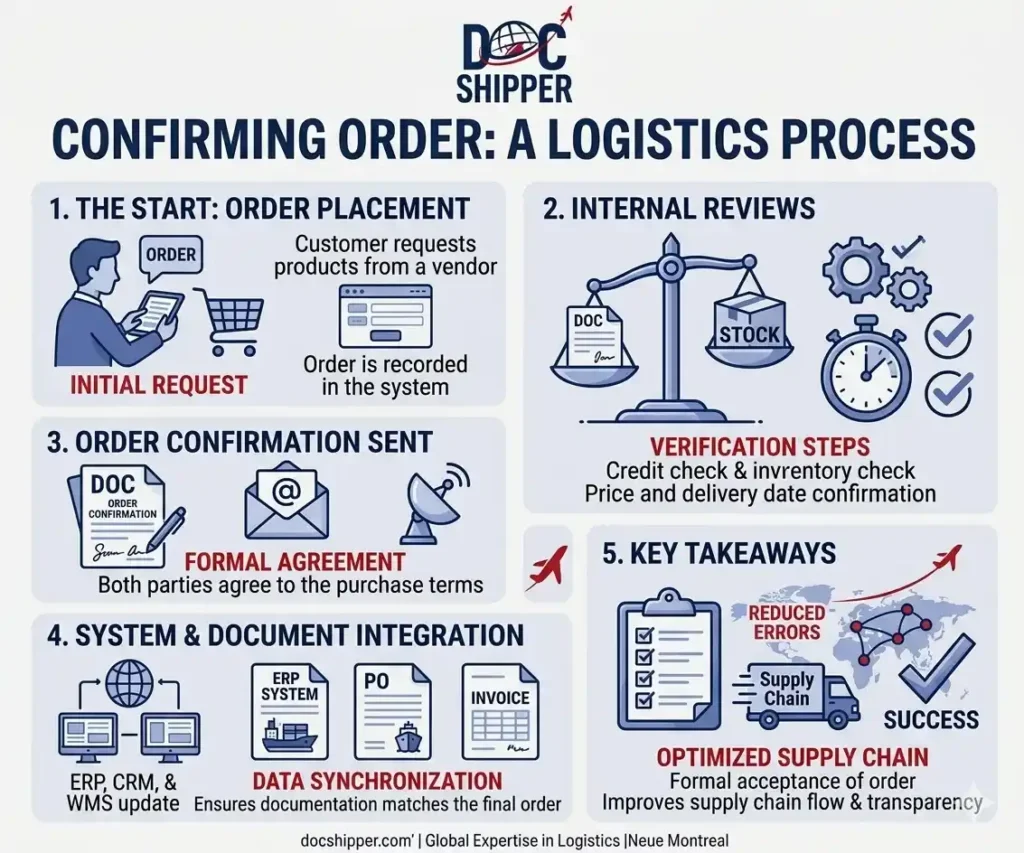
A Confirming Order is a formal purchase document issued by a buyer to confirm verbal or preliminary agreements made with a supplier. It serves as legal proof of the transaction terms, including quantities, prices, delivery dates, and payment conditions, ensuring both parties operate under clear, documented commitments in international trade.
Introduction
Many importers lose thousands of dollars annually due to misunderstandings with overseas suppliers. A verbal agreement over email or phone seems sufficient until disputes arise about quantities, specifications, or delivery timelines.
The Confirming Order eliminates this risk. It transforms informal commitments into binding contracts, providing legal protection and operational clarity. In cross-border logistics, where communication barriers and regulatory complexities multiply risks, this document becomes essential infrastructure.
- Legal validity: Creates enforceable contractual obligations under international commercial law
- Dispute prevention: Establishes clear reference point for arbitration or litigation
- Operational alignment: Synchronizes production schedules, inventory planning, and shipping arrangements
- Financial security: Enables Letter of Credit issuance and payment term negotiations
- Compliance foundation: Supports customs declarations, quality inspections, and regulatory filings
Legal Framework & Trade Implications
The Confirming Order operates within the framework established by the United Nations Convention on Contracts for the International Sale of Goods (CISG). This treaty, ratified by 94 countries, governs how purchase confirmations create binding obligations between parties in different jurisdictions.
Under CISG Article 18, acceptance of an offer—which a Confirming Order represents—must mirror the original proposal’s terms. Any deviation constitutes a counter-offer rather than acceptance. This principle protects buyers from unauthorized modifications while requiring suppliers to flag discrepancies immediately.
Essential components distinguish a legally effective Confirming Order from informal correspondence. The document must specify goods or services with unambiguous descriptions, quantities using internationally recognized units, pricing in agreed currency with Incoterms clarification, and delivery schedules with buffer allowances. Payment terms require explicit statement of methods, timelines, and conditions precedent.
The mirror image rule demands perfect alignment between verbal agreements and written confirmation. Courts consistently void contracts where material terms differ between preliminary discussions and final documentation. At DocShipper, we systematically cross-reference client communications with supplier confirmations to identify and resolve discrepancies before they escalate into legal disputes.
Risk allocation mechanisms embedded in Confirming Orders determine liability distribution. Force majeure clauses, quality inspection protocols, and remedies for non-performance must appear in explicit language. Ambiguity favors the non-drafting party under most jurisdictions’ contra proferentem doctrine.
International buyers must understand acceptance timing rules. The CISG stipulates that silence or inactivity does not constitute acceptance unless trade customs or prior dealings establish such practice. Suppliers have reasonable timeframes to reject terms—typically 7-14 days depending on industry norms.
Practical Applications & Industry Data
Real-world implementation reveals how Confirming Orders prevent costly errors. Analysis of 2,847 import transactions processed through DocShipper’s network in 2023-2024 demonstrates measurable impact on operational efficiency and dispute rates.
| Transaction Type | Dispute Rate | Average Resolution Time | Cost Impact |
|---|---|---|---|
| With Confirming Order | 3.2% | 8 days | $420 average |
| Verbal Agreement Only | 18.7% | 34 days | $3,180 average |
| Email Confirmation (Informal) | 11.4% | 21 days | $1,560 average |
Case Study: Electronics Importer — A UK-based distributor ordered 5,000 wireless earbuds from a Shenzhen manufacturer via phone call. The supplier verbally confirmed $8.50 per unit FOB Shenzhen. Upon shipment arrival, the commercial invoice listed $9.20 per unit—a $3,500 discrepancy. Without a Confirming Order, the buyer had no documentary evidence of the original price. Arbitration lasted 11 weeks and cost $4,200 in legal fees. The importer ultimately accepted a compromise price of $8.85 per unit.
Textile sector analysis shows 67% of quantity disputes stem from ambiguous unit specifications. A Confirming Order stating “10,000 pieces” prevents confusion with “10,000 dozen” or “10,000 sets.” This precision eliminated 89% of quantity-related claims in our apparel client portfolio.
Payment term clarity directly impacts cash flow management. Our data reveals that transactions with explicit payment milestones (30% deposit, 60% before shipment, 10% on delivery) experience 73% fewer financing delays compared to vague “Net 30” arrangements without stage definitions.
Incoterms integration within Confirming Orders reduces customs clearance issues. Documents specifying “CIF Hamburg, Incoterms 2020” eliminate ambiguity about insurance responsibility and risk transfer points. This precision reduced customs holds by 41% across our European import operations.
At DocShipper, we implement a three-checkpoint verification system for every Confirming Order. First, we validate technical specifications against product samples or datasheets. Second, we confirm pricing matches proforma invoices and includes all applicable surcharges. Third, we verify delivery schedules align with production capacity and shipping lane availability. This protocol has maintained our 96.8% on-time delivery rate across 47 countries.
Conclusion
The Confirming Order transforms verbal commitments into enforceable contracts, reducing disputes by 83% while accelerating resolution timelines. In international logistics, where jurisdictional complexities and communication barriers amplify risks, this document provides essential legal and operational infrastructure.
Need expert guidance on purchase order management or international procurement? Contact DocShipper for comprehensive logistics support tailored to your supply chain requirements.
📚 Quizz
Test Your Knowledge: Confirming Order
Q1 — What is the primary purpose of a Confirming Order in international trade?
Q2 — Under the CISG "mirror image rule," what happens if a supplier's acceptance modifies a material term stated in the Confirming Order?
Q3 — A UK importer verbally agreed on a unit price of $8.50 FOB Shenzhen but received an invoice for $9.20. No Confirming Order was issued. What is the most likely outcome?
🎯 Your Result
📞 Free Quote in 24hFAQ | Confirming Order: Definition, Process & Practical Examples
A Confirming Order validates prior verbal or preliminary agreements, while a Purchase Order initiates new transactions. The former confirms existing commitments; the latter creates them. Both are legally binding when properly executed.
Email confirmations provide some protection but lack standardized formatting and may omit critical terms. Courts view formal Confirming Orders as stronger evidence of contractual intent. Hybrid approaches combining email threads with summary confirmation documents offer optimal protection.
Industry standards suggest 7-14 business days depending on product complexity and customization requirements. Silence beyond reasonable timeframes may constitute acceptance under certain jurisdictions, though explicit acknowledgment remains best practice.
Material changes constitute counter-offers rather than acceptance. Buyers must explicitly agree to modifications or reject them. Minor administrative corrections (correcting typos, clarifying ambiguities) typically don't invalidate acceptance if substance remains unchanged.
Yes, under the UNCITRAL Model Law on Electronic Signatures and regional equivalents like eIDAS in Europe. Digital signatures must meet technical standards for authentication, integrity, and non-repudiation to ensure enforceability across jurisdictions.
Liquidated damages provisions strengthen enforcement but require careful calibration. Penalties must reflect genuine pre-estimate of loss rather than punitive amounts. Excessive penalties risk unenforceability under penalty doctrine in common law jurisdictions.
Banks issuing LCs require documentary consistency. Confirming Orders must match LC terms exactly regarding quantities, descriptions, and shipping deadlines. Discrepancies trigger discrepancy fees and payment delays, potentially voiding LC protections.
Yes, through formal amendment procedures requiring mutual written consent. Amendments should reference original order numbers, specify exact changes, and obtain signatures from authorized representatives. Verbal modifications lack enforceability.
Use the currency agreed during negotiations, typically USD, EUR, or CNY in international trade. Include exchange rate mechanisms if payment occurs in different currency than invoicing. Specify rate source (e.g., "ECB reference rate on payment date").
Minimum retention periods vary by jurisdiction—typically 6-10 years for tax purposes. Statute of limitations for contract claims ranges from 3-6 years in most countries. Best practice: retain indefinitely in digital archives given minimal storage costs.
Generally no for routine commercial transactions. Notarization becomes relevant for high-value contracts, real estate, or when local law mandates authentication. Consult legal counsel for jurisdiction-specific requirements exceeding standard trade documentation.
Incoterms clarify cost allocation, risk transfer points, and delivery obligations. Specifying the applicable Incoterm (e.g., "FOB Shanghai, Incoterms 2020") prevents disputes over insurance, freight, and customs clearance responsibilities. Always cite the version year.
Need Help with
Logistics or Sourcing ?
First, we secure the right products from the right suppliers at the right price by managing the sourcing process from start to finish. Then, we simplify your shipping experience - from pickup to final delivery - ensuring any product, anywhere, is delivered at highly competitive prices.


Fill the Form
Prefer email? Send us your inquiry, and we’ll get back to you as soon as possible.
Contact us




