


In short ⚡
A consultant is an independent expert who provides specialized advice to organizations seeking to optimize their operations, solve complex problems, or implement strategic changes. In international logistics, consultants analyze supply chains, regulatory compliance, and operational efficiency to deliver actionable recommendations that reduce costs and mitigate risks.
Introduction
Many importers and exporters struggle with hidden costs, customs delays, and regulatory complexities that consultants are specifically trained to resolve. The consultant’s role becomes critical when internal teams lack the specialized knowledge required for cross-border operations.
In global trade, consultants bridge knowledge gaps between operational teams and regulatory requirements. They transform theoretical compliance frameworks into practical workflows.
- Strategic expertise: Consultants provide market-specific insights unavailable to generalist teams
- Risk mitigation: They identify compliance vulnerabilities before they become costly violations
- Cost optimization: Through process audits, consultants uncover efficiency gains averaging 15-30%
- Temporary deployment: Companies access high-level expertise without permanent hiring costs
- Objective analysis: External consultants challenge internal assumptions and identify blind spots
Expertise & Operational Mechanisms
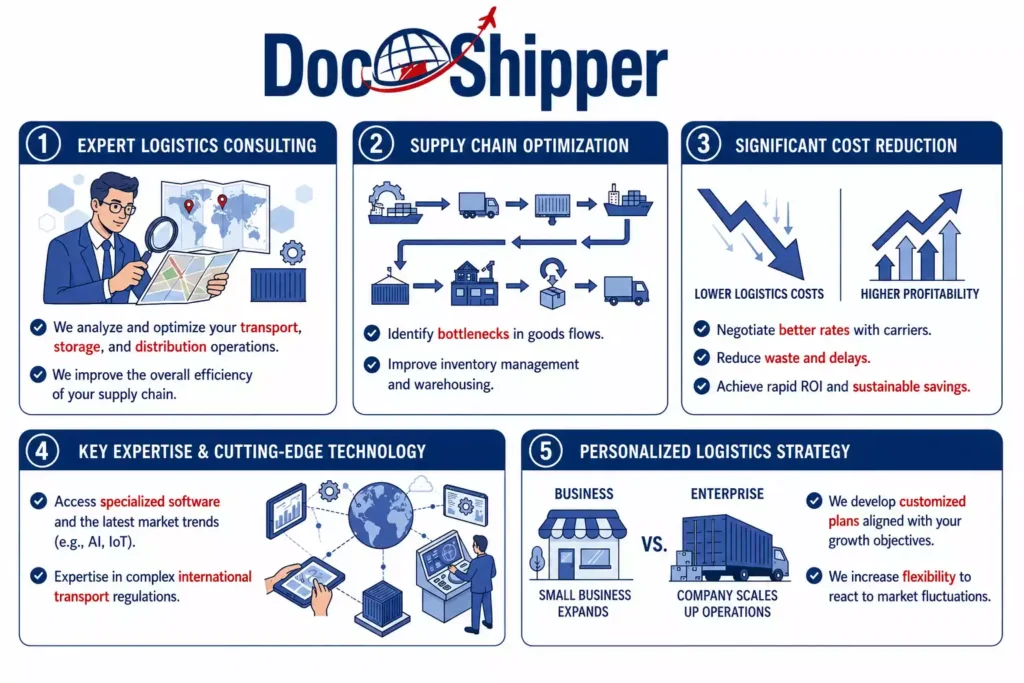
Logistics consultants operate through diagnostic assessment, where they map current-state processes against industry benchmarks and regulatory standards. This phase typically involves data collection, stakeholder interviews, and workflow observation.
The strategic recommendation phase translates findings into actionable roadmaps. Consultants prioritize interventions based on ROI potential, implementation complexity, and risk exposure. These recommendations often address customs classification errors, inefficient routing, or inadequate documentation systems.
Implementation support distinguishes effective consultants from purely advisory roles. This includes training internal teams, configuring software systems, and establishing performance metrics. At DocShipper, our consultants remain engaged through the execution phase to ensure recommendations deliver measurable results.
Regulatory compliance represents a core consultant function. With customs regulations varying across 195+ jurisdictions, specialists maintain current knowledge of tariff classifications, origin rules, and prohibited goods lists. The World Customs Organization provides foundational frameworks that consultants adapt to specific trade lanes.
Technology integration has transformed consultant deliverables. Modern practitioners implement TMS platforms, automate customs declarations, and deploy real-time tracking systems. This technical capability separates strategic consultants from traditional advisors who focus solely on process documentation.
Concrete Examples & Data
A European electronics importer engaged a logistics consultant after experiencing 22% customs rejection rates on Asian shipments. The consultant identified incorrect HS code applications and implemented a classification verification protocol, reducing rejections to 3% within four months and saving €180,000 annually in demurrage fees.
| Consultant Type | Primary Focus | Typical Engagement Duration | Average Cost Reduction |
|---|---|---|---|
| Customs Compliance | Tariff optimization, duty drawback | 3-6 months | 12-18% |
| Supply Chain Strategy | Network design, carrier selection | 6-12 months | 20-35% |
| Technology Implementation | WMS/TMS deployment, automation | 4-9 months | 15-25% |
| Risk Management | Compliance audits, contingency planning | 2-4 months | 8-14% |
Use Case: A pharmaceutical company expanding into Southeast Asian markets hired a regulatory consultant to navigate import licensing requirements. The consultant mapped 47 separate documentation requirements across six countries, established relationships with local customs brokers, and reduced market entry timelines from 18 months to 9 months.
Industry data shows that companies utilizing logistics consultants achieve 23% faster problem resolution compared to internal-only approaches. The consultant model proves particularly effective for mid-sized importers lacking dedicated compliance departments.
Cost structures vary significantly. Hourly rates for specialized logistics consultants range from $150-$400, while project-based engagements typically span $25,000-$200,000 depending on scope complexity and geographic coverage.
Conclusion
Consultants transform logistical complexity into competitive advantage by applying specialized expertise that most organizations cannot economically maintain in-house. Their value lies in rapid problem diagnosis and implementation-focused solutions.
Need expert guidance on optimizing your international logistics operations? Contact DocShipper to discuss how our consulting services can address your specific challenges.
📚 Quiz
Test Your Knowledge: Consultant
1. What best defines a logistics consultant's core role?
2. A company assumes that once a logistics consultant submits their report, the engagement is complete. Is this correct?
3. A mid-sized importer is experiencing a 22% customs rejection rate on international shipments. Which consultant type is best suited to address this issue?
🎯 Your Result
📞 Free Quote in 24hFAQ | Consultant: Definition, Role & Concrete Examples in Logistics
Effective logistics consultants typically hold certifications like CSCMP, APICS CSCP, or customs broker licenses, combined with 5+ years of operational experience in international trade or supply chain management.
Consultants provide strategic advisory services without executing shipments, while freight forwarders handle physical cargo movement. Consultants focus on process optimization; forwarders manage operational execution.
Engage consultants when facing recurring compliance issues, planning market expansion, experiencing cost overruns exceeding 10%, or implementing new technology systems requiring specialized integration knowledge.
Well-executed consulting projects typically deliver 3:1 to 8:1 ROI through cost reductions, penalty avoidance, and efficiency gains, with payback periods averaging 6-18 months post-implementation.
Most engagements combine remote analysis with periodic on-site visits. Initial diagnostics often require 2-5 days on-site, followed by remote collaboration with monthly progress reviews at client facilities.
Professional consultants maintain memberships in trade associations, subscribe to regulatory update services, attend customs seminars, and participate in government-industry liaison programs to ensure compliance knowledge remains current.
Many consultants offer scaled services for SMEs, including hourly advisory sessions, focused audits on specific issues, or group workshops that distribute costs across multiple clients facing similar challenges.
Standard deliverables include diagnostic reports with quantified findings, prioritized recommendation roadmaps, implementation playbooks, training materials, and performance dashboards tracking agreed metrics.
Reputable consultants execute non-disclosure agreements before engagement, implement secure data handling protocols, and maintain professional liability insurance covering information security breaches.
Independent consultants offer specialized depth and lower costs but limited bandwidth. Firms provide broader capabilities, scalable resources, and continuity but typically charge 30-50% premiums over independent practitioners.
Engagements range from 2-week focused assessments to 12-month transformation programs. Most compliance or process optimization projects span 3-6 months, balancing thorough analysis with timely implementation.
Ethical consultants provide estimated savings ranges based on diagnostic findings but avoid guarantees due to variables like client implementation discipline, market conditions, and regulatory changes beyond consultant control.
Need Help with
Logistics or Sourcing ?
First, we secure the right products from the right suppliers at the right price by managing the sourcing process from start to finish. Then, we simplify your shipping experience - from pickup to final delivery - ensuring any product, anywhere, is delivered at highly competitive prices.


Fill the Form
Prefer email? Send us your inquiry, and we’ll get back to you as soon as possible.
Contact us




