


In short ⚡
A broker is an intermediary agent who facilitates transactions between buyers and sellers without taking ownership of goods. In international logistics, brokers specialize in customs clearance, freight forwarding, or cargo insurance, earning commissions by connecting parties and managing regulatory compliance throughout the supply chain.
Introduction
Many importers confuse brokers with freight forwarders or direct service providers. This misunderstanding can lead to unexpected costs, compliance failures, or shipment delays.
Brokers play a critical role in international trade by bridging information gaps, navigating complex regulations, and reducing transaction risks. Unlike carriers or warehouses, they don’t handle physical goods—they orchestrate relationships and documentation.
- Non-asset-based model: Brokers operate without owning trucks, vessels, or warehouses.
- Regulatory specialists: Customs brokers hold licenses from government authorities (e.g., U.S. Customs and Border Protection).
- Commission-driven compensation: Earnings depend on transaction value or flat fees per service.
- Risk mitigation: They verify documentation, ensuring compliance with import/export laws.
- Network leverage: Brokers maintain relationships with carriers, insurers, and customs officials globally.
In-Depth Analysis & Expertise
Brokers function as specialized agents across three primary domains: customs brokerage, freight brokerage, and insurance brokerage. Each requires distinct expertise and licensing.
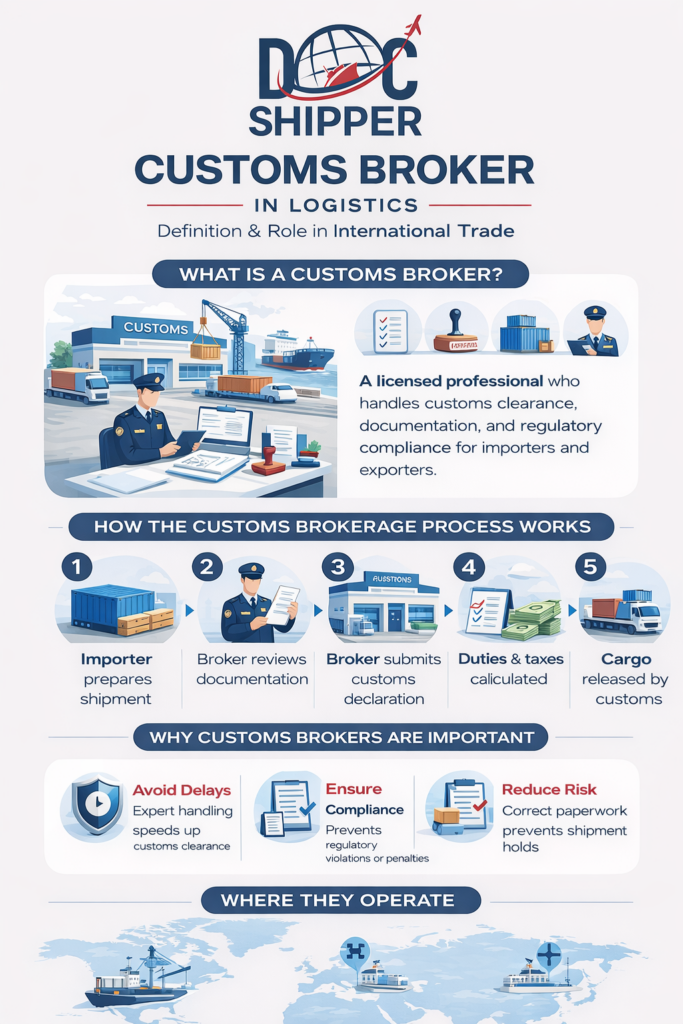
Customs brokers prepare and submit documentation for clearing goods through customs authorities. They classify products under Harmonized System (HS) codes, calculate duties, and ensure compliance with sanitary, phytosanitary, or security regulations. In the European Union, the Union Customs Code (Regulation 952/2013) mandates specific procedures that brokers must follow. The U.S. requires customs brokers to pass a federal exam administered by U.S. Customs and Border Protection.
Freight brokers match shippers with carriers for domestic or international transport. They negotiate rates, track shipments, and manage disputes. Unlike forwarders, they don’t issue bills of lading or assume liability for cargo. Their value lies in market knowledge and carrier vetting.
Insurance brokers arrange marine cargo insurance, covering risks like theft, damage, or general average. They assess coverage needs, compare policies, and assist with claims. The International Chamber of Commerce’s Institute Cargo Clauses (ICC) define standard coverage terms brokers use globally.
At DocShipper, we collaborate with licensed customs brokers in over 50 countries to ensure seamless clearance and compliance for every shipment. Our network eliminates guesswork, reducing clearance times by an average of 30%.
Legal obligations vary by jurisdiction. In Canada, brokers must be licensed by the Canada Border Services Agency. In China, customs declaration enterprises require Ministry of Commerce approval. Non-compliance can result in fines, shipment seizures, or license revocation.
Concrete Examples & Data
Understanding broker functions becomes clearer through real-world scenarios and comparative data.
Use Case: Electronics Import from China to the United States
A U.S. retailer imports 5,000 smartphones valued at $500,000. The customs broker:
- Classifies goods under HS code 8517.12.00 (smartphones).
- Calculates import duty (0% under MFN rates for electronics) and Merchandise Processing Fee (0.3464%, minimum $27.75, maximum $538.40).
- Prepares ISF (Importer Security Filing) 24 hours before vessel departure to avoid $5,000 penalties.
- Submits entry documentation via ACE (Automated Commercial Environment) system.
- Charges a flat fee of $150 per entry plus $75 for ISF filing.
Result: Clearance completed in 48 hours. Without a broker, the importer risks classification errors, leading to duty reassessments or FDA holds for electronic devices.
Comparative Table: Broker vs. Freight Forwarder vs. Carrier
| Criteria | Broker | Freight Forwarder | Carrier |
|---|---|---|---|
| Owns Assets | No | Rarely (may own warehouses) | Yes (trucks, ships, planes) |
| Issues BOL | No | Yes (House BOL) | Yes (Master BOL) |
| Customs Clearance | Primary function | Often subcontracts to brokers | Not involved |
| Licensing Required | Yes (government-issued) | No (but may need NVOCC license) | Yes (operating authority) |
| Revenue Model | Commission/flat fee per transaction | Markup on freight + service fees | Freight charges per shipment |
DocShipper Platform
Cut logistics costs. Not corners.
See exactly where your logistics costs are bleeding — and how to fix it. Book your expert demo.
Key Data Points
- Average customs broker fee (U.S.): $50–$200 per entry, depending on complexity.
- Freight broker margin: 15–20% markup on carrier rates.
- Customs clearance time: 24–72 hours with broker assistance; 5–10 days without.
- Penalty avoidance: ISF violations cost $5,000–$10,000; misclassification penalties range from 10% to 40% of shipment value.
- Global customs broker market size: $6.8 billion (2023), projected 5.2% CAGR through 2030.
Conclusion
Brokers serve as indispensable navigators in the complex terrain of international trade, ensuring compliance, optimizing costs, and accelerating clearance. Their specialized knowledge transforms regulatory obstacles into manageable processes.
Need expert brokerage support for your shipments? Contact DocShipper for seamless customs clearance and freight coordination worldwide.
📚 Quiz
Test Your Knowledge: Broker
Question 1 — Which of the following best defines a broker in international logistics?
Question 2 — A common misconception is that a customs broker and a freight forwarder are the same. What is the key distinction?
Question 3 — A U.S. retailer imports 5,000 smartphones from China. The customs broker must file an ISF (Importer Security Filing). When must this be submitted to avoid a $5,000 penalty?
🎯 Your Result
📞 Free Quote in 24hFAQ | Broker: Definition, Role & Concrete Examples in International Trade
A customs broker specializes in clearing goods through customs, preparing documentation, and ensuring regulatory compliance. A freight forwarder arranges transportation and may handle warehousing, often subcontracting customs clearance to brokers.
Not always. De minimis shipments (under $800 in the U.S.) may clear informally. However, commercial imports, regulated goods (food, pharmaceuticals), or high-value shipments require licensed broker assistance to avoid penalties.
Fees vary by country and complexity. In the U.S., expect $50–$200 per entry. Europe ranges from €75–€150. Additional charges apply for ISF filing, product classification research, or urgent clearance.
Yes, in some countries. The U.S. allows self-filing via ACE, but requires deep knowledge of HTS codes, duty calculations, and compliance rules. Mistakes can result in fines, delays, or cargo seizures.
Typically: commercial invoice, packing list, bill of lading, certificate of origin, and any permits (FDA, USDA, EPA). For regulated goods, additional certifications or lab reports may be required.
Standard clearance takes 24–72 hours. Expedited services can clear goods in 4–12 hours. Delays occur if documentation is incomplete, goods require inspection, or duties are unpaid.
Licensed brokers carry Errors & Omissions (E&O) insurance. If their error causes financial loss (duty penalties, storage fees), you can file a claim. However, liability is often limited to their service fee.
Yes, but their focus is on transportation logistics. For cross-border moves, they coordinate with customs brokers or freight forwarders who manage documentation and compliance.
A POA authorizes the broker to act on your behalf with customs authorities. It's required for filing entries, paying duties, and signing declarations. Most brokers use a standard CBP Form 5291 in the U.S.
Not directly. Brokers are licensed per country. However, global brokerage networks (like DocShipper's) coordinate licensed agents in each destination, providing unified service across borders.
Licensed brokers meet government requirements (exams, bonds, audits) and can legally file customs entries. Unlicensed intermediaries cannot represent you to customs and risk penalties for unauthorized practice.
Evaluate licensing status, industry experience, technology capabilities (EDI, API integrations), response times, and fee transparency. Request references from clients in your product category and trade lanes.
Need Help with
Logistics or Sourcing ?
First, we secure the right products from the right suppliers at the right price by managing the sourcing process from start to finish. Then, we simplify your shipping experience - from pickup to final delivery - ensuring any product, anywhere, is delivered at highly competitive prices.


Fill the Form
Prefer email? Send us your inquiry, and we’ll get back to you as soon as possible.
Contact us




