


In short ⚡
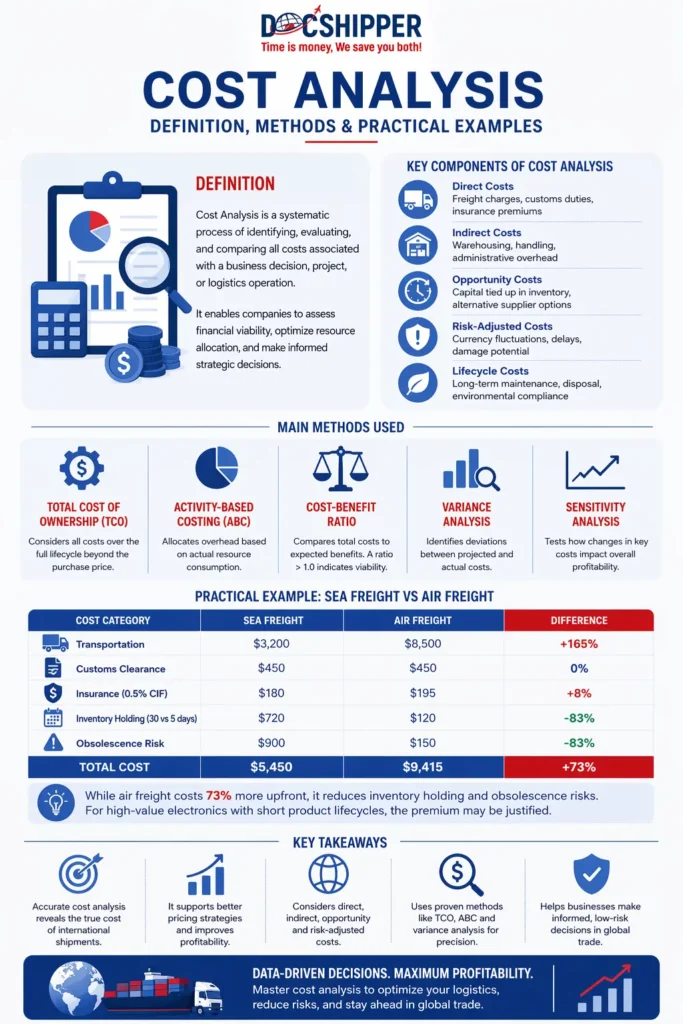
Cost Analysis is a systematic process of identifying, evaluating, and comparing all costs associated with a business decision, project, or logistics operation. It enables companies to assess financial viability, optimize resource allocation, and make informed strategic decisions in international trade and supply chain management.
Introduction
Many importers and exporters struggle to accurately predict the true cost of their international shipments. Hidden fees, fluctuating exchange rates, and complex regulatory requirements create financial uncertainty.
In global logistics, cost analysis serves as the foundation for competitive pricing strategies and profitability assessment. It transforms raw financial data into actionable insights that drive supply chain efficiency.
Key components of comprehensive cost analysis include:
- Direct costs: Freight charges, customs duties, insurance premiums
- Indirect costs: Warehousing, handling, administrative overhead
- Opportunity costs: Capital tied up in inventory, alternative supplier options
- Risk-adjusted costs: Currency fluctuations, delays, damage potential
- Lifecycle costs: Long-term maintenance, disposal, environmental compliance
Understanding Cost Analysis in International Logistics
Effective cost analysis requires understanding the distinction between fixed costs (unchanging regardless of volume) and variable costs (proportional to shipment size). This classification enables accurate break-even calculations and pricing strategies.
The Total Cost of Ownership (TCO) methodology extends beyond purchase price to encompass acquisition, operation, maintenance, and disposal costs. In international trade, TCO reveals the true financial impact of supplier selection across different countries.
Activity-Based Costing (ABC) allocates overhead expenses based on actual resource consumption rather than arbitrary percentages. This precision identifies cost drivers in complex supply chains where traditional accounting methods fail.
Regulatory frameworks significantly influence cost structures. According to WTO Trade Facilitation Agreement, transparent cost disclosure requirements help importers anticipate total landed costs and avoid unexpected charges.
The cost-benefit ratio quantifies whether a logistics decision generates positive returns. A ratio above 1.0 indicates financial viability, while values below signal potential losses requiring strategic reassessment.
At DocShipper, we conduct detailed cost analysis for every shipment proposal, ensuring clients understand the complete financial picture before committing to international transactions. This transparency eliminates surprises and builds long-term trust.
Practical Applications & Data-Driven Examples
Consider a European electronics retailer importing components from Asia. A proper cost analysis reveals hidden expenses that transform an apparently profitable deal into a marginal operation.
| Cost Category | Sea Freight | Air Freight | Difference |
|---|---|---|---|
| Transportation | $3,200 | $8,500 | +165% |
| Customs Clearance | $450 | $450 | 0% |
| Insurance (0.5% CIF) | $180 | $195 | +8% |
| Inventory Holding (30 vs 5 days) | $720 | $120 | -83% |
| Obsolescence Risk | $900 | $150 | -83% |
| TOTAL COST | $5,450 | $9,415 | +73% |
This comparison demonstrates that while air freight costs 73% more upfront, it reduces inventory holding and obsolescence risks. For high-value electronics with short product lifecycles, the premium may be justified.
Variance analysis identifies deviations between projected and actual costs. A 15% variance threshold typically triggers investigation. Common causes include currency fluctuations, unexpected demurrage charges, or documentation errors.
The cost per unit metric enables accurate pricing decisions. For a container holding 10,000 units with total logistics costs of $8,000, the per-unit cost is $0.80. This figure must be factored into retail pricing to maintain margins.
Sensitivity analysis tests how cost changes impact profitability. If fuel surcharges increase by 20%, how does this affect the bottom line? This scenario planning prepares businesses for market volatility.
Benchmarking against industry standards reveals competitive positioning. According to logistics industry data, international shipping costs typically represent 8-12% of product value for manufactured goods. Deviations signal potential inefficiencies.
Conclusion
Cost analysis transforms complex financial data into strategic clarity, enabling businesses to optimize international logistics decisions and maintain competitive advantage. Mastering this discipline separates profitable operations from financially vulnerable ones.
Need expert guidance on analyzing your international shipping costs? Contact DocShipper for a comprehensive cost breakdown tailored to your specific trade requirements.
📚 Quiz
Test Your Knowledge: Cost Analysis
Q1. What is the primary purpose of cost analysis in international logistics?
Q2. A company notices that air freight costs $9,415 vs. sea freight at $5,450 for the same shipment. After a full cost analysis including inventory holding and obsolescence risk, which statement is correct?
Q3. An importer receives a supplier quote and only factors in the product price and freight charge. Which cost analysis concept are they failing to apply?
🎯 Your Result
📞 Free Quote in 24hFAQ | Cost Analysis: Definition, Methods & Practical Examples
Cost estimation predicts future expenses before they occur, while cost analysis examines actual incurred costs to evaluate performance, identify inefficiencies, and improve future planning accuracy.
Total landed cost includes product price, international freight, insurance, customs duties, taxes, port handling fees, inland transportation, and any regulatory compliance costs. Sum all components for the complete figure.
Industry benchmarks suggest 8-12% for manufactured goods, 15-20% for perishables requiring refrigeration, and 5-8% for bulk commodities. Deviations indicate potential optimization opportunities.
Quarterly reviews suit most operations, with monthly analysis for high-volume shippers. Major contract renewals, route changes, or significant market shifts warrant immediate reassessment.
Activity-based costing allocates overhead expenses based on actual resource consumption rather than volume percentages. It reveals true cost drivers like order processing complexity or special handling requirements.
Yes. Analyzing emissions costs per transport mode, route optimization potential, and packaging efficiency reveals opportunities to reduce both environmental impact and operational expenses simultaneously.
Enterprise Resource Planning (ERP) systems, Transportation Management Software (TMS), and specialized freight audit platforms provide data integration, automated calculations, and variance tracking capabilities.
Exchange rate volatility can alter costs by 5-15% between quotation and payment. Hedging strategies, multi-currency accounts, and real-time rate monitoring mitigate this financial risk.
The break-even point occurs when total revenue equals total costs. Calculate by dividing fixed costs by the difference between unit selling price and variable cost per unit.
Absolutely. Presenting comprehensive cost analysis including duties, compliance, and logistics expenses during negotiations ensures suppliers understand true competitiveness and may adjust pricing accordingly.
FCL offers predictable per-container pricing, while LCL charges vary by cubic meter or weight. LCL includes consolidation/deconsolidation fees absent in FCL, affecting small-volume cost efficiency.
Beyond unit price comparison, cost analysis evaluates total acquisition expenses including quality defect rates, delivery reliability, payment terms, and long-term partnership value for informed sourcing decisions.
Need Help with
Logistics or Sourcing ?
First, we secure the right products from the right suppliers at the right price by managing the sourcing process from start to finish. Then, we simplify your shipping experience - from pickup to final delivery - ensuring any product, anywhere, is delivered at highly competitive prices.


Fill the Form
Prefer email? Send us your inquiry, and we’ll get back to you as soon as possible.
Contact us




