


In short ⚡
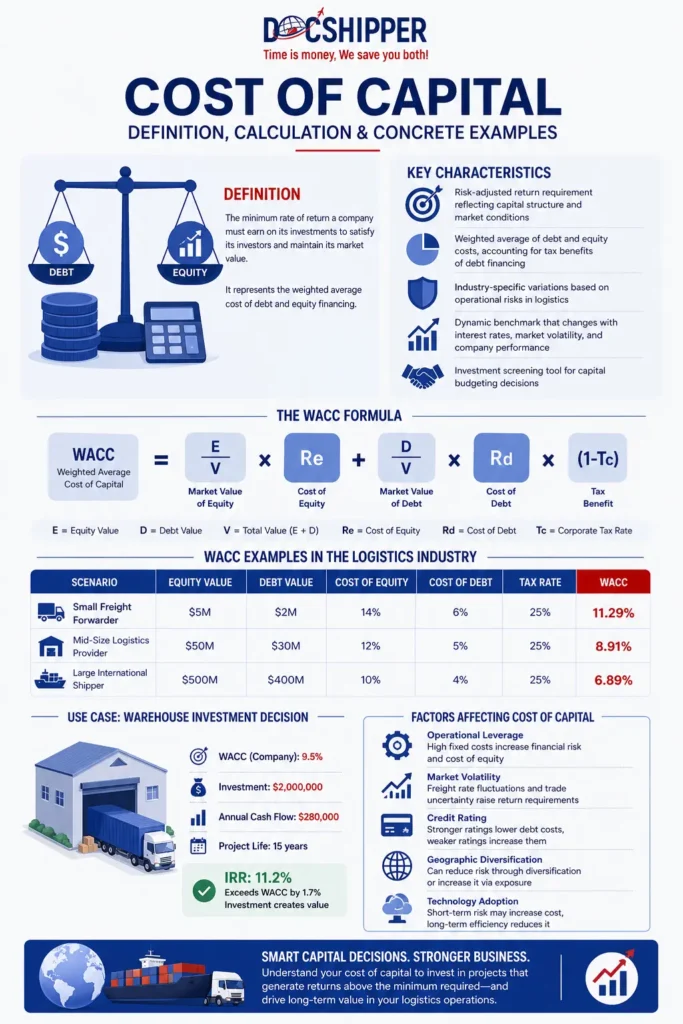
Cost of Capital is the minimum rate of return a company must earn on its investments to satisfy its investors and maintain its market value. It represents the weighted average cost of debt and equity financing, serving as a critical benchmark for evaluating investment decisions in international logistics and supply chain operations.
Introduction
Many businesses struggle to determine whether investing in new warehousing infrastructure, fleet expansion, or international shipping routes will generate sufficient returns. Without understanding the cost of capital, companies risk making unprofitable investments that drain resources and erode shareholder value.
In import/export operations, this metric becomes particularly crucial when evaluating capital-intensive decisions like purchasing container vessels, establishing distribution centers, or implementing automated logistics systems. The cost of capital serves as the financial hurdle rate that separates value-creating investments from value-destroying ones.
Key characteristics of cost of capital in logistics include:
- Risk-adjusted return requirement reflecting the company’s capital structure and market conditions
- Weighted average of debt and equity costs, accounting for tax benefits of debt financing
- Industry-specific variations based on operational risks in freight forwarding, customs brokerage, and warehousing
- Dynamic benchmark that changes with interest rates, market volatility, and company performance
- Investment screening tool for capital budgeting decisions across supply chain infrastructure
Understanding Cost of Capital in Logistics
The Weighted Average Cost of Capital (WACC) formula combines the cost of equity and cost of debt proportionally based on their market values. For logistics companies, this calculation must account for the capital-intensive nature of operations, including vehicle fleets, warehouse facilities, and technology infrastructure.
The cost of equity represents the return investors expect for bearing the risk of ownership. In freight forwarding and customs brokerage, this typically ranges from 10% to 15%, depending on market volatility and company-specific risk factors. This component is calculated using models like the Capital Asset Pricing Model (CAPM), which considers the risk-free rate, market risk premium, and company beta.
The cost of debt reflects the effective interest rate a company pays on borrowed funds. For established logistics operators, this might range from 3% to 7%, depending on creditworthiness and prevailing market rates. The tax deductibility of interest payments reduces the effective cost, making debt financing attractive for asset-heavy investments like container purchases or warehouse construction.
Capital structure optimization involves balancing debt and equity to minimize overall cost of capital while maintaining financial flexibility. Logistics companies often maintain debt-to-equity ratios between 0.5 and 1.5, allowing them to leverage tax benefits without excessive financial risk. At DocShipper, we help clients evaluate financing options for international expansion, ensuring capital structure decisions align with operational requirements and risk tolerance.
The marginal cost of capital increases as companies raise additional funds, reflecting higher risk premiums and diminishing access to low-cost financing sources. This concept is particularly relevant when logistics firms consider major expansions, such as opening new regional hubs or acquiring competitors. Understanding this progression helps managers prioritize investments and avoid overextending financial resources.
According to the International Chamber of Commerce, proper cost of capital assessment is fundamental to sustainable international trade finance and investment decision-making.
Calculation Methods & Real-World Applications
The standard WACC formula is: WACC = (E/V × Re) + (D/V × Rd × (1-Tc)), where E represents equity market value, D represents debt market value, V equals total value (E+D), Re is cost of equity, Rd is cost of debt, and Tc is the corporate tax rate.
| Scenario | Equity Value | Debt Value | Cost of Equity | Cost of Debt | Tax Rate | WACC |
|---|---|---|---|---|---|---|
| Small Freight Forwarder | $5M | $2M | 14% | 6% | 25% | 11.29% |
| Mid-Size Logistics Provider | $50M | $30M | 12% | 5% | 25% | 8.91% |
| Large International Shipper | $500M | $400M | 10% | 4% | 25% | 6.89% |
Use Case: Warehouse Investment Decision
A customs brokerage firm with a WACC of 9.5% is considering investing $2 million in an automated warehouse facility. The project is expected to generate annual cash flows of $280,000 for 15 years. The internal rate of return (IRR) calculates to 11.2%, exceeding the cost of capital by 1.7 percentage points. This positive spread indicates the investment will create shareholder value and should proceed.
At DocShipper, we regularly assist clients in evaluating such capital allocation decisions, ensuring that investments in logistics infrastructure meet or exceed their cost of capital thresholds while aligning with strategic growth objectives.
Key factors influencing cost of capital in logistics:
- Operational leverage – Higher fixed costs from warehouses and fleets increase financial risk and cost of equity
- Market volatility – Freight rate fluctuations and trade policy uncertainty raise investor return requirements
- Credit rating – Strong ratings reduce debt costs, while weaker ratings increase borrowing expenses significantly
- Geographic diversification – International operations can either reduce risk through diversification or increase it through currency and political exposure
- Technology adoption – Investments in digital logistics platforms may temporarily increase cost of capital due to implementation risks but reduce it long-term through efficiency gains
Conclusion
Understanding and accurately calculating cost of capital is essential for making sound investment decisions in international logistics, from fleet acquisitions to warehouse expansions. This financial benchmark ensures that capital is allocated to projects generating returns above the minimum threshold required by investors and lenders.
Need guidance on evaluating logistics investments or optimizing your capital structure? Contact DocShipper for expert assistance in financial planning and international supply chain strategy.
📚 Quiz
Test Your Knowledge: Cost of Capital
Q1 — What does the Cost of Capital represent for a logistics company?
Q2 — A logistics firm's WACC is 9.5% and a warehouse investment project has an IRR of 8.0%. What should the company do?
Q3 — Why do large international shippers typically have a lower WACC than small freight forwarders?
🎯 Your Result
📞 Free Quote in 24hFAQ | Cost of Capital: Definition, Calculation & Concrete Examples
Cost of capital represents the company's perspective on financing costs, while required rate of return reflects the investor's expected return for a given risk level. In practice, these converge as the company must meet investor expectations to attract capital.
Lower cost of capital increases company valuation by reducing the discount rate applied to future cash flows. Logistics firms with strong credit ratings and stable operations typically command higher valuations due to their lower capital costs.
Variations stem from differences in operational risk, capital structure, geographic exposure, service mix, and company size. Asset-heavy operators generally face higher costs than asset-light digital freight platforms.
No, cost of capital cannot be negative as it represents the minimum acceptable return. Even in low-interest environments, equity investors require positive returns to compensate for business risk.
Companies should review cost of capital quarterly or whenever significant changes occur in interest rates, capital structure, market conditions, or business risk profile to ensure accurate investment decision-making.
Beta measures a company's stock volatility relative to the overall market. Logistics companies with betas above 1.0 are more volatile than the market, resulting in higher cost of equity as investors demand greater compensation for increased risk.
Currency volatility increases perceived risk for international operations, potentially raising cost of equity. Companies can mitigate this through hedging strategies, which may slightly increase cost of debt but stabilize overall capital costs.
No, different segments have varying risk profiles. Express delivery services typically have higher costs of capital than contract warehousing due to operational complexity and competitive intensity.
Strong ESG performance can lower cost of capital by attracting socially responsible investors and reducing regulatory risks. Green financing options often offer favorable terms for sustainable logistics infrastructure investments.
Economic Value Added (EVA) measures profit after deducting cost of capital charges. Logistics companies create value when their return on invested capital exceeds their cost of capital, indicating efficient capital deployment.
No, startups typically face higher costs of capital due to greater uncertainty, limited track records, and higher failure rates. As they mature and demonstrate stable cash flows, their cost of capital typically decreases toward industry norms.
Trade policy uncertainty increases business risk, potentially raising cost of equity as investors demand higher returns for geopolitical exposure. Companies with diversified trade routes typically experience smaller cost of capital increases during trade disputes.
Need Help with
Logistics or Sourcing ?
First, we secure the right products from the right suppliers at the right price by managing the sourcing process from start to finish. Then, we simplify your shipping experience - from pickup to final delivery - ensuring any product, anywhere, is delivered at highly competitive prices.


Fill the Form
Prefer email? Send us your inquiry, and we’ll get back to you as soon as possible.
Contact us




