



In short ⚡
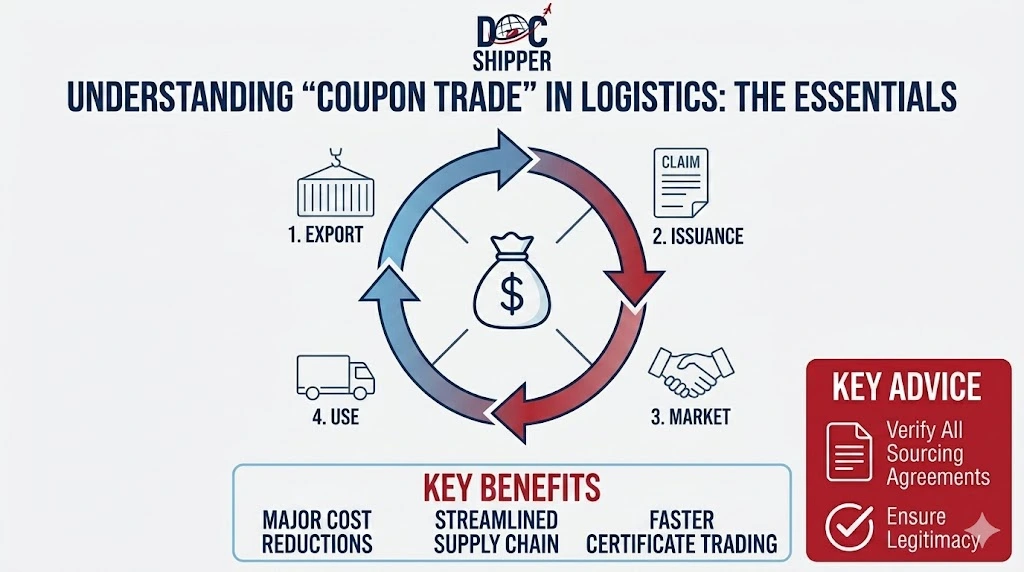
A coupon is a discount document or promotional certificate issued by manufacturers, retailers, or service providers that entitles the holder to a price reduction on specific goods or services. In international logistics, coupons facilitate commercial transactions by reducing landed costs, incentivizing bulk purchases, and supporting marketing strategies across cross-border supply chains.Introduction
Many importers overlook coupons as strategic tools for cost optimization. Yet these instruments directly impact landed costs, customs valuation, and profit margins in international trade.
In global logistics, coupons serve multiple functions beyond simple discounts. They influence purchasing decisions, facilitate market entry strategies, and affect customs declarations when applied to imported goods.
- Cost reduction: Direct decrease in unit price affecting total shipment value
- Customs implications: May require declaration adjustments depending on timing and application
- Supply chain incentive: Encourages volume purchases and supplier loyalty programs
- Marketing integration: Supports promotional campaigns across international markets
- Cash flow management: Improves working capital through immediate or deferred savings
In-Depth Analysis & Expertise
Coupons in international logistics operate through distinct mechanisms depending on their issuance point and redemption conditions. Understanding these nuances prevents customs complications and maximizes financial benefits.
Pre-shipment coupons apply before goods leave the origin country. These reduce the invoice value and consequently affect customs duties calculated on CIF (Cost, Insurance, Freight) valuation. According to WCO valuation principles, discounts applied before shipment must be reflected in customs declarations.
Post-importation rebates create different scenarios. When coupons are redeemed after customs clearance, the original duty assessment remains unchanged unless the importer files for duty drawback—a complex administrative procedure requiring documentation of the discount and proof of overpayment.
Manufacturer versus retailer coupons carry distinct implications. Manufacturer coupons typically reduce the transaction value at source, while retailer coupons may not affect customs valuation if applied downstream in the distribution chain. At DocShipper, we systematically review coupon documentation during pre-clearance audits to ensure accurate duty calculations and compliance with customs regulations.
Digital coupon platforms introduce traceability challenges. E-coupons require proper documentation trails for customs authorities, particularly when applied to B2B transactions. Electronic proof of discount must align with commercial invoices to avoid valuation disputes.
Currency conversion considerations emerge when coupons denominated in one currency apply to transactions in another. The exchange rate timing—whether at coupon issuance or redemption—can create discrepancies in customs valuation requiring reconciliation documentation.
Practical Examples & Data
Real-world applications demonstrate how coupons impact international logistics costs and customs procedures across different scenarios.
| Scenario | Original Value | Coupon Discount | Customs Impact |
|---|---|---|---|
| Pre-shipment manufacturer coupon | $50,000 | 15% ($7,500) | Duties calculated on $42,500 |
| Post-clearance retailer coupon | $50,000 | 10% ($5,000) | Duties remain on $50,000 |
| Volume purchase coupon (FOB) | $100,000 | 20% ($20,000) | Reduces CIF basis by $20,000 |
| Promotional e-coupon | $25,000 | $2,500 fixed | Requires electronic proof documentation |
Use Case: Electronics Importer
A European electronics distributor imports smartphones from China valued at $200,000 FOB. The manufacturer offers a 12% volume purchase coupon ($24,000 discount) applied before shipment. The revised commercial invoice shows $176,000 FOB.
With shipping costs of $8,000 and insurance at $2,000, the CIF value becomes $186,000. At a 5% duty rate, customs duties total $9,300 instead of $10,500 without the coupon—a $1,200 savings on duties alone, plus the original $24,000 product discount.
Key data points for coupon optimization:
- Pre-shipment discounts reduce duty liability by 5-15% on average
- Post-clearance coupons offer no immediate customs benefit but improve retail margins
- Volume coupons (10,000+ units) typically range from 15-25% discount
- Digital coupon redemption adds 2-3 days to documentation processing time
- Currency fluctuations can create 2-4% variance in final discount value
Conclusion
Coupons represent strategic financial instruments in international logistics, directly impacting customs valuation, duty calculations, and overall landed costs. Proper documentation and timing of coupon application determine both compliance and cost optimization outcomes.
Need expert guidance on optimizing coupon strategies for your imports? Contact DocShipper for personalized customs and logistics consulting.
📚 Quiz
Test Your Knowledge: Coupon
Q1 — What is a coupon in the context of international logistics?
Q2 — A retailer applies a 10% coupon to a $50,000 shipment after customs clearance. What is the impact on import duties?
Q3 — A European importer receives a 12% manufacturer coupon on a $200,000 FOB shipment from China, applied before shipment. Which statement correctly describes the customs outcome?
🎯 Your Result
📞 Free Quote in 24hFAQ | Coupon: Definition, Calculation & Practical Examples
Yes, when applied before shipment. Pre-shipment manufacturer coupons reduce the transaction value, lowering the customs valuation basis and resulting duty liability.
Duty drawback procedures may allow refunds, but require extensive documentation proving the discount and original overpayment. Processing typically takes 6-12 months.
Electronic coupons require printable proof showing discount amount, terms, and application date. This documentation must match commercial invoice adjustments for customs acceptance.
Trade discounts are negotiated price reductions for business customers, while coupons are promotional instruments. Both reduce transaction value but have different documentation requirements.
No, retailer coupons applied after customs clearance don't affect duty calculations. Duties are assessed on the import transaction value, not subsequent retail discounts.
Yes, if the coupon terms allow. Each shipment requires proportional documentation showing the discount allocation and remaining coupon balance.
Exchange rate timing matters. Coupons denominated in foreign currency must be converted at the rate prevailing when the discount is applied, not when originally issued.
No, expired coupons cannot reduce declared value. Customs authorities require valid, current documentation at the time of importation.
Incomplete coupon documentation may result in customs rejecting the discount, requiring duty payment on the full undiscounted value, plus potential penalties for misrepresentation.
Yes, multiple discounts can apply simultaneously if properly documented. Each discount must be separately identified on commercial invoices with clear calculation methodology.
Free shipping coupons don't reduce product value but eliminate freight charges from CIF calculation, potentially lowering the overall customs valuation basis.
Maintain coupon records for minimum 5 years. Customs authorities can audit past declarations, requiring proof of all valuation adjustments including coupon discounts.
Need Help with
Logistics or Sourcing ?
First, we secure the right products from the right suppliers at the right price by managing the sourcing process from start to finish. Then, we simplify your shipping experience - from pickup to final delivery - ensuring any product, anywhere, is delivered at highly competitive prices.


Fill the Form
Prefer email? Send us your inquiry, and we’ll get back to you as soon as possible.
Contact us




