


In short ⚡
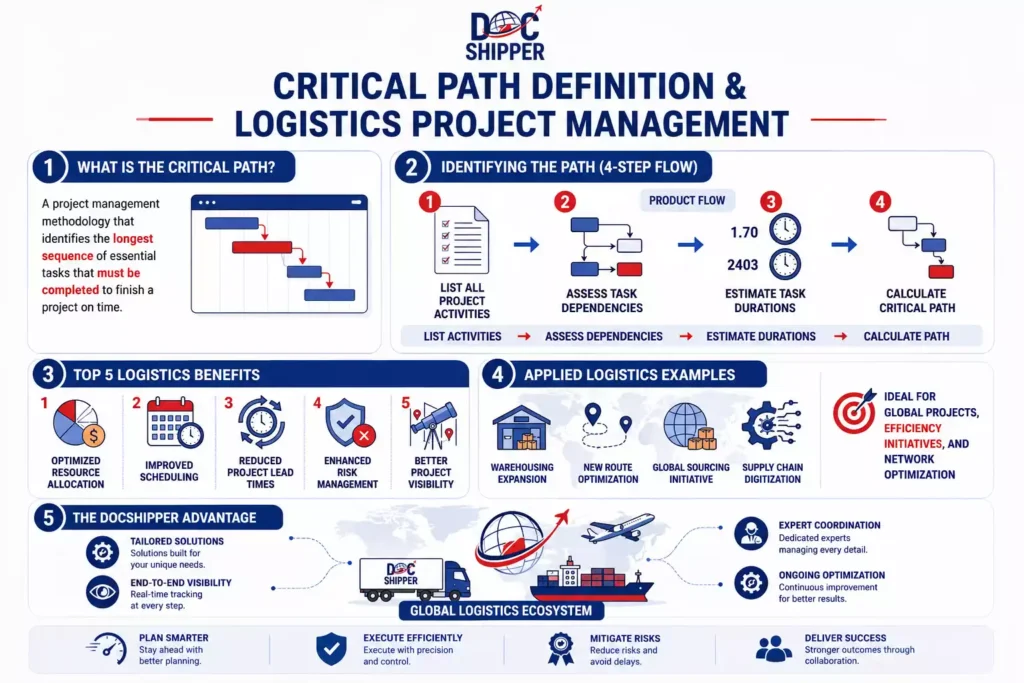
The Critical Path is the longest sequence of dependent tasks in a project that determines the minimum completion time. Any delay in critical path activities directly impacts the overall project deadline, making it essential for logistics planning and supply chain management.
Introduction
Many importers underestimate shipping timelines, only to face costly delays when one component arrives late. The critical path method addresses this challenge by identifying which tasks cannot be delayed without affecting the entire project.
In international logistics, understanding the critical path is crucial for coordinating multiple stakeholders—suppliers, freight forwarders, customs brokers, and final delivery services. One bottleneck can cascade through the entire supply chain.
Key characteristics of critical path management include:
- Task dependency mapping: Identifying which activities must precede others
- Zero float tolerance: Critical tasks have no scheduling flexibility
- Timeline optimization: Focusing resources on activities that control project duration
- Risk identification: Highlighting vulnerable points in the logistics chain
- Resource allocation: Prioritizing efforts where delays are most impactful
In-Depth Analysis & Expert Insights
The Critical Path Method (CPM) was developed in the late 1950s by DuPont and Remington Rand to manage complex industrial projects. Today, it remains the backbone of project management across industries, particularly in logistics where coordination across borders is essential.
To calculate the critical path, project managers identify all tasks, their durations, and dependencies. The path with the longest total duration becomes the critical path. Tasks not on this path have float or slack—buffer time that allows flexibility without impacting the final deadline.
In international shipping, typical critical path activities include:
- Production completion: Factory must finish goods before shipping begins
- Export documentation: Commercial invoices, certificates of origin, and packing lists
- Main carriage transit: Ocean or air freight duration
- Customs clearance: Import declaration processing and duty payment
- Final delivery: Last-mile transportation to destination warehouse
According to the World Trade Organization’s Trade Facilitation Agreement, reducing customs processing time—a common critical path bottleneck—can decrease trade costs by up to 14.3% for developing countries.
At DocShipper, we systematically map the critical path for each shipment, identifying potential delays before they occur. Our project management approach ensures customs documentation is prepared in parallel with production, reducing overall transit time by 15-20% on average.
The forward pass and backward pass techniques calculate earliest and latest start times for each task. The difference reveals which activities have scheduling flexibility and which are truly critical. This mathematical approach transforms logistics from reactive firefighting to proactive management.
Concrete Examples & Data
Consider a furniture importer shipping from Vietnam to Germany. The project involves multiple interdependent tasks with varying durations:
| Task | Duration (Days) | Dependencies | Critical? |
|---|---|---|---|
| Production | 30 | None | ✓ |
| Quality Inspection | 3 | Production | ✓ |
| Export Documentation | 5 | Quality Inspection | ✓ |
| Container Loading | 2 | Export Documentation | ✓ |
| Ocean Freight | 35 | Container Loading | ✓ |
| Customs Clearance | 4 | Ocean Freight | ✓ |
| Final Delivery | 3 | Customs Clearance | ✓ |
| Insurance Arrangement | 2 | Production | — |
Critical Path: Production → Quality Inspection → Export Documentation → Container Loading → Ocean Freight → Customs Clearance → Final Delivery
Total Duration: 82 days
The insurance arrangement, while necessary, can be completed anytime after production starts and before shipping. It has 33 days of float and is not on the critical path.
A 2023 study by the European Shippers’ Council found that companies using critical path analysis reduced average shipment delays by 28%. The method is particularly effective for multi-modal transport where coordination between sea, rail, and road segments is essential.
Real-world application: An electronics importer reduced their China-to-USA delivery time from 65 to 52 days by identifying that customs pre-clearance could begin while cargo was still in transit. This parallel processing removed 13 days from the critical path without additional cost.
Key insights for logistics optimization:
- Parallel processing: Non-dependent tasks can run simultaneously to compress timelines
- Buffer management: Add contingency only to critical path activities
- Vendor coordination: Share critical path schedules with suppliers to align expectations
- Technology integration: Real-time tracking systems monitor critical milestones automatically
- Continuous improvement: Analyze completed projects to identify recurring bottlenecks
Conclusion
The critical path method transforms complex logistics operations into manageable, predictable processes. By identifying which tasks truly control your timeline, you can allocate resources strategically and avoid costly delays.
Need expert guidance on optimizing your supply chain timeline? Contact DocShipper for a comprehensive critical path analysis of your next shipment.
Conclusion
The critical path method transforms complex logistics operations into manageable, predictable processes. By identifying which tasks truly control your timeline, you can allocate resources strategically and avoid costly delays.
Need expert guidance on optimizing your supply chain timeline? Contact DocShipper for a comprehensive critical path analysis of your next shipment.
📚 Quiz
Test Your Knowledge: Critical Path
Q1 — What does the Critical Path in a logistics project represent?
Q2 — In the Vietnam-to-Germany furniture shipment example, why is "Insurance Arrangement" NOT on the critical path?
Q3 — An electronics importer reduced their China-to-USA delivery from 65 to 52 days. Which critical path technique made this possible?
🎯 Your Result
📞 Free Quote in 24hFAQ | Critical Path: Definition, Calculation & Real-World Examples
Critical path focuses on task dependencies and durations, while critical chain also considers resource constraints. Critical chain adds buffers at strategic points rather than padding individual task estimates, often resulting in shorter overall project timelines.
Yes, when two or more task sequences have identical durations and no float. This increases project risk since delays on any path will impact the deadline. Effective management requires monitoring all critical paths simultaneously.
Review weekly for standard shipments, daily for time-sensitive cargo. Major events like port delays or customs holds require immediate recalculation to assess impact and identify mitigation options.
Float represents the time a task can be delayed without affecting the project deadline. Tasks on the critical path have zero float, while non-critical activities have positive float providing scheduling flexibility.
Not necessarily. While transit time is shorter, air freight often requires more stringent documentation and security screening. For consolidated shipments, deconsolidation delays can extend the critical path beyond expectations.
Customs is typically on the critical path since cargo cannot be released until clearance completes. Pre-clearance programs and AEO (Authorized Economic Operator) status can reduce this bottleneck significantly.
Yes, modern TMS (Transportation Management Systems) and project management tools like Microsoft Project or Primavera automatically identify critical paths when task dependencies and durations are entered.
It becomes critical. The project now has a new critical path, and further delays will impact the final deadline. This requires immediate attention and possible resource reallocation.
Options include fast-tracking (parallel processing of sequential tasks), crashing (adding resources to shorten durations), choosing faster transport modes, or improving process efficiency at bottleneck points.
No, even small shipments benefit from understanding dependencies. For recurring shipments, mapping the critical path once creates a template that improves efficiency across all future orders.
Experienced forwarders identify potential bottlenecks, coordinate parallel activities, and provide realistic duration estimates based on route-specific data. They act as critical path project managers for your shipment.
Peak seasons (Chinese New Year, Christmas) extend critical path durations due to port congestion, limited vessel space, and customs backlogs. Adding 20-30% buffer time to critical activities during these periods is prudent.
Need Help with
Logistics or Sourcing ?
First, we secure the right products from the right suppliers at the right price by managing the sourcing process from start to finish. Then, we simplify your shipping experience - from pickup to final delivery - ensuring any product, anywhere, is delivered at highly competitive prices.


Fill the Form
Prefer email? Send us your inquiry, and we’ll get back to you as soon as possible.
Contact us




