


In short ⚡
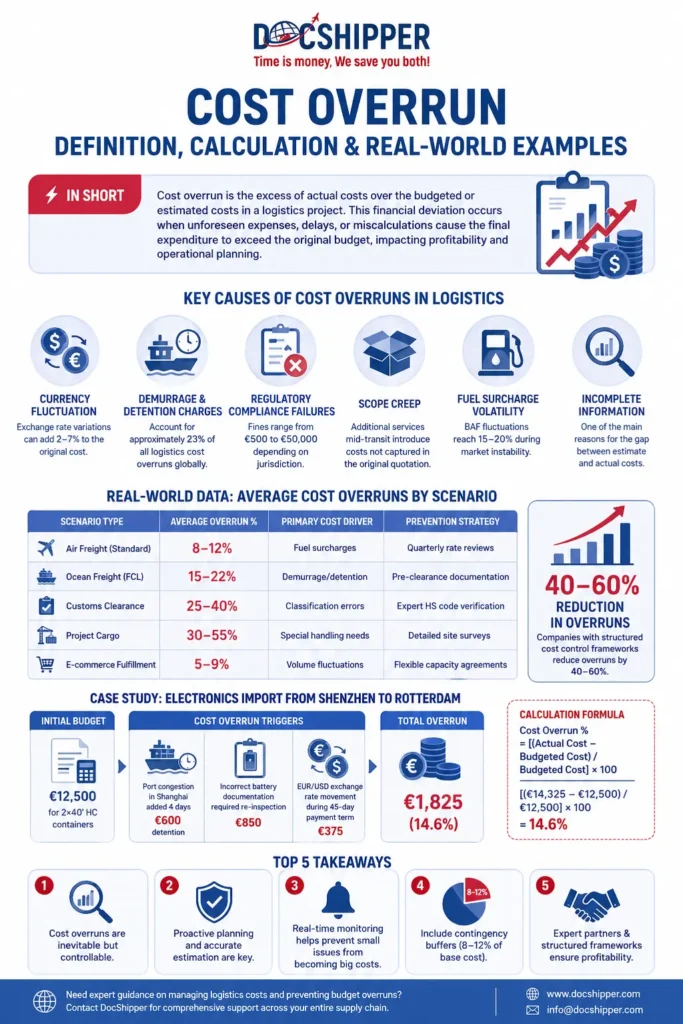
Cost overrun is the excess of actual costs over the budgeted or estimated costs in a logistics project. This financial deviation occurs when unforeseen expenses, delays, or miscalculations cause the final expenditure to exceed the original budget, impacting profitability and operational planning.
Introduction
In international logistics, even a 5% budget deviation can transform a profitable shipment into a financial loss. Cost overruns represent one of the most critical challenges facing freight forwarders, importers, and supply chain managers worldwide.
This financial phenomenon affects every stage of the logistics chain—from initial quotation to final delivery. Understanding cost overruns is essential for maintaining competitive margins and ensuring project viability in an industry where profit margins often hover between 3-8%.
Key characteristics of cost overruns in logistics include:
- Deviation between estimated and actual project costs
- Impact on cash flow and working capital requirements
- Potential damage to client relationships and reputation
- Cascade effects on subsequent shipments and contracts
- Regulatory and compliance cost implications
Understanding Cost Overrun: Mechanisms & Implications
Cost overruns in international logistics stem from multiple interconnected factors. The primary mechanism involves the gap between initial cost estimation and actual expenses incurred during execution. This divergence typically results from incomplete information during the quotation phase or unforeseen operational challenges.
Currency fluctuation represents a major contributor to cost overruns in cross-border operations. When payment terms extend beyond 30 days, exchange rate variations can add 2-7% to the original cost. Forward contracts and hedging strategies mitigate this risk but introduce additional complexity.
The demurrage and detention charges category accounts for approximately 23% of all logistics cost overruns globally. Delays in customs clearance, documentation errors, or port congestion trigger these penalty fees. A single container can accumulate $75-150 per day in combined charges, rapidly escalating project costs.
Regulatory compliance failures generate substantial unexpected expenses. Incorrect HS code classification, missing certificates, or non-compliant packaging can result in fines ranging from €500 to €50,000 depending on jurisdiction. According to European Commission customs regulations, these penalties also include potential shipment seizure and storage costs.
The scope creep phenomenon occurs when additional services become necessary mid-transit. Transshipment requirements, special handling needs, or destination country inspection mandates introduce costs not captured in the original quotation. At DocShipper, we implement comprehensive pre-shipment assessments to identify potential scope expansions before they materialize into cost overruns.
Fuel surcharge volatility creates ongoing budget uncertainty. Carriers adjust BAF (Bunker Adjustment Factor) monthly, with fluctuations reaching 15-20% during market instability. Long-term contracts with fixed fuel components provide protection but require careful negotiation and volume commitments.
Real-World Examples & Data Analysis
Analyzing actual cost overrun scenarios reveals patterns that inform better risk management. The following comparative data demonstrates typical deviation percentages across different logistics scenarios.
| Scenario Type | Average Overrun % | Primary Cost Driver | Prevention Strategy |
|---|---|---|---|
| Air Freight (Standard) | 8-12% | Fuel surcharges | Quarterly rate reviews |
| Ocean Freight (FCL) | 15-22% | Demurrage/detention | Pre-clearance documentation |
| Customs Clearance | 25-40% | Classification errors | Expert HS code verification |
| Project Cargo | 30-55% | Special handling needs | Detailed site surveys |
| E-commerce Fulfillment | 5-9% | Volume fluctuations | Flexible capacity agreements |
Case Study: Electronics Import from Shenzhen to Rotterdam
Initial budget: €12,500 for 2×40′ HC containers. The shipment encountered three cost overrun triggers: port congestion in Shanghai added 4 days (€600 detention), incorrect battery documentation required re-inspection (€850), and EUR/USD exchange rate movement during the 45-day payment term (€375). Total overrun: €1,825 (14.6%).
This example illustrates how multiple small deviations compound into significant budget impacts. At DocShipper, we implement real-time monitoring systems that flag potential overrun triggers within 24 hours, allowing proactive intervention before costs escalate.
Calculation Formula:
Cost Overrun % = [(Actual Cost – Budgeted Cost) / Budgeted Cost] × 100
Using the case above: [(€14,325 – €12,500) / €12,500] × 100 = 14.6%
Industry data reveals that companies implementing structured cost control frameworks reduce overruns by 40-60%. These frameworks include contingency buffers (typically 8-12% of base cost), milestone-based budget reviews, and automated variance alerts.
Conclusion
Cost overruns remain an inevitable aspect of international logistics, but their magnitude and frequency can be substantially controlled through proactive planning, accurate estimation, and continuous monitoring. The difference between profitable operations and financial losses often hinges on anticipating and mitigating these budget deviations.
Need expert guidance on managing logistics costs and preventing budget overruns? Contact DocShipper for comprehensive support across your entire supply chain.
📚 Quiz
Test Your Knowledge: Cost Overrun
Q1. What is the correct definition of a cost overrun in international logistics?
Q2. Which logistics scenario typically experiences the highest average cost overrun percentage?
Q3. A freight forwarder quotes €12,500 for an ocean shipment. Due to port congestion, documentation errors, and currency fluctuation, the final cost reaches €14,325. Using the cost overrun formula, what is the correct overrun percentage?
🎯 Your Result
📞 Free Quote in 24hFAQ | Cost Overrun: Definition, Calculation & Real-World Examples
Average cost overruns range from 8-22% depending on transport mode and route complexity. Ocean freight typically experiences higher deviations than air freight due to longer transit times and more touchpoints.
When invoices are issued in one currency but payment occurs weeks later in another, exchange rate movements create price differences. A 3% currency swing on a $50,000 shipment equals $1,500 in unexpected costs.
Demurrage applies when containers remain at the port terminal beyond free time. Detention charges accrue when containers are held outside the terminal past the allowed period. Combined rates typically range $75-200 daily.
Complete elimination is unrealistic due to external variables beyond control. However, implementing robust estimation processes, contingency planning, and real-time monitoring can reduce overruns by 60-80% compared to reactive approaches.
Industry best practice suggests 8-12% contingency for standard shipments, 15-20% for complex routes, and 25-35% for project cargo. These buffers should be explicitly itemized rather than hidden in base pricing.
Incorrect HS code classification, missing certificates of origin, incomplete commercial invoices, and non-compliant packing lists account for 68% of documentation-related cost overruns according to customs broker associations.
Peak season surcharges (PSS) can add 15-40% to base freight rates during high-demand periods like pre-Chinese New Year or Q4 retail season. These surcharges often appear with minimal advance notice.
Inappropriate Incoterms create unclear responsibility boundaries, leading to unexpected charges. FOB shipments where buyers underestimate destination costs experience 30% higher overrun rates than DDP arrangements with comprehensive pricing.
Transportation Management Systems (TMS) with predictive analytics identify deviation patterns before they materialize. Real-time tracking prevents detention charges, while automated documentation reduces compliance errors by 75%.
Major port congestion events increase costs through extended transit times, additional storage fees, and missed connection windows. The 2021 Suez Canal blockage created average cost overruns of 18-25% for affected shipments.
Contract terms should clearly define which overruns are customer-responsible (scope changes, incorrect information) versus supplier-absorbed (estimation errors, operational inefficiencies). Transparent communication maintains trust while protecting margins.
Cargo insurance covers physical loss or damage but rarely covers operational cost overruns like demurrage or regulatory penalties. Separate contingent cargo insurance policies exist but add 0.3-0.8% to shipment costs.
Need Help with
Logistics or Sourcing ?
First, we secure the right products from the right suppliers at the right price by managing the sourcing process from start to finish. Then, we simplify your shipping experience - from pickup to final delivery - ensuring any product, anywhere, is delivered at highly competitive prices.


Fill the Form
Prefer email? Send us your inquiry, and we’ll get back to you as soon as possible.
Contact us




