


In short ⚡
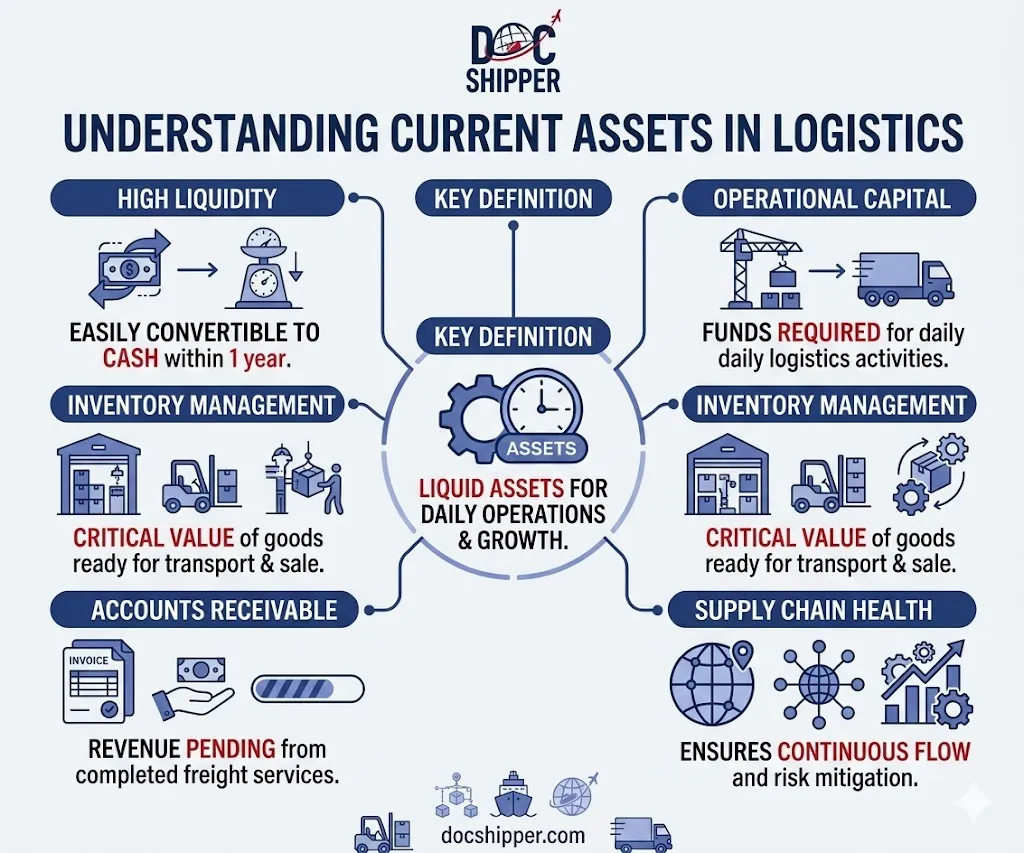
Current assets are liquid resources that a company expects to convert into cash, sell, or consume within one fiscal year or operating cycle. They include cash, accounts receivable, inventory, and marketable securities, serving as indicators of short-term financial health and operational efficiency.Introduction
Many importers and exporters struggle to assess their liquidity position when managing international transactions. Understanding current assets is essential for maintaining cash flow stability during shipping cycles, customs clearance delays, and payment terms negotiations.
In international logistics, current assets directly impact a company’s ability to finance inventory purchases, cover freight costs, and respond to market opportunities. Proper management of these assets ensures smooth operations across borders.
- Liquidity indicator: Measures immediate financial resources available
- Operating cycle dependency: Tied to inventory turnover and collection periods
- Working capital component: Essential for calculating operational efficiency ratios
- Trade finance basis: Used by banks to evaluate creditworthiness for letters of credit
- Risk management tool: Helps predict short-term solvency in volatile markets
In-Depth Analysis & Expert Insights
Current assets are classified based on their conversion timeline and liquidity hierarchy. The most liquid assets appear first on balance sheets, following accounting standards like IFRS and GAAP.
The five primary categories include:
Cash and cash equivalents represent the most liquid form, including bank deposits and short-term investments maturing within 90 days. For international traders, multi-currency accounts fall into this category.
Marketable securities are short-term investments easily convertible to cash, such as treasury bills or commercial paper. These provide flexibility when managing currency fluctuations during cross-border transactions.
Accounts receivable reflect outstanding customer payments, typically collected within 30-90 days. In international trade, this includes export invoices pending payment after goods clear customs. At DocShipper, we help clients optimize collection cycles by coordinating documentation delivery with payment milestones.
Inventory encompasses raw materials, work-in-progress, and finished goods awaiting sale. For importers, this includes goods in transit, in bonded warehouses, or awaiting customs clearance. Proper inventory classification affects duty calculations and customs valuation procedures.
Prepaid expenses cover advance payments for services like insurance, freight, or warehouse leases. These convert to expenses as services are consumed during the operating period.
The current ratio (current assets ÷ current liabilities) serves as a fundamental liquidity metric. A ratio above 1.5 typically indicates healthy short-term financial stability for logistics operations.
Concrete Examples & Data
Consider a European electronics importer with the following current assets structure:
| Asset Category | Amount (EUR) | % of Total | Conversion Period |
|---|---|---|---|
| Cash & Equivalents | €150,000 | 15% | Immediate |
| Marketable Securities | €50,000 | 5% | 1-3 days |
| Accounts Receivable | €300,000 | 30% | 45-60 days |
| Inventory | €450,000 | 45% | 90-120 days |
| Prepaid Expenses | €50,000 | 5% | Throughout year |
| Total Current Assets | €1,000,000 | 100% | — |
Use Case: This importer receives a shipment worth €200,000 from China. The inventory increases by this amount upon customs clearance. Simultaneously, accounts receivable decrease by €180,000 as a major retailer settles their invoice. The net effect maintains total current assets at €1,020,000.
Key operational insights from this structure:
- Inventory dominance: 45% concentration suggests potential cash flow constraints if turnover slows
- Receivables efficiency: 30% indicates balanced credit terms with customers
- Liquidity cushion: 20% in highly liquid assets provides flexibility for urgent freight payments
- Working capital calculation: With current liabilities of €600,000, the current ratio stands at 1.67 (healthy)
- Days sales outstanding (DSO): Approximately 55 days based on receivables turnover
Industry benchmarks show that logistics companies typically maintain current ratios between 1.2 and 2.0, with inventory representing 30-50% of current assets depending on business model.
Conclusion
Current assets form the financial backbone of international trade operations, determining a company’s ability to navigate payment cycles, inventory fluctuations, and operational expenses. Proper management ensures sustained competitiveness in global markets.
Need expert guidance on optimizing your logistics cash flow? Contact DocShipper for tailored solutions that align financial planning with supply chain efficiency.
📚 Quiz
Test Your Knowledge: Current Assets
Q1. What is the defining characteristic of a current asset?
Q2. A European importer receives goods shipped from China under FOB terms. At what point does this in-transit inventory become a current asset?
Q3. A logistics company has current assets of €1,000,000 and current liabilities of €600,000. A bank is evaluating whether to issue a letter of credit. Which statement best reflects the company's liquidity position?
🎯 Your Result
📞 Free Quote in 24hFAQ | Current Assets: Definition, Calculation & Concrete Examples
Any resource convertible to cash within one year or operating cycle, including cash, receivables, inventory in transit, marketable securities, and prepaid freight or insurance expenses related to immediate operations.
Current assets convert to cash within 12 months and support daily operations, while fixed assets like warehouses or trucks provide long-term value over multiple years and aren't intended for quick liquidation.
Banks and suppliers use this ratio to assess creditworthiness when issuing letters of credit or trade credit terms. A ratio above 1.5 typically signals sufficient liquidity to cover short-term obligations.
Yes, inventory in transit becomes a current asset once ownership transfers per Incoterms. For FOB shipments, this occurs at the port of loading; for CIF, upon vessel departure.
Foreign currency-denominated receivables and cash holdings require revaluation at each reporting period, creating unrealized gains or losses that impact the total current asset value on balance sheets.
The quick ratio excludes inventory from current assets, dividing the remainder by current liabilities. It measures immediate liquidity without relying on inventory sales, crucial during market downturns.
Yes, refundable customs deposits or duty drawback claims qualify as current assets since they're expected to be recovered within the operating cycle, typically within 6-12 months of filing.
Monthly reviews align with typical accounting cycles, but high-volume importers benefit from weekly monitoring to track inventory turnover, receivables aging, and cash position during peak shipping seasons.
Current assets are liquidated first to satisfy creditors, with cash and marketable securities distributed immediately, followed by receivables collection and inventory sales at potentially discounted values.
Yes, advance payments for shipping services appear as prepaid expenses until the shipment completes. The cost then transfers to inventory or cost of goods sold depending on accounting treatment.
Working capital equals current assets minus current liabilities. Optimizing this balance ensures sufficient funds for operations without tying up excessive capital in slow-moving inventory or extended payment terms.
Lenders use current asset values as collateral for invoice financing, inventory loans, or revolving credit facilities, enabling businesses to access capital based on their liquid resources rather than fixed property.
Need Help with
Logistics or Sourcing ?
First, we secure the right products from the right suppliers at the right price by managing the sourcing process from start to finish. Then, we simplify your shipping experience - from pickup to final delivery - ensuring any product, anywhere, is delivered at highly competitive prices.


Fill the Form
Prefer email? Send us your inquiry, and we’ll get back to you as soon as possible.
Contact us




