


In short ⚡
Current liabilities are financial obligations a company must settle within one year or one operating cycle, whichever is longer. These include accounts payable, short-term debt, accrued expenses, and taxes owed. They represent immediate financial commitments critical for assessing a business's short-term liquidity and operational health in international trade operations.
Introduction
Many businesses struggle to distinguish between current and long-term obligations, leading to cash flow crises during peak shipping seasons. In import/export operations, mismanaging current liabilities can halt shipments, damage supplier relationships, and trigger penalties.
Current liabilities form the backbone of working capital management. They directly impact a company’s ability to finance inventory purchases, pay customs duties, and maintain smooth logistics operations. For freight forwarders and importers, understanding these obligations is essential for maintaining creditworthiness and operational continuity.
Key characteristics of current liabilities include:
- Settlement required within 12 months or one operating cycle
- Direct impact on working capital and liquidity ratios
- Include both monetary debts and accrued obligations
- Vary significantly based on business cycles and trade volumes
- Critical for customs compliance and supplier negotiations
Understanding Current Liabilities in Depth
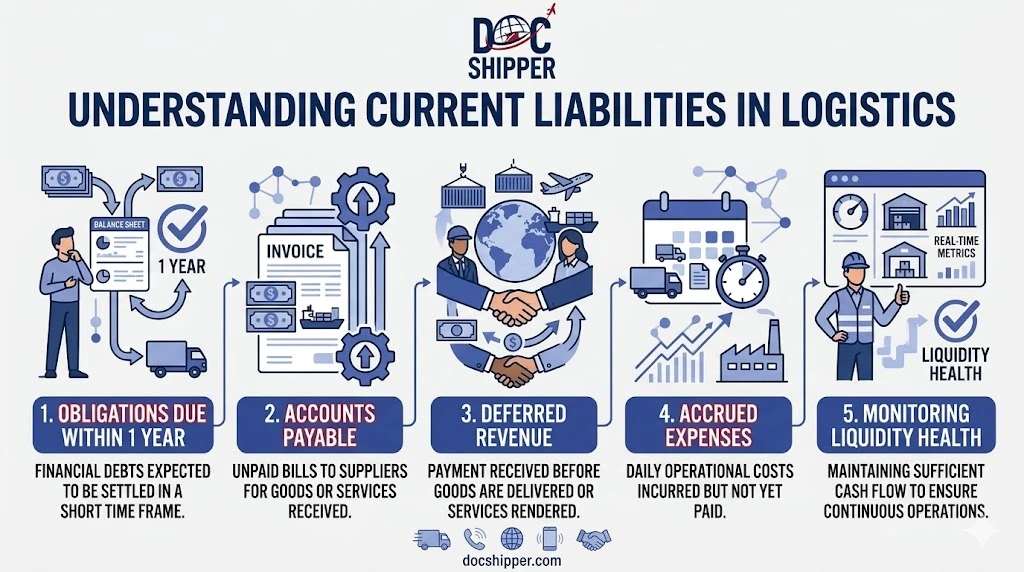
Current liabilities encompass several distinct categories, each with unique implications for international logistics operations. Accounts payable represent amounts owed to suppliers for goods or services received but not yet paid. In shipping contexts, this includes outstanding invoices for freight charges, warehouse storage, and customs brokerage fees.
Short-term debt includes portions of long-term loans due within the year, lines of credit, and working capital loans. Many importers use these facilities to bridge the gap between paying suppliers and receiving customer payments, especially when dealing with extended shipping times.
Accrued expenses are costs incurred but not yet invoiced or paid. Common examples include employee wages, utility bills, and interest on outstanding debt. For logistics companies, accrued demurrage charges and detention fees fall into this category, often accumulating unexpectedly during port congestion.
Taxes payable represent obligations to government authorities, including customs duties, VAT, and corporate income taxes. According to EU Customs regulations, importers must account for duties as current liabilities upon goods entry, even before physical payment.
Deferred revenue occurs when customers prepay for services not yet delivered. Freight forwarders often receive advance payments for shipments in transit, creating a liability until delivery completion. At DocShipper, we carefully track these obligations to maintain transparent financial reporting and ensure timely service fulfillment for our clients.
Practical Examples & Financial Data
Understanding current liabilities requires examining real-world scenarios. Consider an importer with the following balance sheet snapshot:
| Liability Type | Amount (USD) | Due Date |
|---|---|---|
| Accounts Payable (Suppliers) | $125,000 | 30-60 days |
| Freight & Logistics Payable | $45,000 | 15 days |
| Customs Duties Payable | $32,000 | Immediate |
| Short-term Loan (Current Portion) | $50,000 | Within 12 months |
| Accrued Wages & Benefits | $18,000 | Monthly |
| Total Current Liabilities | $270,000 | — |
Use Case: Current Ratio Calculation
A shipping company holds $400,000 in current assets (cash, receivables, inventory) and $270,000 in current liabilities. The current ratio equals 1.48 ($400,000 ÷ $270,000). This indicates reasonable short-term financial health, though many lenders prefer ratios above 1.5 for trade finance approval.
Key insights for logistics operations:
- Customs duties require immediate settlement to release cargo, making them the most urgent liability
- Freight payables typically have 15-30 day terms, requiring careful cash flow planning
- Supplier payment terms (30-60 days) provide working capital flexibility if managed properly
- Accrued expenses can accumulate silently, creating unexpected cash demands during audits
- Maintaining a current ratio above 1.2 ensures access to trade credit and favorable shipping terms
Conclusion
Current liabilities represent the financial pulse of any import/export operation, directly influencing liquidity, creditworthiness, and operational capacity. Proper management ensures smooth cargo flow and sustainable business growth.
Need expert guidance on managing your international trade finances? Contact DocShipper for comprehensive support across sourcing, shipping, and customs clearance.
📚 Quiz
Test Your Knowledge: Current Liabilities
Q1 — What is the defining timeframe for an obligation to be classified as a current liability?
Q2 — A freight forwarder receives advance payment from a client for a shipment still in transit. How should this be recorded?
Q3 — An importer has $400,000 in current assets and $270,000 in current liabilities. A bank requires a current ratio above 1.5 for trade finance approval. What is the importer's situation?
🎯 Your Result
📞 Free Quote in 24hFAQ | Current Liabilities: Definition, Calculation & Practical Examples
Current liabilities must be settled within one year or one operating cycle, while long-term liabilities extend beyond this timeframe. The distinction affects financial ratios and working capital calculations critical for trade finance decisions.
Unpaid customs duties and taxes are current liabilities that must be settled before cargo release. Failure to manage these obligations results in storage fees, demurrage charges, and potential cargo seizure by customs authorities.
Extended payment terms delay cash outflow but do not eliminate the liability. The obligation remains on the balance sheet until settled, though it may improve short-term liquidity ratios and cash flow management.
Most financial institutions prefer current ratios between 1.5 and 3.0 for import businesses. Ratios below 1.0 indicate potential liquidity problems, while excessively high ratios may suggest inefficient asset utilization.
Accrued expenses like unpaid demurrage, detention fees, or warehouse charges accumulate as current liabilities. These hidden costs can suddenly strain cash flow if not tracked properly through accounting systems.
Letters of credit create contingent liabilities that become current liabilities upon document presentation. Importers must reserve funds or credit lines to honor these obligations when shipments arrive and documentation is submitted.
This situation indicates negative working capital, signaling potential insolvency risk. Businesses may struggle to pay suppliers, customs duties, or freight charges, leading to operational disruptions and damaged trade relationships.
Monthly reviews are standard practice, with weekly monitoring recommended during high-volume shipping periods. Real-time tracking of customs duties and freight payables prevents cash flow surprises and maintains supplier confidence.
Only warranty claims expected within the next 12 months qualify as current liabilities. Long-term warranty provisions are classified as non-current, though importers should monitor product return rates that could accelerate these obligations.
Payment terms for accounts payable can often be extended through negotiation, especially with established supplier relationships. However, customs duties and statutory obligations remain non-negotiable and must be paid according to regulatory timelines.
Liabilities denominated in foreign currencies fluctuate with exchange rates until settlement. Importers should account for potential currency losses as additional current liabilities, particularly when payment terms extend beyond 30 days.
Lenders analyze current liabilities against current assets to assess repayment capacity. High-quality current liability management demonstrates financial discipline and improves approval chances for letters of credit, working capital loans, and supplier credit lines.
Need Help with
Logistics or Sourcing ?
First, we secure the right products from the right suppliers at the right price by managing the sourcing process from start to finish. Then, we simplify your shipping experience - from pickup to final delivery - ensuring any product, anywhere, is delivered at highly competitive prices.


Fill the Form
Prefer email? Send us your inquiry, and we’ll get back to you as soon as possible.
Contact us




