


In short ⚡
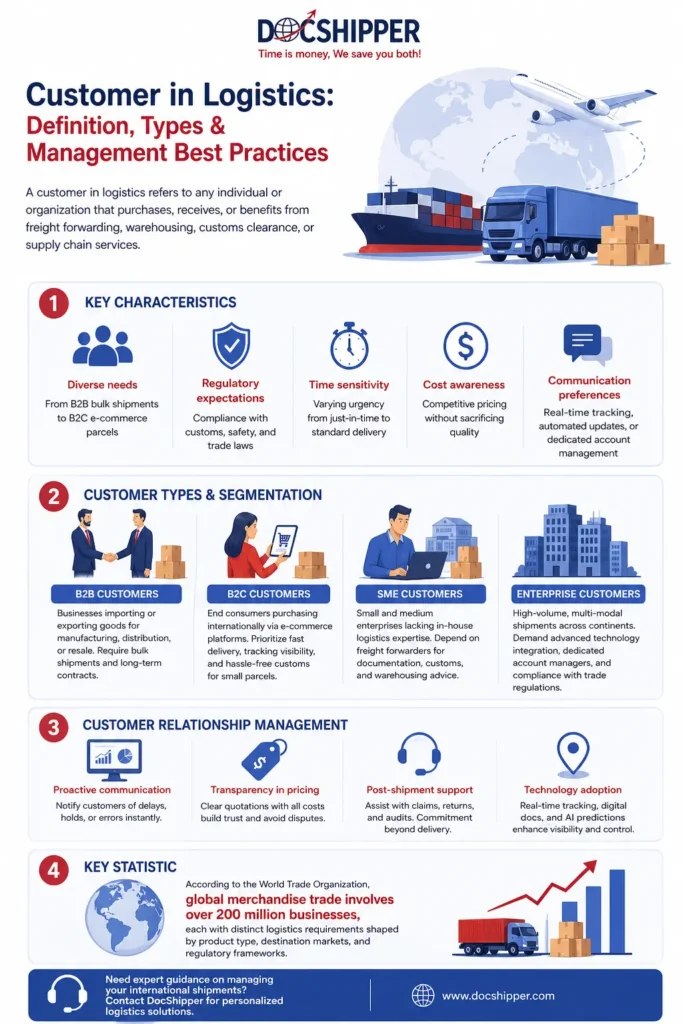
A customer in logistics refers to any individual or organization that purchases, receives, or benefits from freight forwarding, warehousing, customs clearance, or supply chain services. In international trade, customers range from importers and exporters to manufacturers and retailers requiring end-to-end shipment solutions.
Introduction
In global logistics, the term “customer” extends far beyond a simple buyer-seller relationship. A logistics customer expects timely delivery, regulatory compliance, cost transparency, and proactive communication throughout the supply chain. Misunderstanding customer needs leads to delays, disputes, and lost business.
Whether you’re shipping electronics from China or automotive parts from Germany, identifying your customer type determines service requirements, documentation standards, and communication protocols.
Key characteristics of logistics customers include:
- Diverse needs – From B2B bulk shipments to B2C e-commerce parcels
- Regulatory expectations – Compliance with customs, safety, and trade laws
- Time sensitivity – Varying urgency levels from just-in-time to standard delivery
- Cost awareness – Demand for competitive pricing without sacrificing quality
- Communication preferences – Real-time tracking, automated updates, or dedicated account management
Customer Types & Segmentation in Logistics
Logistics providers segment customers based on shipment volume, industry sector, service complexity, and geographic reach. Understanding these categories allows freight forwarders to tailor solutions and allocate resources efficiently.
B2B customers represent businesses importing or exporting goods for manufacturing, distribution, or resale. They typically require bulk shipments, consolidated cargo, and long-term contracts with predictable pricing structures.
B2C customers are end consumers purchasing products internationally through e-commerce platforms. They prioritize fast delivery, transparent tracking, and hassle-free customs clearance for small parcels.
SME customers (small and medium enterprises) often lack in-house logistics expertise. They depend on freight forwarders for comprehensive support, including documentation, customs brokerage, and warehousing advice.
Enterprise customers manage high-volume, multi-modal shipments across continents. They demand advanced technology integration, dedicated account managers, and compliance with international trade regulations like Incoterms 2020.
At DocShipper, we classify customers by shipment frequency and complexity to assign specialized teams, ensuring each client receives appropriate service levels and proactive risk management.
According to the World Trade Organization, global merchandise trade involves over 200 million businesses, each with distinct logistics requirements shaped by product type, destination markets, and regulatory frameworks.
Customer Relationship Management & Service Excellence
Effective customer management in logistics revolves around communication accuracy, problem resolution speed, and value-added services. Freight forwarders must anticipate challenges before customers encounter them.
The following table compares service expectations across customer segments:
| Customer Type | Primary Need | Communication Frequency | Technology Requirement |
|---|---|---|---|
| B2B Importer | Cost efficiency & reliability | Weekly updates | EDI integration |
| E-commerce Seller | Speed & tracking visibility | Real-time notifications | API for order sync |
| SME Exporter | Customs compliance support | On-demand consultation | Web portal access |
| Enterprise Client | Multi-modal coordination | Daily reports | TMS integration |
Proactive communication prevents disputes. Customers expect immediate notification of delays, customs holds, or documentation errors. Automated tracking systems reduce manual inquiries by 60% on average.
Transparency in pricing builds trust. Hidden fees or unexpected surcharges damage long-term relationships. Detailed quotations including freight, customs duties, and handling charges set clear expectations.
Post-shipment support differentiates premium service providers. Assisting with claims, returns, or regulatory audits demonstrates commitment beyond basic freight movement.
Technology adoption enhances customer experience. Real-time GPS tracking, digital documentation, and AI-powered delivery predictions meet modern expectations for visibility and control.
DocShipper implements customer feedback loops through quarterly reviews, ensuring service adjustments align with evolving business needs and market conditions.
Conclusion
Understanding customer segmentation and service expectations is fundamental to logistics success. Whether managing B2B contracts or e-commerce parcels, tailored communication and proactive problem-solving create lasting partnerships.
Need expert guidance on managing your international shipments? Contact DocShipper for personalized logistics solutions.
📚 Quizz
Test Your Knowledge: Customer in Logistics
Q1 — Which of the following best defines a "customer" in the context of international logistics?
Q2 — A common misconception is that B2B and B2C logistics customers have the same service needs. What is the key difference between them?
Q3 — A small manufacturing company is exporting goods for the first time. They have no in-house logistics team and need help with customs documentation and compliance. Which customer segment do they belong to, and what do they primarily need?
🎯 Your Result
📞 Free Quote in 24hFAQ | Customer in Logistics: Definition, Types & Management Best Practices
A logistics customer is any entity requiring freight forwarding, customs clearance, warehousing, or supply chain services. This includes importers, exporters, manufacturers, and retailers across B2B and B2C sectors.
B2B customers ship bulk cargo with long-term contracts, while B2C customers prioritize fast parcel delivery with real-time tracking. Service models, pricing structures, and communication frequencies vary significantly between these segments.
Small and medium enterprises require comprehensive support including customs documentation, compliance advice, and cost-effective shipping solutions. They often lack in-house logistics expertise and value consultative partnerships.
Segmentation allows providers to allocate resources efficiently, tailor communication strategies, and deliver appropriate service levels. Enterprise clients need dedicated teams, while e-commerce sellers benefit from automated tracking systems.
Real-time tracking, automated notifications, API integrations, and digital documentation reduce manual inquiries, increase transparency, and enable customers to monitor shipments independently throughout the supply chain.
Frequent issues include unexpected customs delays, hidden fees, poor communication during transit, documentation errors, and lack of visibility into shipment status. Proactive freight forwarders address these through transparency and technology.
Immediate acknowledgment, root cause analysis, transparent communication, and corrective action plans build trust. Documenting resolutions and implementing preventive measures demonstrate commitment to service improvement.
Timely updates on shipment status, proactive problem notification, and accessible support channels directly correlate with customer retention. Automated systems reduce response times while maintaining personalized service quality.
Enterprise clients manage high-volume, multi-modal shipments requiring advanced technology integration, dedicated account management, and complex compliance support. SMEs prioritize cost efficiency and educational guidance through the logistics process.
Key performance indicators include on-time delivery rates, documentation accuracy, response time to inquiries, claims resolution speed, and Net Promoter Score (NPS). Regular surveys and feedback loops identify improvement opportunities.
Consistent service quality, competitive pricing, proactive communication, value-added services like customs consulting, and technology investments create loyalty. Long-term contracts with volume discounts incentivize ongoing partnerships.
Standard documents include commercial invoices, packing lists, bills of lading, certificates of origin, and customs declarations. Industry-specific requirements may add phytosanitary certificates, dangerous goods declarations, or import licenses.
Need Help with
Logistics or Sourcing ?
First, we secure the right products from the right suppliers at the right price by managing the sourcing process from start to finish. Then, we simplify your shipping experience - from pickup to final delivery - ensuring any product, anywhere, is delivered at highly competitive prices.


Fill the Form
Prefer email? Send us your inquiry, and we’ll get back to you as soon as possible.
Contact us




