


In short ⚡
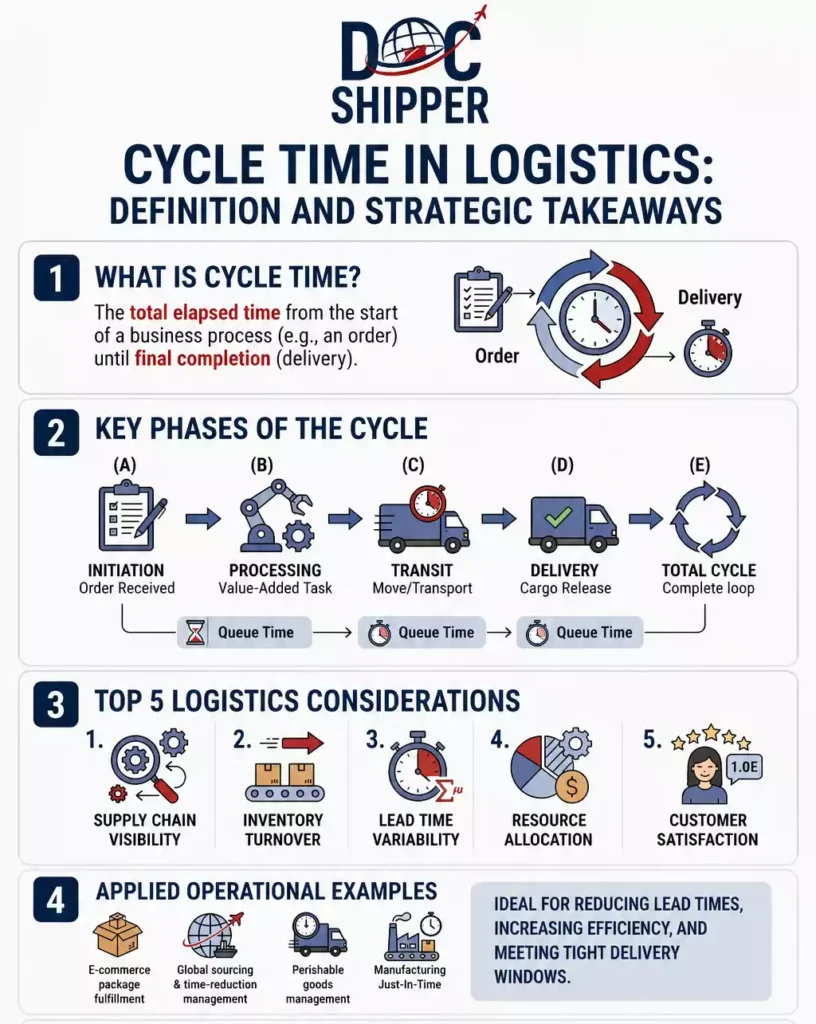
Cycle Time is the total duration required to complete one full operational process, from initiation to final delivery. In international logistics, it measures the elapsed time between order placement and cargo arrival, encompassing production, transit, customs clearance, and last-mile delivery phases.
Introduction
Delayed shipments cost businesses millions annually. Many importers confuse lead time with cycle time, creating unrealistic delivery expectations and inventory shortages.
In global supply chains, cycle time directly impacts cash flow, customer satisfaction, and competitive positioning. Reducing this metric by even 10% can transform operational efficiency.
Key characteristics include:
- End-to-end measurement: Captures every process stage without gaps
- Variability factors: Influenced by transport mode, customs complexity, and seasonal peaks
- Continuous improvement metric: Benchmarked to identify bottlenecks
- Cross-functional dependency: Requires coordination between suppliers, carriers, and customs brokers
- Predictability driver: Lower variance enables better inventory planning
Understanding Cycle Time Components & Optimization
Cycle time in international logistics comprises five distinct phases. The order processing stage includes confirmation, documentation preparation, and payment clearance. Production or procurement follows, where manufacturing lead time or supplier readiness determines duration.
The pre-shipment phase involves quality control, packaging, and cargo consolidation at origin. Transit time varies dramatically—air freight averages 3-7 days versus 25-45 days for ocean shipping. Customs clearance adds 1-5 days depending on documentation accuracy and regulatory complexity.
Final delivery encompasses deconsolidation, local transport, and recipient handover. At DocShipper, we map each component to identify delay patterns, enabling clients to reduce cycle time by 15-30% through strategic interventions.
The critical path method isolates non-compressible activities. For instance, ocean transit cannot be accelerated, but parallel customs pre-clearance can eliminate post-arrival delays. Buffer management distinguishes strategic reserves from waste—optimal buffers absorb variability without inflating total cycle time.
According to the WTO Trade Facilitation Agreement, streamlined customs procedures reduce border crossing times by up to 47%. Implementing Authorized Economic Operator (AEO) status accelerates clearance through pre-approved compliance frameworks.
Concrete Examples & Comparative Data
Consider an electronics importer sourcing from Shenzhen to Rotterdam. Standard cycle time breaks down as follows:
| Phase | Ocean Freight | Air Freight | Optimized Ocean |
|---|---|---|---|
| Order Processing | 3 days | 2 days | 1 day |
| Production | 15 days | 15 days | 12 days |
| Pre-Shipment | 4 days | 2 days | 2 days |
| Transit | 35 days | 5 days | 32 days |
| Customs Clearance | 4 days | 3 days | 1 day |
| Final Delivery | 2 days | 1 day | 2 days |
| Total Cycle Time | 63 days | 28 days | 50 days |
The optimized scenario achieves a 21% reduction through parallel documentation processing, AEO-certified customs clearance, and consolidated production scheduling. Air freight cuts cycle time by 56% but increases costs by 300-500%.
Use Case: A pharmaceutical company importing temperature-sensitive vaccines from Belgium to Singapore faced a 42-day cycle time. By implementing pre-arrival customs filing and direct airport-to-warehouse cold chain logistics, DocShipper reduced this to 29 days, preventing €180,000 in potential spoilage losses.
Industry benchmarks show automotive parts average 55-day cycles, while fast fashion operates at 30-40 days. Companies achieving sub-30-day cycles typically leverage vendor-managed inventory (VMI) and predictive analytics to anticipate demand shifts.
Key performance indicators include:
- On-time delivery rate: Target 95%+ for stable cycle times
- Cycle time variance: Standard deviation below 10% signals process control
- Cost per day saved: Quantifies optimization ROI
- Process bottleneck ratio: Identifies highest-impact improvement areas
- Perfect order index: Combines cycle time with quality and accuracy metrics
Conclusion
Mastering cycle time transforms logistics from a cost center into a competitive advantage. Systematic measurement and targeted optimization unlock cash flow improvements and customer loyalty gains.
Need expert guidance on reducing your supply chain cycle time? Contact DocShipper for a customized analysis of your logistics processes.
📚 Quiz
Test Your Knowledge: Cycle Time
Q1 — What does "Cycle Time" measure in international logistics?
Q2 — A logistics manager wants to reduce cycle time without increasing shipping costs. Which approach is most effective?
Q3 — An electronics importer ships from Shenzhen to Rotterdam via standard ocean freight. Their total cycle time is 63 days. After optimization (AEO clearance, parallel documentation), it drops to 50 days. What is the correct interpretation?
🎯 Your Result
📞 Free Quote in 24hFAQ | Cycle Time: Definition, Calculation & Concrete Examples
Lead time measures the duration from order placement to delivery, while cycle time tracks the actual operational process duration. Lead time includes waiting periods; cycle time focuses on active work phases.
Sum the duration of order processing, production, pre-shipment, transit, customs clearance, and final delivery. Track each phase separately to identify bottlenecks and measure improvement initiatives accurately.
Transit mode selection, customs complexity, documentation accuracy, supplier reliability, and seasonal demand peaks. Customs delays account for 15-30% of total cycle time variability in cross-border shipments.
Yes, through process optimization like parallel documentation, pre-clearance programs, and consolidated shipments. These methods eliminate waste rather than accelerating transit, maintaining cost efficiency while improving speed.
Industry best practice targets a standard deviation below 10% of average cycle time. Higher variance indicates process instability requiring root cause analysis and corrective actions.
DDP terms extend seller responsibility through final delivery, potentially lengthening cycle time but simplifying buyer operations. EXW transfers control earlier, reducing seller cycle time but increasing buyer coordination requirements.
Digital platforms enable real-time tracking, automated documentation, and predictive analytics. These tools reduce manual processing delays by 40-60% and improve exception management response times significantly.
Weekly measurement provides sufficient data for trend analysis without overwhelming operations. Monthly reviews identify systemic issues, while quarterly benchmarking assesses strategic improvement initiatives.
Major port congestion can add 7-14 days to cycle time. Diversifying port-of-entry options and monitoring real-time congestion data helps mitigate these delays through proactive routing adjustments.
Yes, shorter cycles reduce inventory holding energy consumption and enable mode shifts to consolidated shipments. Optimized routes lower fuel consumption per unit, reducing carbon footprint by 15-25%.
Longer cycle times require higher safety stock to buffer demand variability. Reducing cycle time by 20% can decrease inventory holding costs by 15-18% while maintaining service levels.
Experienced brokers with AEO status and pre-clearance capabilities reduce customs phase duration by 50-70%. Their regulatory expertise prevents documentation errors that cause costly delays and inspections.
Need Help with
Logistics or Sourcing ?
First, we secure the right products from the right suppliers at the right price by managing the sourcing process from start to finish. Then, we simplify your shipping experience - from pickup to final delivery - ensuring any product, anywhere, is delivered at highly competitive prices.


Fill the Form
Prefer email? Send us your inquiry, and we’ll get back to you as soon as possible.
Contact us




