


In short ⚡
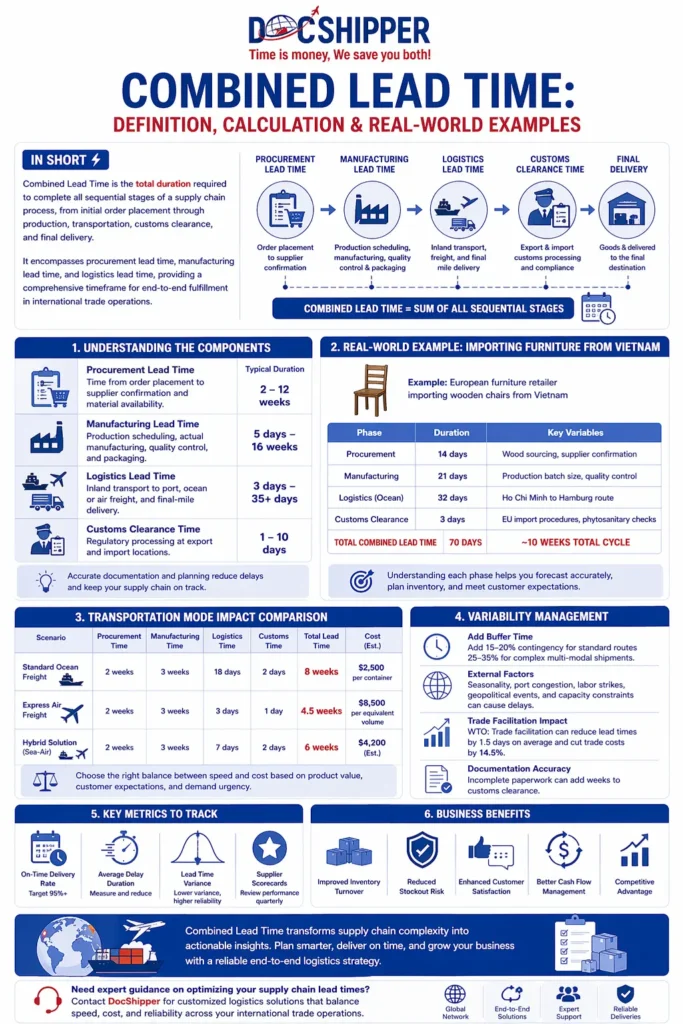
Combined Lead Time is the total duration required to complete all sequential stages of a supply chain process, from initial order placement through production, transportation, customs clearance, and final delivery. It encompasses procurement lead time, manufacturing lead time, and logistics lead time, providing a comprehensive timeframe for end-to-end fulfillment in international trade operations.
Introduction
One of the most common pitfalls in international logistics is underestimating delivery timelines. Businesses often focus on shipping duration alone, ignoring procurement delays, production schedules, and customs processing times. This fragmented view creates inventory shortages, missed sales opportunities, and damaged customer relationships.
Combined Lead Time addresses this challenge by providing a holistic measurement of the entire supply chain cycle. For importers and exporters, understanding this metric is essential for accurate demand forecasting, inventory management, and customer promise fulfillment. It transforms abstract timelines into actionable planning tools.
Key characteristics of Combined Lead Time include:
- Aggregates all sequential process stages into a single metric
- Accounts for supplier reliability, production capacity, and transportation modes
- Includes buffer time for customs clearance and regulatory compliance
- Varies significantly based on origin-destination pairs and product complexity
- Serves as the foundation for safety stock calculations and reorder point strategies
Understanding Combined Lead Time Components
Combined Lead Time consists of four distinct but interconnected phases. Procurement Lead Time covers the period from order placement to supplier confirmation and material availability. This stage varies dramatically across industries—electronics components may require 8-12 weeks, while standard textile materials might be available within 2-3 weeks.
Manufacturing Lead Time encompasses production scheduling, actual manufacturing, quality control, and packaging. Complex products with multiple components naturally extend this phase. For example, custom machinery manufacturing may span 12-16 weeks, whereas simple consumer goods might complete production in 5-7 days.
The Logistics Lead Time includes inland transportation to the port of origin, ocean or air freight, and final-mile delivery. Ocean freight from Shanghai to Rotterdam typically requires 28-35 days, while air freight completes the same route in 3-5 days. At DocShipper, we optimize this phase by selecting the most efficient routing and consolidation strategies for each shipment.
Customs Clearance Time represents the regulatory processing period at both export and import locations. Standard shipments clear customs in 1-3 days, but specialized goods requiring certifications or inspections may extend this to 5-10 days. Documentation accuracy directly impacts this timeline—incomplete paperwork can add weeks to the process.
External factors significantly influence Combined Lead Time. Seasonal demand fluctuations create capacity constraints during peak periods (Q4 for retail, Chinese New Year for Asian manufacturing). Port congestion, labor strikes, and geopolitical events introduce unpredictable delays. According to the World Trade Organization, trade facilitation improvements can reduce lead times by 1.5 days on average and cut trade costs by 14.5%.
Calculation Methods & Real-World Scenarios
Calculating Combined Lead Time requires systematic tracking of each supply chain stage. The basic formula aggregates all sequential phases:
Combined Lead Time = Procurement LT + Manufacturing LT + Logistics LT + Customs Clearance LT
Consider a European furniture retailer importing wooden chairs from Vietnam. The breakdown reveals critical planning insights:
| Phase | Duration | Key Variables |
|---|---|---|
| Procurement | 14 days | Wood sourcing, supplier confirmation |
| Manufacturing | 21 days | Production batch size, quality control |
| Logistics (Ocean) | 32 days | Ho Chi Minh to Hamburg route |
| Customs Clearance | 3 days | EU import procedures, phytosanitary checks |
| Total Combined Lead Time | 70 days | ~10 weeks total cycle |
A comparative scenario illustrates transportation mode impact. An electronics importer sourcing components from Taiwan faces different Combined Lead Time profiles based on urgency:
- Standard Ocean Freight: 8 weeks total (2 weeks procurement + 3 weeks manufacturing + 18 days ocean freight + 2 days customs)
- Express Air Freight: 4.5 weeks total (2 weeks procurement + 3 weeks manufacturing + 3 days air freight + 1 day customs)
- Hybrid Solution: 6 weeks total (2 weeks procurement + 3 weeks manufacturing + 7 days sea-air combination + 2 days customs)
The cost-time tradeoff becomes evident. Ocean freight costs $2,500 per container but extends lead time by 15 days compared to air freight at $8,500 per equivalent volume. For high-value, time-sensitive products, the premium justifies faster delivery. At DocShipper, we analyze your product margins and demand patterns to recommend the optimal balance between speed and cost efficiency.
Variability management represents a critical consideration. Smart companies build buffer time into their Combined Lead Time calculations. Industry best practice suggests adding 15-20% contingency for standard routes and 25-35% for complex multi-modal shipments. A 70-day baseline becomes 80-85 days in planning models, protecting against unforeseen disruptions.
Advanced practitioners track lead time performance metrics to identify improvement opportunities. Key performance indicators include on-time delivery rate, average delay duration, and lead time variance. Companies achieving 95%+ on-time performance typically maintain detailed supplier scorecards and conduct quarterly supply chain reviews.
Conclusion
Combined Lead Time transforms supply chain complexity into manageable planning parameters. By understanding and optimizing each component—from procurement through final delivery—businesses gain competitive advantages through improved inventory turnover, reduced stockout risk, and enhanced customer satisfaction. The metric serves as both a diagnostic tool for identifying bottlenecks and a strategic framework for supplier selection and logistics mode decisions.
Need expert guidance on optimizing your supply chain lead times? Contact DocShipper for customized logistics solutions that balance speed, cost, and reliability across your international trade operations.
📚 Quiz
Test Your Knowledge: Combined Lead Time
Q1 — What does Combined Lead Time measure?
Q2 — A company calculates a baseline Combined Lead Time of 70 days. According to industry best practice, what should their planning model use for standard routes?
Q3 — A European retailer imports wooden chairs from Vietnam. Customs clearance takes 3 days out of a 70-day Combined Lead Time. A colleague argues customs is negligible and documentation quality doesn't matter much. Is this correct?
🎯 Your Result
📞 Free Quote in 24hFAQ | Combined Lead Time: Definition, Calculation & Real-World Examples
Lead time typically refers to a single process stage (manufacturing or shipping), while combined lead time encompasses all sequential stages from order placement to final delivery, providing a complete end-to-end timeline measurement.
Calculate each supplier's individual combined lead time separately, then use the longest duration for planning purposes if components must arrive simultaneously for assembly. Consider staggered ordering for suppliers with shorter lead times.
Standard practice recommends 15-20% buffer for established routes and reliable suppliers, increasing to 25-35% for new suppliers, complex products, or routes prone to disruptions like seasonal congestion or regulatory changes.
Yes, through supplier consolidation, improved production scheduling, pre-clearance customs programs, and optimized inland transportation. Many companies reduce lead time by 10-15% through process improvements before considering mode changes.
Longer combined lead times require higher safety stock levels to maintain service levels during replenishment cycles. The formula typically multiplies lead time by demand variability and desired service level percentage.
Customs clearance typically represents 5-10% of total combined lead time but causes disproportionate delays when documentation is incomplete. Proper classification, valuation, and certificate preparation minimize this risk.
Peak seasons (Chinese New Year, Golden Week, Western holidays) can extend combined lead time by 30-50% due to factory closures, port congestion, and carrier capacity constraints. Forward planning 3-4 months ahead mitigates these effects.
Use average combined lead time for baseline inventory planning, but apply maximum observed lead time for safety stock calculations and customer promise dates to maintain high service levels.
Complex products with multiple components, specialized materials, or stringent quality requirements can triple manufacturing lead time compared to simple products. Custom machinery may require 12-16 weeks versus 5-7 days for basic consumer goods.
Supply chain visibility platforms, ERP systems with logistics modules, and specialized freight management software provide real-time tracking across all stages. Integration with supplier systems enables proactive delay identification.
Incoterms determine which party controls each supply chain stage. FOB terms transfer responsibility at origin port, while DDP terms mean the seller manages the entire combined lead time including destination customs clearance.
Yes, even similar products can show 20-40% lead time variance based on supplier location, manufacturing capacity, material availability, and regulatory requirements. Component sourcing complexity often drives these differences.
Need Help with
Logistics or Sourcing ?
First, we secure the right products from the right suppliers at the right price by managing the sourcing process from start to finish. Then, we simplify your shipping experience - from pickup to final delivery - ensuring any product, anywhere, is delivered at highly competitive prices.


Fill the Form
Prefer email? Send us your inquiry, and we’ll get back to you as soon as possible.
Contact us




