


In short ⚡
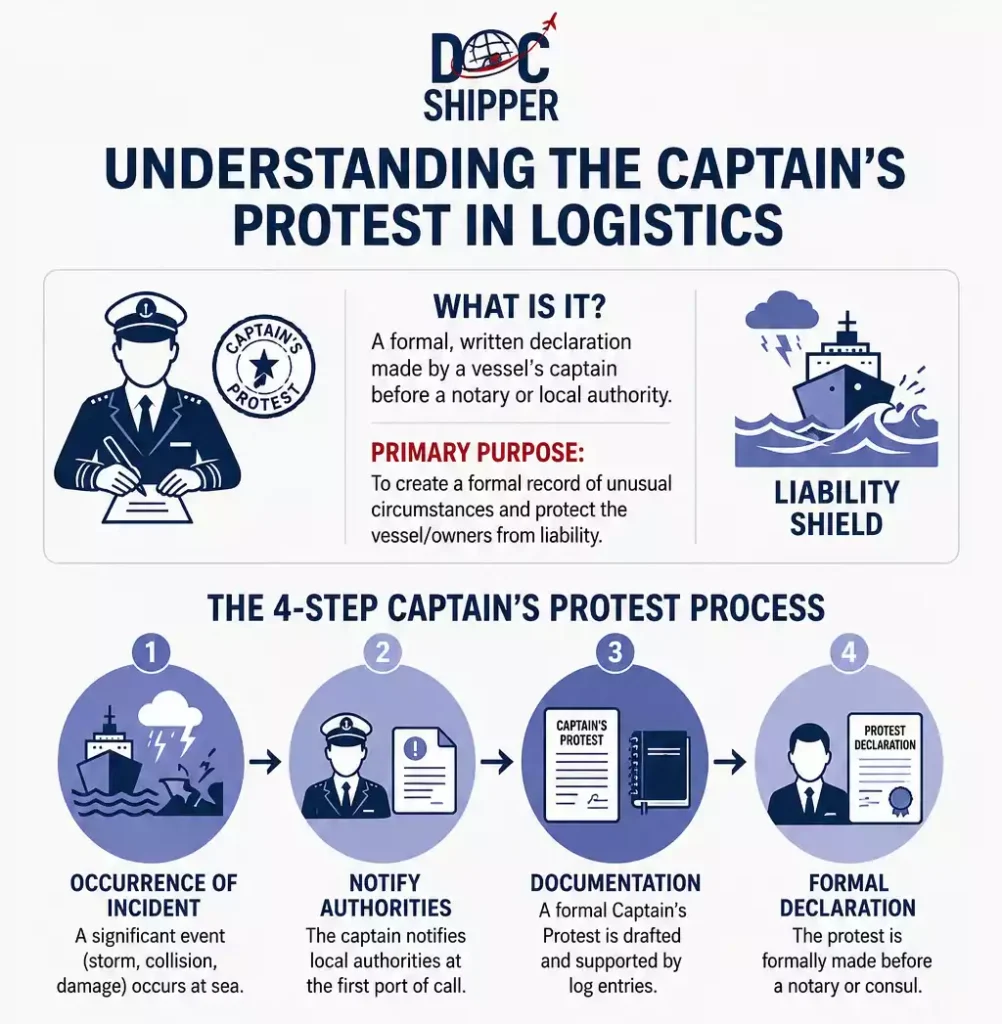
A Captain's Protest is a formal written declaration made by a ship's master to document extraordinary events, damages, or circumstances encountered during a voyage. This legal instrument protects the shipowner, carrier, and crew from liability claims by establishing an official record of incidents beyond their control, such as severe weather, mechanical failures, or cargo damage.
Introduction
In international maritime trade, disputes frequently arise over cargo damage, delays, or vessel incidents. Without proper documentation, carriers face significant liability exposure. The Captain’s Protest serves as the primary defense mechanism.
This centuries-old maritime practice remains essential in modern shipping law. It establishes contemporaneous evidence of events that may lead to insurance claims, legal disputes, or cargo compensation issues.
Key characteristics of a Captain’s Protest include:
- Timely filing: Must be lodged within 24-48 hours of arrival at port or incident occurrence
- Notarial authentication: Requires certification by a notary public, consul, or maritime authority
- Detailed documentation: Must contain specific facts, dates, weather conditions, and witness statements
- Legal protection: Preserves the right to limit liability under international maritime conventions
- Insurance prerequisite: Often required for processing hull, cargo, or P&I insurance claims
Understanding this instrument is critical for shipowners, freight forwarders, and cargo insurers navigating international trade complexities.
Legal Framework & Procedural Requirements
The Captain’s Protest originates from common law maritime tradition, codified in various national and international shipping regulations. While not universally mandated, it remains recognized across most maritime jurisdictions as admissible evidence.
The procedural filing process typically involves the master presenting himself before a competent authority—usually a notary public, consul, or port captain—within a prescribed timeframe. This official records the master’s sworn statement regarding the incident.
According to International Maritime Organization (IMO) guidelines, the protest must include specific elements: vessel identification, voyage details, chronological event description, weather data from official sources, crew witness accounts, and photographic evidence when available.
The legal weight of a Captain’s Protest varies by jurisdiction. In Anglo-American maritime law, it creates a rebuttable presumption of accuracy. Continental European systems may require corroborating evidence but still recognize its evidentiary value.
Limitation of liability provisions under the 1976 Convention on Limitation of Liability for Maritime Claims (LLMC) often require timely protest filing. Failure to lodge a protest may waive the shipowner’s right to invoke tonnage limitation.
At DocShipper, we systematically advise clients on protest requirements for each jurisdiction, ensuring compliance with local maritime regulations and protecting their contractual rights throughout the shipping process.
Practical Applications & Case Studies
The Captain’s Protest serves multiple practical functions across different maritime scenarios. Understanding when and how to file dramatically impacts claim outcomes.
Common Filing Scenarios
| Scenario | Protest Purpose | Typical Timeline |
|---|---|---|
| Heavy Weather Damage | Document force majeure conditions causing cargo shift or vessel damage | Within 24 hours of port arrival |
| Cargo Contamination | Establish pre-existing condition or inherent vice of goods | Before cargo discharge begins |
| Mechanical Breakdown | Justify voyage delays and additional expenses | Immediately upon incident occurrence |
| Port Congestion Delays | Protect against demurrage claims from charterers | Upon arrival at congested port |
| Shortage/Overage Discovery | Document discrepancies between manifest and actual cargo | During or immediately after discharge |
Case Study: Container Vessel Weather Incident
A 4,500 TEU container vessel encountered Force 10 winds crossing the North Atlantic in February 2023. Severe rolling caused 23 containers to shift, with 8 falling overboard.
Action taken: The master filed a Captain’s Protest in Halifax within 18 hours of arrival, including:
- Meteorological data from NOAA showing sustained 55-knot winds
- Vessel motion recorder data documenting 35-degree rolls
- Photographic evidence of lashing failures
- Witness statements from chief officer and bosun
- Classification society inspection report
Outcome: The protest successfully established force majeure conditions. The P&I insurer accepted the claim without dispute, and cargo interests could not pursue negligence allegations against the carrier. Estimated legal defense cost savings exceeded $400,000.
DocShipper assists clients in gathering the necessary documentation immediately after incidents occur, ensuring protests meet evidentiary standards required by insurers and courts.
Conclusion
The Captain’s Protest remains an indispensable legal tool in maritime commerce, protecting carriers from unfounded liability while establishing factual records of extraordinary events. Proper and timely filing can mean the difference between successful claim defense and costly litigation.
Need assistance with maritime documentation or international shipping procedures? Contact DocShipper for expert guidance on protecting your cargo interests.
📚 Quiz
Test Your Knowledge: Captain's Protest
Q1 — What is the primary purpose of a Captain's Protest?
Q2 — Does filing a Captain's Protest automatically guarantee full protection from liability?
Q3 — A container vessel arrives in port after encountering Force 10 winds that caused cargo to shift overboard. What is the correct course of action?
🎯 Your Result
📞 Free Quote in 24hFAQ | Captain's Protest: Definition, Legal Framework & Practical Examples
Most jurisdictions require filing within 24-48 hours of arrival at port or incident occurrence. Specific timeframes vary by local maritime law, so consult legal counsel in the relevant jurisdiction promptly.
Acceptable authorities include notaries public, consular officials, port captains, maritime surveyors, or other officials recognized under local law. The key requirement is impartiality and legal authority to administer oaths.
No. It creates a contemporaneous record and rebuttable presumption but does not automatically absolve liability. Courts and arbitrators evaluate all evidence, though timely protests significantly strengthen the carrier's defense position.
Some jurisdictions now accept electronic filing with digital signatures, but many still require physical presence before a notary. Verify local requirements before the filing deadline expires to ensure validity.
Failure to protest may waive certain defenses, particularly force majeure claims. It can also complicate insurance claims and strengthen cargo owners' negligence allegations. However, absence of protest is not necessarily fatal to all defenses.
Include specific dates, times, locations, weather conditions, sea state, vessel responses, damage extent, and actions taken. Vague generalities undermine credibility. Attach supporting documents like weather reports and photographs whenever possible.
Generally no. The protest must come from the master (captain) as the vessel's legal representative. If the master is incapacitated, the chief officer may file under specific circumstances with proper documentation of the master's inability.
Not necessarily. Minor damages within normal shipping tolerances may not warrant formal protest. However, any significant damage, delay, or unusual circumstance should trigger protest consideration to preserve legal rights and insurance coverage.
Notary fees typically range from $50-300 depending on jurisdiction. Additional costs may include translation services, surveyor fees, and document authentication. These expenses are usually recoverable as general average or covered by P&I insurance.
Yes, supplementary protests can add information discovered after the initial filing. However, the initial protest should be as comprehensive as possible, as later amendments may be viewed skeptically if they contradict original statements.
Maintain all protest records for at least six years, corresponding to typical statute of limitations periods for maritime claims. Some jurisdictions have longer periods, so consult legal counsel regarding specific retention requirements.
While not always legally mandatory, a protest significantly supports general average claims by documenting the extraordinary circumstances and master's actions. Most average adjusters expect contemporaneous protest documentation for substantial general average cases.
Need Help with
Logistics or Sourcing ?
First, we secure the right products from the right suppliers at the right price by managing the sourcing process from start to finish. Then, we simplify your shipping experience - from pickup to final delivery - ensuring any product, anywhere, is delivered at highly competitive prices.


Fill the Form
Prefer email? Send us your inquiry, and we’ll get back to you as soon as possible.
Contact us




