


In short ⚡
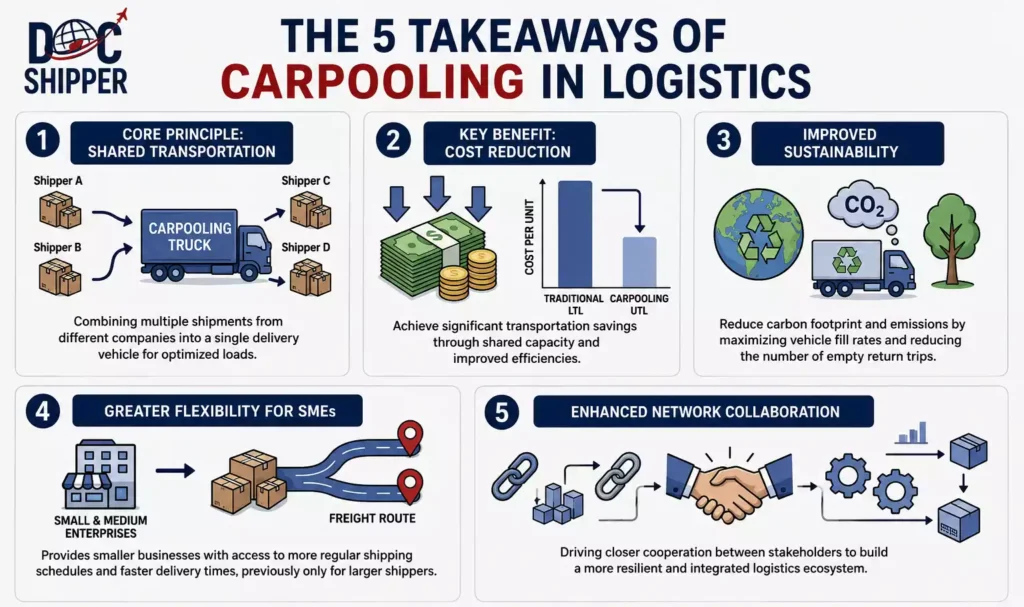
Car pooling in logistics refers to the consolidation of multiple shipments from different shippers into a single vehicle or container to optimize transportation costs, reduce carbon emissions, and maximize cargo space utilization. This collaborative shipping method enables businesses to share freight costs while improving supply chain efficiency and sustainability.
Introduction
Many importers and exporters struggle with high transportation costs when their shipments don’t fill an entire container or truck. This inefficiency creates financial waste and environmental impact that can be avoided through strategic consolidation.
Car pooling represents a fundamental shift in freight management. By combining multiple partial loads, businesses access economies of scale previously reserved for high-volume shippers.
Key characteristics of logistics car pooling include:
- Cost sharing – Multiple shippers divide transportation expenses proportionally
- Route optimization – Carriers maximize vehicle capacity across compatible destinations
- Reduced environmental footprint – Fewer vehicles on roads decrease CO2 emissions
- Flexible scheduling – Regular consolidation cycles accommodate varying shipment volumes
- Enhanced accessibility – Small and medium enterprises gain access to professional freight networks
Mechanisms & Strategic Implementation
The car pooling process begins with shipment aggregation, where freight forwarders collect cargo from multiple clients heading to similar geographic regions. Advanced logistics platforms use algorithms to match compatible loads based on destination, timing, and cargo specifications.
Consolidation centers serve as physical hubs where goods are temporarily stored, sorted, and combined. These facilities operate on strict schedules to maintain delivery timelines while achieving optimal load factors. Modern warehouses use automated systems to track individual shipments within consolidated loads.
Legal frameworks govern liability distribution in pooled shipments. International conventions like the CMR (Convention on the Contract for the International Carriage of Goods by Road) establish clear responsibilities. Each shipper maintains separate documentation while the carrier issues a master bill of lading covering the entire consolidated load.
Technology enables real-time visibility across fragmented shipments. GPS tracking, IoT sensors, and blockchain-based documentation systems allow each participant to monitor their specific cargo within the shared transport. At DocShipper, we implement advanced tracking protocols to ensure complete transparency throughout the consolidation process.
Pricing models typically calculate costs based on volumetric weight or pallet positions. The formula considers actual weight, dimensional measurements, and handling complexity. Carriers apply volumetric conversion ratios (commonly 1m³ = 167kg for air freight, 1m³ = 333kg for ocean freight) to determine billable weight, ensuring fair cost allocation among participants.
For regulatory compliance details, consult the UNECE CMR Convention framework.
Concrete Examples & Performance Data
Industry data demonstrates significant financial advantages. A comparative analysis reveals cost reductions across different consolidation scenarios:
| Shipment Type | Volume | Solo Cost | Pooled Cost | Savings |
|---|---|---|---|---|
| Ocean FCL (20ft) | 8 CBM | $2,400 | $960 | 60% |
| Air Freight | 500 kg | $3,750 | $2,250 | 40% |
| Road Transport | 5 pallets | $1,200 | $600 | 50% |
| Express Parcel | 200 kg | $850 | $595 | 30% |
Use Case: Electronics Importer – A German retailer imports smartphones from China. Individual weekly shipments of 3 CBM would cost $720 per ocean LCL. By joining a weekly consolidation service with four other importers, the cost drops to $288 per shipment, saving $22,464 annually while maintaining the same delivery frequency.
Environmental impact metrics show pooled logistics reduce carbon emissions by 15-30% per ton-kilometer compared to individual shipments. A 2023 European logistics study found that consolidation services prevented 2.4 million metric tons of CO2 emissions across participating networks.
Key performance indicators for successful car pooling programs:
- Load factor efficiency – Achieving 85%+ vehicle capacity utilization
- Transit time consistency – Maintaining ±1 day variance from standard delivery schedules
- Cost predictability – Stable per-unit pricing across quarterly contracts
- Damage rates – Maintaining <0.5% incident rates through proper handling protocols
- Network density – Operating regular consolidations on 15+ major trade lanes
Technology platforms report 40% faster booking times and 25% reduction in documentation errors when using automated consolidation matching systems compared to manual coordination methods.
Conclusion
Car pooling transforms freight economics by democratizing access to efficient transportation networks while advancing sustainability goals. Strategic implementation requires understanding consolidation mechanics, regulatory frameworks, and technology integration.
Need expert guidance on optimizing your shipping consolidation strategy? Contact DocShipper for tailored logistics solutions.
📚 Quiz
Test Your Knowledge: Car Pooling in Logistics
Q1 — What does "car pooling" mean in a logistics context?
Q2 — A common misconception about car pooling in freight is that it always significantly delays deliveries. What does the article actually state?
Q3 — A German retailer ships 3 CBM of smartphones from China weekly. Instead of paying $720 per individual LCL shipment, they join a weekly consolidation pool with four other importers. What is the most accurate outcome according to the article?
🎯 Your Result
📞 Free Quote in 24hFAQ | Car Pooling in Logistics: Definition, Benefits & Practical Applications
Most consolidation services accept shipments from 0.1 CBM (cubic meters) or 50 kg. Smaller parcels may be combined through express groupage services with slightly higher per-kilo rates but still offer savings over individual courier shipments.
Consolidated shipments typically add 2-5 days to transit times compared to dedicated transport due to collection, sorting, and deconsolidation processes. However, regular weekly or bi-weekly schedules provide predictable delivery windows that many businesses find acceptable given the cost savings.
Yes, specialized reefer consolidation exists for perishables and pharmaceuticals. These services group compatible temperature-range cargo (chilled at 2-8°C or frozen at -18°C) while maintaining cold chain integrity through compartmentalized containers and continuous monitoring.
Professional consolidators implement strict cut-off times and may proceed without late shipments to protect other participants' schedules. Late arrivals typically roll to the next consolidation cycle. Liability clauses in service agreements clarify responsibilities for delay-induced costs.
Each shipper's goods are palletized, shrink-wrapped, or placed in sealed cartons with unique identifiers. Consolidation facilities use CCTV surveillance, restricted access protocols, and itemized inventory systems. Cargo insurance covers individual shipments within the consolidated load.
Hazardous materials, high-value goods (above $50,000), and oversized items often require dedicated transport. Standard consolidation accepts general merchandise, consumer goods, industrial components, and commercial samples that meet carrier safety regulations.
Each shipper maintains separate commercial invoices and customs declarations. The consolidator provides a master manifest listing all participants. Customs authorities process individual entries while the physical container clears as a single unit, then deconsolidates at the destination facility.
Volumetric weight pricing dominates, where carriers charge based on whichever is greater: actual weight or dimensional weight (length × width × height ÷ volumetric divisor). This ensures fair pricing for both dense and lightweight cargo within the same consolidation.
Modern logistics platforms provide granular tracking with unique reference numbers for each shipper's cargo. Real-time updates show collection confirmation, consolidation facility arrival, departure, and final delivery milestones specific to your goods.
Car pooling typically offers 20-35% lower costs than standard LCL (Less than Container Load) by achieving higher container fill rates through active load matching. LCL services consolidate based on available space, while dedicated pooling networks optimize routes and frequencies.
Standard requirements include commercial invoice, packing list, shipper's letter of instruction, and any product-specific certificates (origin, phytosanitary, quality). The consolidator issues a house bill of lading or airway bill specific to your portion of the shipment.
Leading providers hold ISO 14001 environmental management certification and participate in programs like SmartWay (North America) or GLEC Framework (global). These verify carbon calculation methodologies and emission reduction commitments through consolidation practices.
Need Help with
Logistics or Sourcing ?
First, we secure the right products from the right suppliers at the right price by managing the sourcing process from start to finish. Then, we simplify your shipping experience - from pickup to final delivery - ensuring any product, anywhere, is delivered at highly competitive prices.


Fill the Form
Prefer email? Send us your inquiry, and we’ll get back to you as soon as possible.
Contact us




