


In short ⚡
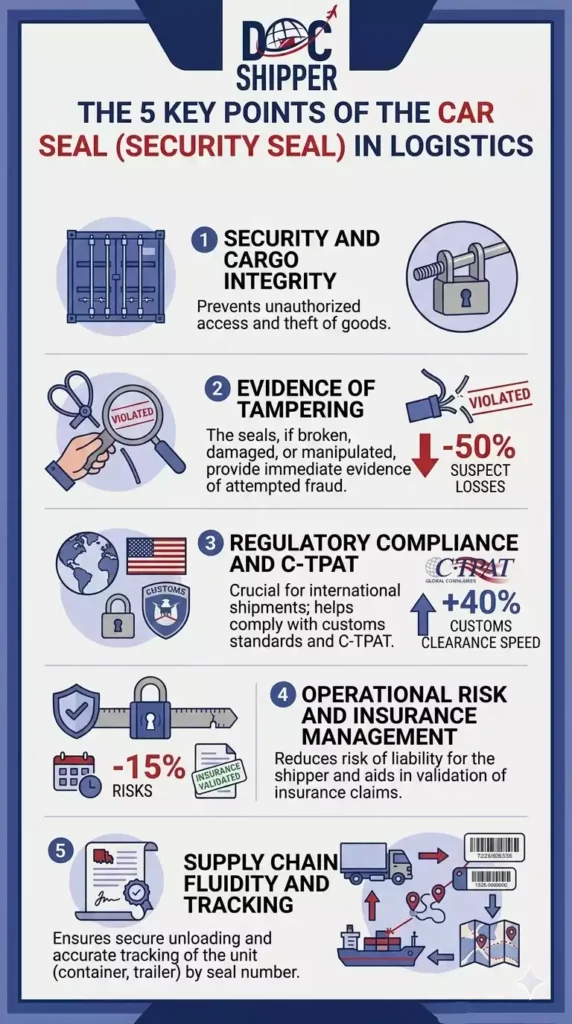
A car seal is a tamper-evident security device used to secure shipping containers, trucks, and cargo compartments during international transport. It ensures cargo integrity by preventing unauthorized access and provides customs authorities with visual proof of non-tampering throughout the supply chain.
Introduction
Many importers discover cargo tampering only after delivery—when it’s too late to file insurance claims or prove breach of custody. The car seal addresses this critical vulnerability by creating an unbroken chain of security from origin to destination.
In international trade, car seals serve as the first line of defense against theft, contamination, and regulatory non-compliance. Customs authorities worldwide require specific seal types for cross-border shipments, making proper seal selection and application essential for smooth clearance.
- Tamper-evident design: Physical destruction required for removal, leaving visible evidence of interference
- Unique identification: Sequential numbering or barcoding enables tracking and verification
- Regulatory compliance: Meets ISO 17712 standards for high-security seals in international shipping
- Multi-point application: Secures container doors, truck panels, and intermodal equipment
- Audit trail creation: Documents custody transfer at each logistics checkpoint
Technical Standards & Regulatory Framework
The ISO 17712 standard classifies car seals into three categories based on security level: indicative, security, and high-security. High-security bolt seals represent the gold standard for containerized cargo, requiring minimum breaking strength of 250 kg and specific construction materials.
Indicative seals provide basic tamper evidence for low-risk shipments. These plastic or wire seals cost $0.10–$0.30 per unit but offer minimal resistance to forced entry. Security seals use reinforced plastic or metal construction with breaking strengths exceeding 100 kg, suitable for domestic trucking and regional transport.
The Container Security Initiative (CSI) mandates high-security seals for all US-bound containers from participating ports. Customs and Border Protection maintains an approved seal manufacturer list, and non-compliant seals trigger automatic inspection holds. At DocShipper, we verify seal compliance before container stuffing to prevent costly clearance delays.
Electronic seals (e-seals) integrate RFID or GPS technology for real-time tracking. These devices transmit location data and breach alerts but cost $15–$50 per unit compared to $2–$5 for mechanical high-security seals. The European Union’s Authorized Economic Operator (AEO) program recognizes e-seals as enhanced security measures.
Seal application protocols require documentation at five critical points: container stuffing, terminal gate-in, vessel loading, discharge port, and final delivery. The Bill of Lading must reference the seal number, and any discrepancy between documented and physical seals mandates cargo inspection. Proper seal placement covers all locking mechanisms—a single unsealed locking bar compromises the entire security system.
Practical Applications & Industry Data
Understanding seal selection and implementation through real-world scenarios demonstrates their impact on supply chain security and operational efficiency. The following data reflects current industry practices across major trade routes.
| Seal Type | Breaking Strength | Cost per Unit | Typical Application |
|---|---|---|---|
| Plastic Indicative | 10–20 kg | $0.10–$0.30 | Domestic LTL, mail bags |
| Cable Security | 100–150 kg | $0.80–$1.50 | Regional trucking, trailers |
| Bolt High-Security | 250+ kg | $2.00–$5.00 | Ocean containers, international |
| Electronic RFID | 150+ kg + tracking | $15.00–$50.00 | High-value cargo, pharmaceuticals |
Use Case: Electronics Shipment from Shenzhen to Rotterdam
A 40-foot container loaded with $280,000 worth of consumer electronics requires ISO 17712 high-security bolt seals. The exporter applies seal #SH4782639 at the factory, documenting it on the packing list and commercial invoice.
At Yantian Port, terminal operators verify the seal matches shipping documents before gate-in. The vessel operator records the seal number on the equipment interchange receipt. Upon arrival in Rotterdam, customs scans the container and confirms seal integrity before releasing it for inland transport. Total seal cost: $3.50. Potential loss from undetected tampering: $280,000 plus insurance deductible.
Key Implementation Data Points
- Seal failure rate: Approximately 0.3% of containers arrive with broken or missing seals, triggering mandatory inspections that delay clearance by 3–7 days
- Inspection probability: Containers with seal discrepancies face 85% physical examination rates versus 3% baseline for compliant shipments
- Cost of non-compliance: Average demurrage and storage charges for seal-related holds exceed $1,200 per container in major US ports
- Documentation errors: 12% of seal-related delays stem from clerical mistakes—incorrect seal numbers on Bills of Lading rather than actual tampering
- Regional variations: Middle Eastern and African ports require photographic seal evidence at stuffing, while Asian ports rely primarily on numerical verification
At DocShipper, we implement triple-verification protocols: photographing seals at container closure, cross-referencing numbers across all shipping documents, and providing clients with seal verification reports before vessel departure. This systematic approach has reduced our seal-related clearance issues by 94% compared to industry averages.
Conclusion
The car seal transforms from a simple locking device into a comprehensive security instrument when properly selected, applied, and documented. Its role extends beyond theft prevention to regulatory compliance and supply chain transparency.
Need expert guidance on seal selection for your specific cargo type or destination? Contact DocShipper for customized logistics solutions that ensure compliance and protect your shipments.
📚 Quiz
Test Your Knowledge: Car Seal
1. What is the primary purpose of a car seal in international logistics?
2. A shipper discovers that the seal number on the physical container does not match the number recorded on the Bill of Lading. What is the correct course of action?
3. A freight forwarder is shipping $280,000 worth of electronics in a 40-foot ocean container from China to Europe. Which seal type is the most appropriate choice?
🎯 Your Result
📞 Free Quote in 24hFAQ | Car Seal: Definition, Types & Practical Applications in International Logistics
Customs authorities will inspect the entire container contents, delaying clearance by 3–7 days. The carrier must file an incident report, and insurance claims require proof of seal integrity at origin. Replacement seals must be documented with new numbers on amended shipping documents.
No. Car seals are single-use devices designed to break upon removal. Attempting to reuse or tamper with seals violates customs regulations and voids cargo insurance. Each new shipment requires a fresh seal with unique identification.
Check the manufacturer's certification documentation and look for the ISO 17712 marking on the seal body. The seal must display a unique identifier and meet minimum breaking strength requirements: 250 kg for high-security classification.
The shipper or their designated agent applies the seal after container stuffing. The seal number must be recorded on the Verified Gross Mass (VGM) declaration, packing list, and Bill of Lading before terminal gate-in.
Bolt seals use solid metal construction with locking pins, offering 250+ kg breaking strength for international containers. Cable seals employ flexible steel cables with lower breaking points (100–150 kg), suitable for domestic trucking and less critical cargo.
Air cargo typically uses security tape and numbered tags rather than mechanical seals due to weight restrictions and different handling processes. However, ULD containers on certain routes may require TSA-approved locking devices.
Seals remain valid until the container reaches its final destination and the consignee breaks them for unloading. For long-term storage, customs may require seal replacement every 30–90 days depending on jurisdiction and cargo type.
E-seals provide enhanced tracking but most customs authorities still require them to meet ISO 17712 physical security standards. They complement rather than replace mechanical seals, adding real-time monitoring to tamper-evident protection.
Immediately notify the shipping line and customs broker. Do not break the seal. The carrier must investigate and issue a corrected document or apply a new seal with proper documentation. Mismatched seals trigger automatic inspections.
No universal color standard exists, but many carriers use color coding internally: red for high-value cargo, yellow for temperature-controlled shipments, and green for standard freight. Always prioritize the unique seal number over color for verification.
Officers cross-reference the physical seal number against shipping documents, check for signs of tampering or replication, and may scan barcodes or RFID chips. Sophisticated forgeries are rare due to manufacturer security features like holograms and microprinting.
Consequences include mandatory 100% cargo inspection, civil fines ranging from $5,000–$25,000 per violation in the US, shipment refusal at destination, and potential suspension from trusted trader programs like C-TPAT or AEO.
Need Help with
Logistics or Sourcing ?
First, we secure the right products from the right suppliers at the right price by managing the sourcing process from start to finish. Then, we simplify your shipping experience - from pickup to final delivery - ensuring any product, anywhere, is delivered at highly competitive prices.


Fill the Form
Prefer email? Send us your inquiry, and we’ll get back to you as soon as possible.
Contact us




