


In short ⚡
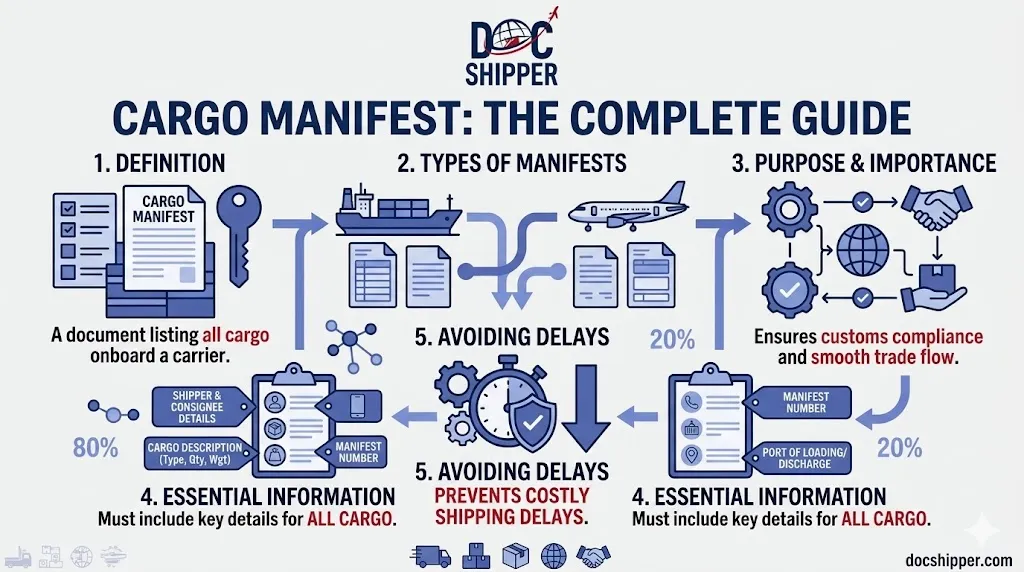
A Cargo Manifest is a comprehensive document listing all goods loaded aboard a vessel, aircraft, or vehicle during international transport. It includes essential details such as shipper and consignee information, cargo description, weight, volume, and container numbers. This document serves as the master inventory for customs authorities, carriers, and logistics operators to verify shipment contents and ensure regulatory compliance throughout the supply chain.
Introduction
Confusion often arises between a cargo manifest and a bill of lading. While both are critical shipping documents, they serve distinct purposes. The cargo manifest provides a complete overview of all shipments aboard a single transport vehicle, whereas individual bills of lading detail specific consignments.
In international trade, the cargo manifest acts as the primary reference document for customs clearance, security screening, and cargo tracking. Without an accurate manifest, shipments face delays, penalties, or even seizure at borders.
Key characteristics include:
- Comprehensive listing of all cargo units aboard a single conveyance
- Mandatory submission to customs authorities before arrival or departure
- Consolidation of multiple bills of lading into one master document
- Inclusion of hazardous material declarations when applicable
- Digital transmission capability through customs electronic systems
Understanding the Components & Legal Framework
The cargo manifest structure varies slightly between maritime, air, and land transport, but core elements remain consistent. Every manifest must identify the carrier, voyage or flight number, port of loading, port of discharge, and detailed cargo information.
For maritime shipments, the manifest includes container numbers, seal numbers, and stowage locations. Air cargo manifests prioritize weight and volume calculations due to aircraft capacity constraints. Road transport manifests focus on vehicle identification and border crossing points.
The shipper’s export declaration data feeds directly into the manifest. Each line item specifies the commodity description using Harmonized System (HS) codes, ensuring customs can properly classify goods for duty assessment. Inaccurate coding triggers automatic risk assessments and potential inspections.
Regulatory compliance requires adherence to international conventions. The International Maritime Organization (IMO) mandates the FAL Convention format for sea cargo manifests. The World Customs Organization (WCO) provides the WCO Data Model as a global standard for electronic customs declarations, which directly impacts manifest data structure.
At DocShipper, we systematically verify manifest accuracy before submission to customs authorities. Our compliance team cross-references each entry against commercial invoices and packing lists to prevent discrepancies that could delay clearance.
The advance manifest rule requires carriers to transmit cargo information to destination customs before departure. The United States enforces the “24-Hour Rule” for ocean freight, while the European Union requires Entry Summary Declarations (ENS) for all imports. Non-compliance results in substantial fines and cargo holds.
Practical Examples & Data Analysis
Understanding manifest requirements through real-world scenarios clarifies their operational impact. Consider a container vessel departing Shanghai for Rotterdam carrying 2,000 TEUs from 150 different shippers.
| Transport Mode | Submission Deadline | Key Data Points | Average Processing Time |
|---|---|---|---|
| Ocean Freight | 24 hours before loading | Container number, seal, HS code, weight | 2-4 hours |
| Air Freight | 4 hours before departure | MAWB number, pieces, weight, volume | 30-60 minutes |
| Road Transport (EU) | 1 hour before border crossing | Vehicle registration, TIR carnet, goods description | 15-30 minutes |
| Rail Freight | 2 hours before departure | Wagon number, consignment note, cargo type | 1-2 hours |
Use Case: A European electronics manufacturer ships 500 laptops via air freight from Frankfurt to Singapore. The cargo manifest must include:
- Master Air Waybill (MAWB) number: 020-12345678
- Number of pieces: 10 pallets
- Gross weight: 1,250 kg
- Volume: 8.5 cubic meters
- HS Code: 8471.30 (portable automatic data processing machines)
The airline submits this data electronically to Singapore Customs via the TradeNet system. Any discrepancy between the manifest and the actual cargo triggers an inspection, potentially delaying delivery by 24-48 hours.
Statistical analysis shows that manifest errors account for 23% of customs clearance delays in major European ports. The most common mistakes include incorrect HS codes (34%), weight discrepancies (28%), and missing shipper details (19%). Automated validation systems reduce error rates by approximately 67%.
DocShipper’s digital platform integrates directly with customs single-window systems, automatically validating manifest data against regulatory databases before submission. This pre-clearance process reduces rejection rates to below 2%, significantly faster than the industry average of 12-15%.
Conclusion
The cargo manifest remains the foundational document enabling efficient international cargo movement. Accurate preparation and timely submission directly determine clearance speed and compliance costs.
Need expert assistance with manifest preparation and customs documentation? Contact DocShipper for comprehensive logistics support tailored to your shipping requirements.
📚 Quiz
Test Your Knowledge: Cargo Manifest
Q1 — What is the primary purpose of a Cargo Manifest?
Q2 — Under the US "24-Hour Rule" for ocean freight, when must the cargo manifest be submitted to customs?
Q3 — A European manufacturer ships 500 laptops by air from Frankfurt to Singapore. The cargo manifest lists the weight as 900 kg, but the actual gross weight is 1,250 kg. What is the most likely consequence?
🎯 Your Result
📞 Free Quote in 24hFAQ | Cargo Manifest: Definition, Components & Practical Examples
A cargo manifest lists all shipments aboard a single transport vehicle, while a bill of lading is a contract for one specific consignment. The manifest consolidates multiple bills of lading into one customs document.
The carrier (shipping line, airline, or trucking company) prepares the manifest based on information provided by shippers and freight forwarders. Ultimate accuracy responsibility lies with the carrier submitting to customs.
Submission deadlines vary by country and transport mode. Ocean freight typically requires 24 hours before loading, air freight 4 hours before departure, and road transport 1 hour before border crossing.
Yes, but amendments must be submitted before cargo arrival and may incur penalties. Some jurisdictions allow electronic corrections within specific timeframes, while others require formal amendment requests.
Errors trigger customs inspections, cargo holds, and potential fines. Minor discrepancies may be corrected administratively, but significant inaccuracies can result in penalties ranging from €500 to €5,000 per violation in the EU.
Yes, all commercial cross-border shipments require a cargo manifest regardless of value or transport mode. Exemptions exist only for diplomatic cargo and certain military shipments under international agreements.
Maritime manifests must include vessel name and voyage number, port of loading and discharge, container numbers, seal numbers, cargo description, HS codes, shipper and consignee details, gross weight, and marks and numbers.
Carriers transmit manifest data through customs single-window systems using standardized formats like EDIFACT or XML. Systems automatically validate data against regulatory requirements before acceptance, providing instant confirmation or error reports.
Penalties vary by jurisdiction. US Customs imposes fines up to $5,000 per violation for late ocean manifests. EU member states apply proportionate penalties based on delay duration and cargo value, typically €300-€2,000 per incident.
Yes, a single cargo manifest typically covers all containers loaded on one vessel, aircraft, or vehicle. Each container is listed as a separate line item with its unique identification number and contents.
Consolidated cargo (multiple shippers in one container) requires a detailed manifest listing each shipper's goods separately. The consolidator submits a master manifest, while individual house bills provide consignment-level details.
Retention requirements vary by country. Most jurisdictions mandate 5-7 years for tax and audit purposes. The EU requires minimum 3 years, while the US Customs mandates 5 years from entry date for import manifests.
Need Help with
Logistics or Sourcing ?
First, we secure the right products from the right suppliers at the right price by managing the sourcing process from start to finish. Then, we simplify your shipping experience - from pickup to final delivery - ensuring any product, anywhere, is delivered at highly competitive prices.


Fill the Form
Prefer email? Send us your inquiry, and we’ll get back to you as soon as possible.
Contact us




