


In short ⚡
Cargo tonnage is the measurement of a vessel's carrying capacity or the total weight of goods transported by ship, truck, or aircraft. It determines freight costs, vessel selection, and compliance with international shipping regulations in global trade operations.
Introduction
Confusion between gross tonnage, net tonnage, and deadweight tonnage causes costly errors in international shipping. Misunderstanding cargo tonnage leads to overcharges, vessel incompatibility, and regulatory penalties.
Cargo tonnage is fundamental to freight forwarding, vessel chartering, and customs clearance. It impacts everything from route planning to insurance premiums in the global supply chain.
- Determines shipping costs: Freight rates are calculated based on weight or volume tonnage.
- Defines vessel capacity: Ensures proper cargo allocation and safety compliance.
- Regulatory requirement: Port authorities and customs use tonnage for documentation and tariffs.
- Influences logistics planning: Affects warehouse space, handling equipment, and delivery schedules.
- Critical for multimodal transport: Tonnage calculations differ across sea, air, and land freight.
Understanding Cargo Tonnage: Technical Depth & Regulations
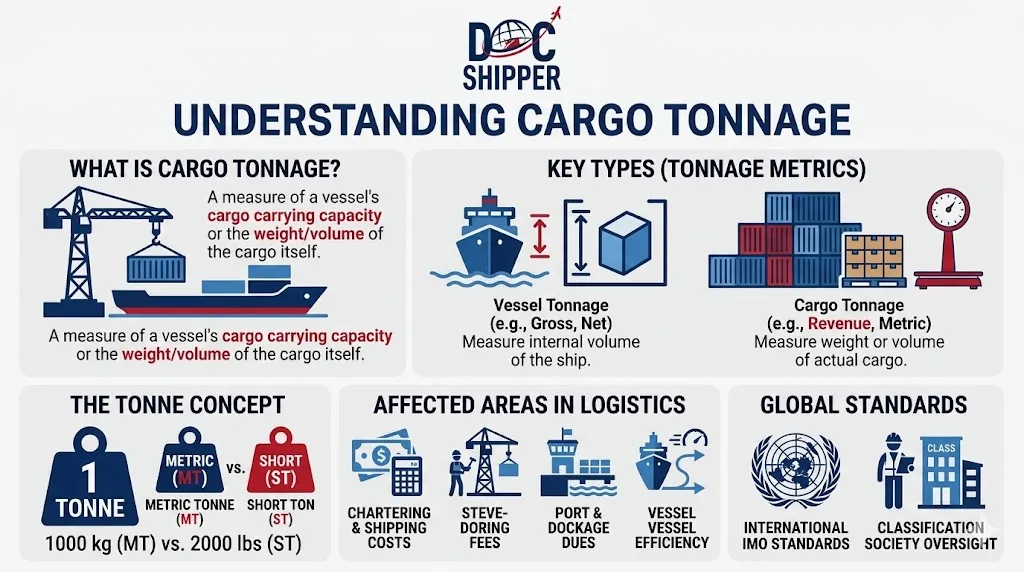
Cargo tonnage encompasses multiple measurement systems. Deadweight tonnage (DWT) represents the total weight a vessel can safely carry, including cargo, fuel, crew, and provisions. This metric is essential for vessel selection and loading plans.
Gross tonnage (GT) measures a ship’s overall internal volume, not weight. It’s calculated using the International Convention on Tonnage Measurement of Ships (1969), determining port fees and regulatory compliance. The formula considers all enclosed spaces multiplied by a coefficient.
Net tonnage (NT) reflects the vessel’s earning capacity by measuring cargo-carrying volume only. Port authorities use NT to calculate docking fees and canal transit charges. According to the International Maritime Organization, NT excludes spaces for crew, machinery, and navigation.
Revenue tonnage determines freight charges. Carriers apply the “whichever is greater” rule between actual weight and volumetric weight. For ocean freight, volumetric weight uses the formula: (Length × Width × Height in cm) ÷ 6000. Air freight typically uses ÷ 5000.
Displacement tonnage measures the weight of water displaced by a vessel, crucial for naval architecture and stability calculations. It equals the ship’s total weight when loaded. At DocShipper, we verify tonnage calculations across all transport modes to prevent billing disputes and ensure regulatory compliance throughout your supply chain.
Practical Examples & Industry Data
Understanding tonnage through real-world scenarios clarifies its practical application in international logistics. These examples demonstrate how tonnage affects cost structures and operational decisions.
| Tonnage Type | Measurement Focus | Primary Use Case | Industry Standard |
|---|---|---|---|
| Deadweight Tonnage | Total carrying capacity | Vessel chartering, cargo planning | Metric tons (MT) |
| Gross Tonnage | Internal vessel volume | Port fees, registration | GT units (dimensionless) |
| Net Tonnage | Cargo-earning volume | Canal tolls, harbor dues | NT units (dimensionless) |
| Revenue Tonnage | Billable weight/volume | Freight cost calculation | kg or CBM |
Use Case 1: Container Ship Optimization
A 20,000 DWT container vessel transports electronics from Shanghai to Rotterdam. Actual cargo weight: 15,000 MT. Volumetric calculation: 18,500 CBM ÷ 1.5 = 12,333 MT equivalent. The carrier bills based on 15,000 MT (higher value), generating $750,000 revenue at $50/MT. Proper tonnage calculation prevents $165,000 revenue loss.
Use Case 2: Air Freight Dimensional Weight
A shipment of textile machinery: Actual weight 2,400 kg. Dimensions: 300×200×180 cm. Volumetric weight: (300×200×180) ÷ 5000 = 2,160 kg. Carrier charges for 2,400 kg at €3.50/kg = €8,400. Understanding this prevents shipper disputes and ensures accurate budgeting.
Key Industry Statistics:
- Global container ship average DWT increased from 50,000 MT (2000) to 85,000 MT (2023).
- Port fees based on GT can range from $0.05 to $0.50 per GT unit depending on jurisdiction.
- Volumetric weight calculations affect 68% of air cargo shipments according to IATA data.
- Suez Canal tolls for vessels over 50,000 GT exceed $300,000 per transit.
- Incorrect tonnage declarations result in average penalties of $15,000 per incident globally.
Conclusion
Cargo tonnage is the cornerstone of accurate freight costing, vessel selection, and regulatory compliance in international trade. Mastering its various forms prevents financial losses and operational delays.
Need expert guidance on tonnage calculations for your shipments? Contact DocShipper for comprehensive freight forwarding solutions tailored to your logistics requirements.
📚 Quiz
Test Your Knowledge: Cargo Tonnage
Q1 — What does Deadweight Tonnage (DWT) measure?
Q2 — A shipper sends a parcel with an actual weight of 2,400 kg and a volumetric weight of 2,160 kg. How will the carrier bill this air freight shipment?
Q3 — Why do port authorities calculate docking fees and canal transit charges based on Net Tonnage (NT) rather than cargo weight?
🎯 Your Result
📞 Free Quote in 24hFAQ | Cargo Tonnage: Definition, Calculation & Concrete Examples
Gross tonnage measures a ship's total internal volume using a mathematical formula, while deadweight tonnage indicates the actual weight capacity for cargo, fuel, and supplies. GT is dimensionless; DWT is measured in metric tons.
Volumetric weight is calculated by multiplying length × width × height (in centimeters), then dividing by a dimensional factor. Ocean freight uses 6000; air freight typically uses 5000. The higher value between actual and volumetric weight determines billing.
Port authorities use gross tonnage because it represents the vessel's overall size and infrastructure impact. Larger ships require more berthing space, deeper channels, and extensive facilities regardless of cargo weight, making GT a fairer fee basis.
Yes, customs authorities often use cargo weight for duty calculations, especially for commodities charged per kilogram or ton. Accurate tonnage declarations prevent penalties and ensure correct tariff classification under harmonized system codes.
Discrepancies trigger inspections, financial penalties, and shipment delays. Carriers may impose surcharges for misdeclared weight. Repeated violations can result in blacklisting, increased scrutiny, and legal consequences under international shipping conventions.
Exceeding deadweight tonnage compromises vessel stability, increasing capsizing risk and structural stress. Maritime regulations mandate strict load limits based on DWT to ensure safe navigation, proper draft levels, and compliance with SOLAS conventions.
Most countries follow the International Convention on Tonnage Measurement (1969), ensuring standardized GT and NT calculations. However, some nations retain legacy systems for domestic vessels, requiring conversion when entering international waters.
Freight class combines density (weight per cubic foot), stowability, handling, and liability. While tonnage determines physical capacity, freight class affects pricing structure. Low-density, high-volume cargo may have lower tonnage but higher freight class rates.
Bulk carriers use grain capacity (cubic meters) and bale capacity for different cargo types. Grain capacity measures maximum volume for free-flowing commodities, while bale capacity accounts for packaged goods. Both relate to DWT limits for safe loading.
Yes, high-volume shippers leverage tonnage commitments for reduced per-ton rates. Contract rates often include minimum tonnage guarantees, volume tiers, and seasonal adjustments. Consistent tonnage volumes strengthen negotiating positions with carriers.
Bills of lading, commercial invoices, packing lists, and customs declarations require accurate tonnage data. Maritime authorities mandate tonnage certificates for vessels, while cargo manifests detail individual shipment weights for regulatory compliance.
Insurance premiums correlate with declared cargo value and tonnage. Higher tonnage increases risk exposure, raising premiums. Accurate tonnage declarations ensure proper coverage; underreporting may void claims, while overreporting inflates unnecessary costs.
Need Help with
Logistics or Sourcing ?
First, we secure the right products from the right suppliers at the right price by managing the sourcing process from start to finish. Then, we simplify your shipping experience - from pickup to final delivery - ensuring any product, anywhere, is delivered at highly competitive prices.


Fill the Form
Prefer email? Send us your inquiry, and we’ll get back to you as soon as possible.
Contact us




