


In short ⚡
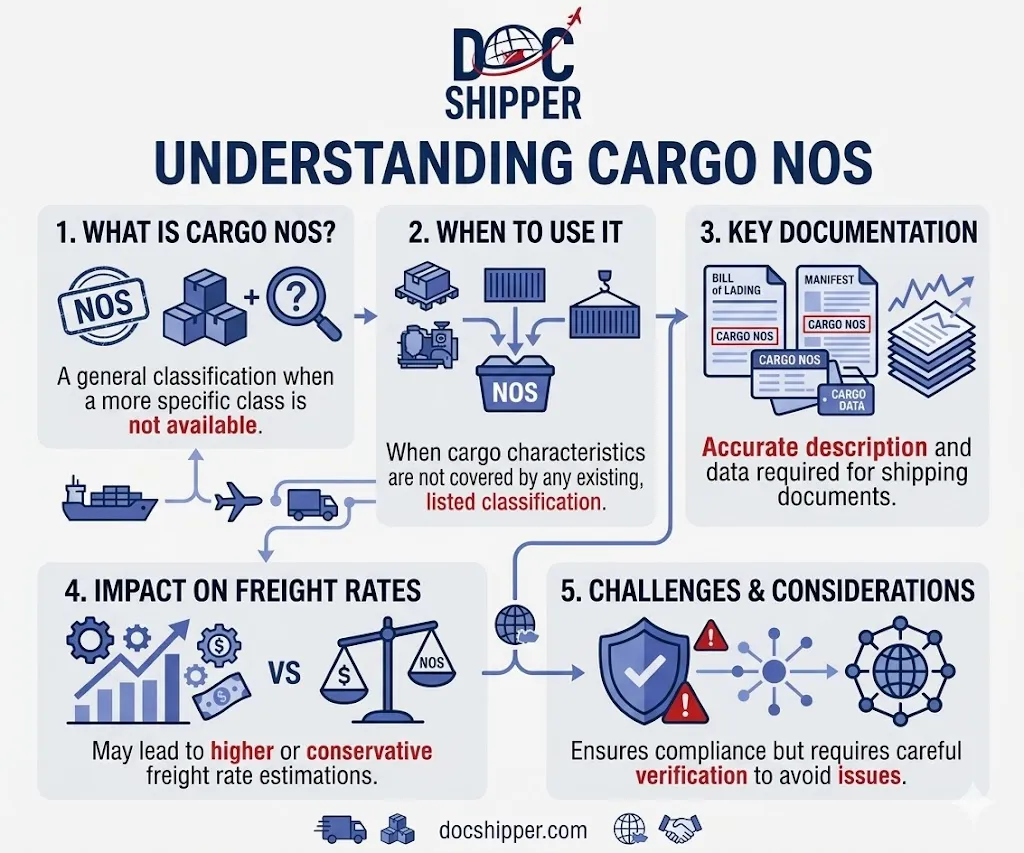
Cargo NOS (Not Otherwise Specified) is a classification term used in international shipping to describe goods that don't fit standard commodity categories or lack precise technical specifications. This designation appears on bills of lading and customs documents when cargo characteristics cannot be detailed comprehensively, requiring additional documentation for proper handling and clearance.Introduction
Shippers frequently encounter confusion when cargo doesn’t match predefined commodity codes. The “Not Otherwise Specified” designation solves this classification challenge but creates potential complications at customs borders.
In global trade, precise cargo identification determines duty rates, handling requirements, and regulatory compliance. NOS classifications serve as placeholders when standard nomenclature proves insufficient.
Key characteristics of Cargo NOS include:
- Used when goods lack specific HS code matches or contain mixed materials
- Requires supplementary documentation explaining cargo composition
- May trigger additional customs inspections and delays
- Common in prototype shipments, custom machinery, or unique assemblies
- Necessitates detailed commercial invoices and technical specifications
Technical Classification & Regulatory Framework
The NOS designation operates within the Harmonized System (HS) maintained by the World Customs Organization. When goods cannot be classified under specific six-digit codes, the NOS category provides a fallback option.
Customs authorities view NOS declarations with heightened scrutiny. The vague nature of this classification raises red flags regarding potential duty evasion or prohibited goods concealment. Importers must provide comprehensive technical documentation to justify the NOS designation.
Dangerous goods regulations apply special restrictions to NOS cargo. The International Maritime Dangerous Goods (IMDG) Code includes specific NOS entries for hazardous materials requiring detailed chemical composition disclosure. Failure to properly declare dangerous goods NOS can result in severe penalties.
Insurance implications become complex with NOS cargo. Underwriters cannot accurately assess risk without precise commodity information, often resulting in higher premiums or coverage limitations. Detailed cargo descriptions mitigate this challenge.
Documentation requirements for NOS shipments exceed standard cargo. Shippers must include technical datasheets, material safety data sheets (MSDS), photographs, and detailed commercial invoices. At DocShipper, we systematically verify all NOS documentation to prevent customs rejections and ensure smooth clearance processes.
For authoritative guidance, consult the World Customs Organization HS nomenclature.
Practical Applications & Case Studies
Understanding NOS applications requires examining real-world scenarios where this classification becomes necessary.
Case Study: Industrial Prototype Equipment
A German manufacturer shipped a custom-built robotic assembly unit to a Chinese factory. The machine combined mechanical, electronic, and pneumatic components in a unique configuration without existing HS code correspondence.
| Challenge | NOS Solution | Outcome |
|---|---|---|
| No matching HS code | Declared as “Industrial machinery NOS” | Required technical drawings + component list |
| Mixed material composition | Detailed material breakdown provided | Customs accepted classification after review |
| Duty rate uncertainty | Pre-clearance ruling requested | 7.5% duty applied vs. potential 15% |
Comparative Analysis: NOS vs. Specific Classification
The following comparison illustrates the impact of NOS designation on shipping efficiency:
| Factor | Standard Classification | NOS Classification |
|---|---|---|
| Customs Clearance Time | 24-48 hours | 3-7 days (inspection likely) |
| Documentation Pages | 5-8 pages | 15-25 pages |
| Inspection Probability | 5-10% | 40-60% |
| Insurance Premium | Standard rate | +15-30% surcharge |
| Duty Dispute Risk | Low (2-3%) | Moderate (15-20%) |
Best Practices for NOS Cargo
Successful NOS shipments require strategic preparation:
- Pre-shipment classification consultation: Engage customs brokers before shipping to explore alternative HS codes
- Comprehensive technical documentation: Include engineering drawings, material certificates, and intended use descriptions
- Proactive customs communication: Submit advance rulings to establish duty rates before cargo arrival
- Photographic evidence: Provide multiple angles showing cargo configuration and labeling
- Value declaration accuracy: Ensure commercial invoice reflects true market value to avoid undervaluation suspicions
Conclusion
Cargo NOS classifications serve essential functions in international trade but demand meticulous documentation and strategic planning. Proper handling transforms potential customs obstacles into manageable administrative processes.
Need expert guidance on NOS cargo documentation? Contact DocShipper for comprehensive customs compliance support.
📚 Quiz
Test Your Knowledge: Cargo NOS
Q1 — What does "Cargo NOS" mean in international shipping?
Q2 — A shipper assumes that using a Cargo NOS designation will speed up customs clearance by avoiding complex classification research. Is this correct?
Q3 — A company is shipping a one-of-a-kind robotic prototype combining mechanical, electronic, and pneumatic parts with no matching HS code. Which approach best reflects correct NOS best practice?
🎯 Your Result
📞 Free Quote in 24hFAQ | Cargo NOS: Definition, Classification & Practical Examples
NOS stands for "Not Otherwise Specified" and indicates cargo that doesn't fit standard commodity classifications. It appears on bills of lading when precise categorization isn't possible with existing nomenclature codes.
The vague nature of NOS classifications raises concerns about duty evasion, prohibited goods concealment, or incorrect valuation. Customs requires detailed documentation to verify legitimate use of this designation.
Often yes, through thorough HS code research and consultation with customs brokers. Many seemingly unique goods have applicable specific classifications that reduce clearance complications and inspection risks.
Expect to provide technical datasheets, material composition certificates, photographs, detailed commercial invoices, intended use statements, and potentially engineering drawings depending on cargo complexity.
Insurance underwriters typically charge 15-30% premium surcharges for NOS cargo due to difficulty assessing risk without precise commodity information. Comprehensive cargo descriptions can mitigate this increase.
Prototype manufacturing, custom machinery fabrication, research equipment, artistic installations, and specialized industrial components commonly require NOS designations due to their unique configurations.
Customs may reclassify cargo under different HS codes, potentially changing duty rates. Severe cases result in cargo detention pending additional documentation or even seizure if prohibited goods are suspected.
Standard NOS clearance requires 3-7 business days versus 24-48 hours for specifically classified goods. Complex cases involving technical reviews may extend to 10-14 days.
Yes, most customs authorities offer binding advance ruling procedures. Submit detailed cargo descriptions before shipment to establish classification and duty rates, reducing clearance uncertainty.
Yes, the IMDG Code includes specific NOS entries for hazardous materials. These require even more detailed chemical composition disclosure and safety documentation than non-hazardous NOS cargo.
"Other" typically appears as a catch-all within specific HS code categories (e.g., "Other machinery parts"), while NOS indicates complete absence of applicable specific classification across all categories.
Experienced forwarders provide classification research, documentation preparation, customs pre-clearance coordination, and dispute resolution. Their expertise significantly reduces NOS-related delays and compliance risks.
Need Help with
Logistics or Sourcing ?
First, we secure the right products from the right suppliers at the right price by managing the sourcing process from start to finish. Then, we simplify your shipping experience - from pickup to final delivery - ensuring any product, anywhere, is delivered at highly competitive prices.


Fill the Form
Prefer email? Send us your inquiry, and we’ll get back to you as soon as possible.
Contact us




