


In short ⚡
A Carrier's Certificate is an official document issued by a transportation company confirming the receipt of goods for shipment. It serves as proof of contract between shipper and carrier, detailing cargo specifications, routing, and handling instructions for international freight operations.
Introduction
In international trade, countless shipments face delays or disputes due to incomplete or incorrect transportation documentation. The Carrier’s Certificate eliminates ambiguity by providing verifiable proof of cargo handover.
This document bridges the gap between contractual agreement and physical movement of goods. It protects both parties in case of damage claims, insurance disputes, or customs inspections.
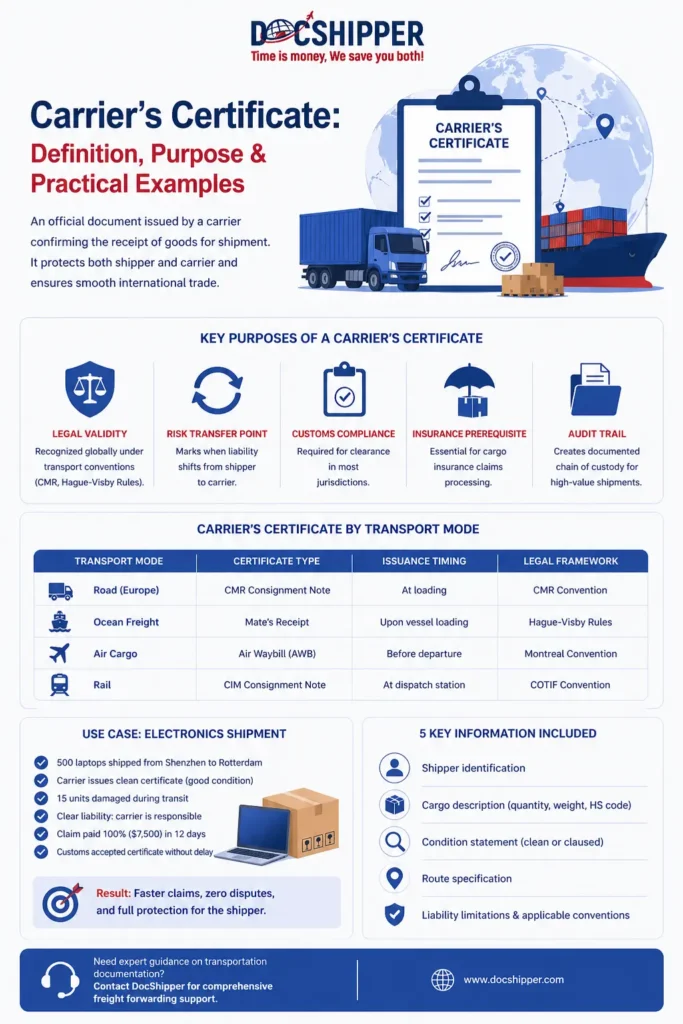
- Legal validity: Recognized globally under transport conventions (CMR, Hague-Visby Rules)
- Risk transfer point: Marks when liability shifts from shipper to carrier
- Customs compliance: Required for clearance in most jurisdictions
- Insurance prerequisite: Essential for cargo insurance claims processing
- Audit trail: Creates documented chain of custody for high-value shipments
Technical Framework & Legal Implications
The Carrier’s Certificate functions within a complex regulatory environment. Unlike a Bill of Lading, which is a negotiable title document, the Carrier’s Certificate primarily serves as evidence of contract terms and cargo receipt.
Under the CMR Convention (Convention on the Contract for the International Carriage of Goods by Road), carriers must issue a receipt document within 24 hours of loading. Maritime transport follows the Hague-Visby Rules, requiring similar documentation standards.
Key legal components include:
- Shipper identification: Full legal name and address of the consignor
- Cargo description: Quantity, weight, volume, and nature of goods (including HS codes)
- Condition statement: Apparent condition of goods at receipt (clean vs. claused)
- Route specification: Origin, destination, and agreed transit points
- Liability limitations: Reference to applicable conventions and carrier’s terms
The document becomes particularly critical during multimodal transport, where goods transfer between different carriers. Each carrier issues their own certificate, creating a documented handover chain.
According to the UNECE CMR Protocol, electronic versions of Carrier’s Certificates now carry the same legal weight as paper documents, provided they meet authentication standards.
At DocShipper, we systematically verify all carrier certificates against booking confirmations to prevent documentation mismatches that could delay customs clearance or trigger inspection holds.
Practical Applications & Real-World Data
Understanding how Carrier’s Certificates function in actual trade scenarios helps businesses avoid costly mistakes. The following comparative analysis demonstrates typical documentation requirements:
| Transport Mode | Certificate Type | Issuance Timing | Legal Framework |
|---|---|---|---|
| Road (Europe) | CMR Consignment Note | At loading | CMR Convention |
| Ocean Freight | Mate’s Receipt | Upon vessel loading | Hague-Visby Rules |
| Air Cargo | Air Waybill (AWB) | Before departure | Montreal Convention |
| Rail | CIM Consignment Note | At dispatch station | COTIF Convention |
Use Case: Electronics Shipment from Shenzhen to Rotterdam
A manufacturer ships 500 laptops (total value: $250,000) via ocean freight. The carrier issues a clean Carrier’s Certificate confirming goods were received in apparent good order.
During transit, 15 units suffer water damage. The importer files a claim. Because the certificate was “clean” (no damage noted at receipt), liability clearly rests with the carrier, not the shipper.
Key data points:
- Claim processing time: Reduced from 45 to 12 days due to clear documentation
- Recovery rate: 100% of damaged goods value ($7,500) compensated
- Insurance deductible: Waived because carrier liability was established
- Documentation cost: Certificate issuance included in freight rate (no additional fee)
- Audit outcome: Customs accepted the certificate without additional verification
This scenario illustrates why DocShipper insists on obtaining clean certificates before goods leave origin facilities. We photograph cargo condition and cross-reference with carrier documentation to prevent disputes.
Conclusion
The Carrier’s Certificate remains a cornerstone of international logistics, providing legal protection and operational clarity. Proper management of this document prevents disputes and accelerates customs processing.
Need expert guidance on transportation documentation? Contact DocShipper for comprehensive freight forwarding support.
📚 Quiz
Test Your Knowledge: Carrier's Certificate
Q1 — What is the primary purpose of a Carrier's Certificate?
Q2 — A Carrier's Certificate is marked as "claused." What does this mean for liability?
Q3 — A shipment of electronics travels from Shenzhen to Rotterdam by sea, then continues by truck to a warehouse in Germany. How are Carrier's Certificates handled in this multimodal scenario?
🎯 Your Result
📞 Free Quote in 24hFAQ | Carrier's Certificate: Definition, Purpose & Practical Examples
A Bill of Lading is a negotiable title document that can transfer ownership, while a Carrier's Certificate is a non-negotiable receipt proving cargo handover. The B/L has broader legal functions in trade finance.
Yes, electronic Carrier's Certificates are legally recognized under CMR e-Protocol and UNCITRAL Model Law on Electronic Transferable Records, provided they meet authentication and integrity standards.
The carrier issues the certificate automatically upon receiving goods. However, shippers should verify receipt of this document within 24 hours to ensure proper documentation for customs and insurance purposes.
A "claused" certificate noting visible damage shifts liability to the shipper or previous handler. This affects insurance claims and may require additional inspection before the carrier accepts responsibility for safe transport.
Requirements vary by jurisdiction. While not always mandatory for domestic transport, carriers typically issue receipts for liability purposes. International shipments always require proper certification for customs clearance.
Retain certificates for at least 3 years (standard limitation period for cargo claims). High-value shipments or regulated goods may require longer retention periods per industry-specific regulations.
Amendments require mutual agreement between shipper and carrier. Corrections must be documented with both parties' signatures. Significant changes may necessitate issuing a replacement certificate to maintain legal validity.
Essential elements include shipper/consignee details, cargo description with weight/volume, apparent condition statement, routing information, carrier identification, issuance date, and applicable liability terms or convention references.
The certificate supports insurance claims by establishing cargo condition at carrier receipt. However, separate cargo insurance policies are required for comprehensive coverage. The certificate alone does not constitute insurance.
In multimodal shipments, each carrier issues a certificate at handover points. These create a documented chain of custody, clarifying liability transitions between road, rail, sea, and air segments.
Customs may reject certificates with incomplete information, mismatched commercial invoice data, or missing required endorsements. Ensure all fields are accurately completed and aligned with other shipping documents.
The certificate confirms goods receipt but doesn't dictate payment terms. Freight charges (prepaid or collect) are specified separately in the transport contract. The certificate validates that contracted services commenced.
Need Help with
Logistics or Sourcing ?
First, we secure the right products from the right suppliers at the right price by managing the sourcing process from start to finish. Then, we simplify your shipping experience - from pickup to final delivery - ensuring any product, anywhere, is delivered at highly competitive prices.


Fill the Form
Prefer email? Send us your inquiry, and we’ll get back to you as soon as possible.
Contact us




