


In short ⚡
The Center of Gravity (COG) is the theoretical point where the entire weight of an object or cargo is concentrated. In logistics, it determines load stability during transport, influences stacking methods, and impacts handling equipment selection. Accurate COG calculation prevents cargo shifts, vehicle rollovers, and container damage during international shipments.
Introduction
Misidentifying the center of gravity causes 23% of cargo damage claims in container shipping. A single miscalculation can trigger chain reactions: container tipping during crane operations, truck instability on highways, or aircraft balance issues. Understanding COG is not optional—it’s a regulatory requirement across maritime, air, and road transport.
In international logistics, the center of gravity directly affects three critical operations:
- Container stuffing: Determines optimal weight distribution to prevent structural stress
- Handling safety: Guides forklift approach angles and lifting points
- Transport compliance: Ensures adherence to IMO SOLAS VGM regulations and IATA DGR standards
- Insurance validity: Incorrect COG declaration may void cargo coverage
- Equipment selection: Influences choice between standard containers, flat racks, or specialized gear
The COG varies with cargo type. Machinery has low COGs due to heavy bases. Palletized goods shift COG upward. Mixed loads require recalculation after each item placement. At DocShipper, we perform systematic COG verification before every container loading to eliminate risk factors.
Technical Implications & Regulatory Framework
The center of gravity operates on three axes—longitudinal, lateral, and vertical. In a 20-foot container, the ideal COG position sits within 30 cm of the geometric center. Deviation beyond this threshold triggers mandatory securing procedures under IMO guidelines.
Key technical principles include:
- Vertical COG: Height above ground level affects rollover risk. Trucks with COG above 1.8m require stability tests per EU Directive 96/53/EC.
- Longitudinal COG: Distance from front axle determines weight distribution. Incorrect positioning violates axle load limits (typically 10-13 tons per axle).
- Lateral COG: Horizontal offset causes container sway during sea transport. SOLAS Chapter VI mandates COG within 15 cm of centerline.
- Dynamic shift: Liquid cargo or unsecured items alter COG during movement, requiring 25% safety margins in calculations.
- Stacking coefficient: When containers stack, cumulative COG affects entire vessel stability—a factor in the 2013 MOL Comfort disaster.
Regulatory compliance extends beyond weight limits. The IMO SOLAS Convention requires verified gross mass (VGM) declarations that implicitly confirm COG accuracy. Shippers must provide this data 24 hours before vessel loading.
Equipment manufacturers design around COG principles. Forklifts display load charts showing maximum capacity at specific COG distances. Container spreaders have sensors detecting imbalance during lifts. At DocShipper, we cross-reference these specifications with actual cargo profiles to prevent operational failures.
Insurance underwriters increasingly scrutinize COG documentation. Policies contain clauses voiding coverage if cargo shifts result from improper weight distribution. A 2021 case involving collapsed steel coils demonstrated how undisclosed COG errors led to $4.2M in uninsured losses.
Calculation Methods & Practical Cases
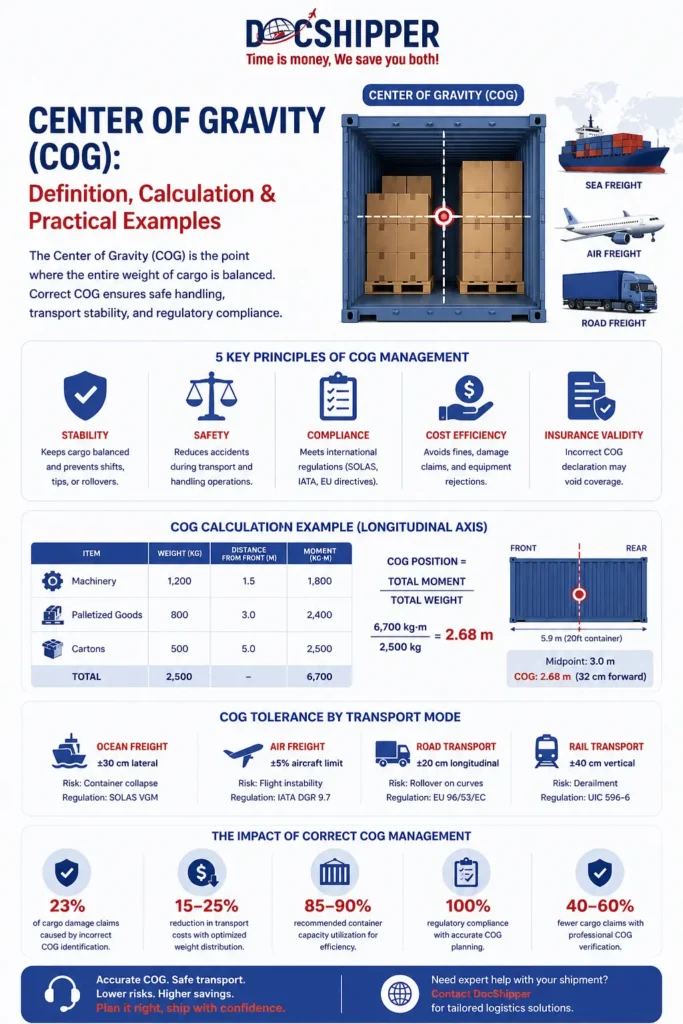
COG calculation follows the moment principle: multiply each item’s weight by its distance from a reference point, sum all moments, then divide by total weight. The formula applies universally across transport modes.
Basic Calculation Example
Scenario: Loading a 20-foot container with three items.
| Item | Weight (kg) | Distance from Front (m) | Moment (kg·m) |
|---|---|---|---|
| Machinery | 1,200 | 1.5 | 1,800 |
| Palletized Goods | 800 | 3.0 | 2,400 |
| Cartons | 500 | 5.0 | 2,500 |
| Total | 2,500 | — | 6,700 |
COG Position: 6,700 kg·m ÷ 2,500 kg = 2.68 meters from front. Container midpoint is at 3.0m, so COG sits 32 cm forward—within acceptable limits.
Real-World Case Study: Heavy Machinery Export
A German manufacturer shipped a 5-ton CNC machine to Brazil. Initial loading placed the machine at the container’s rear, creating a 4.2m COG distance. This exceeded the 3.5m safety threshold for the vessel’s lashing system.
DocShipper’s solution involved:
- Repositioning the machine 1.2m forward using specialized rollers
- Adding 800 kg of counterweight (steel plates) at the front
- Recalculating COG: (5,000×2.8 + 800×0.5) ÷ 5,800 = 2.48m—compliant
- Installing additional lashing straps per IMO CSS Code requirements
- Documenting adjustments for customs and insurance verification
Air Freight Considerations
Aircraft have stricter COG tolerances. A Boeing 747F requires cargo COG within ±5% of design limits. Excess forward COG increases takeoff distance by 15%; aft COG reduces climb performance. Airlines use load planning software that rejects configurations outside these parameters.
Example: A 12-ton shipment of automotive parts required distribution across four ULD containers. The freight forwarder calculated individual COGs, then positioned containers to achieve aircraft-level balance. Front containers held 55% of weight; rear containers 45%—matching the aircraft’s optimal trim.
Comparative Analysis: Transport Modes
| Mode | COG Tolerance | Primary Risk | Regulation |
|---|---|---|---|
| Ocean | ±30 cm lateral | Container collapse | SOLAS VGM |
| Air | ±5% aircraft limit | Flight instability | IATA DGR 9.7 |
| Road | ±20 cm longitudinal | Rollover on curves | EU 96/53/EC |
| Rail | ±40 cm vertical | Derailment | UIC 596-6 |
Software tools like CargoWiz and MAFI Load Calculator automate COG verification. These platforms integrate with 3D container models, showing real-time balance as items are added. DocShipper uses such systems alongside manual checks to ensure dual-layer accuracy.
Conclusion
The center of gravity determines whether cargo arrives intact or becomes a liability. Mastering COG calculation transforms risk into predictability, ensuring regulatory compliance and operational safety across all transport modes.
Need expert guidance on cargo weight distribution for your next shipment? Contact DocShipper for comprehensive logistics support tailored to your specific requirements.
📚 Quiz
Test Your Knowledge: Center of Gravity (COG)
Q1 — What does the Center of Gravity (COG) represent in logistics?
Q2 — A container and another container of identical gross weight are loaded differently. Which statement is correct?
Q3 — A freight forwarder is loading a Boeing 747F with a 12-ton automotive parts shipment. The COG of the loaded aircraft ends up 8% aft of the design limit. What is the most likely consequence?
🎯 Your Result
📞 Free Quote in 24hFAQ | Center of Gravity (COG): Definition, Calculation & Practical Examples
Incorrect COG declarations can void insurance, trigger customs penalties, and cause cargo rejection at ports. Vessels may refuse loading if VGM data conflicts with actual weight distribution, resulting in shipment delays and additional storage fees.
Gross weight measures total mass, while COG indicates where that mass concentrates spatially. Two containers with identical weights can have vastly different COGs depending on internal cargo arrangement, affecting handling and transport safety differently.
Yes, especially with liquid cargo, loose items, or inadequate securing. A 10% COG shift during ocean transport can exceed container design limits. This is why SOLAS requires securing methods that prevent movement exceeding 0.3g acceleration forces.
Professional logistics uses load cells, 3D scanning systems, and weight distribution platforms. Portable systems like Mettler-Toledo's vehicle scales measure axle weights, allowing COG calculation through moment equations. Advanced facilities employ laser-guided positioning systems.
SOLAS mandates VGM for containerized ocean freight, which implicitly requires COG awareness. Air freight under IATA DGR explicitly requires COG documentation for cargo exceeding 150 kg. Road transport regulations vary by jurisdiction but generally require weight distribution compliance.
Divide the object into geometric sections, calculate individual COGs, then apply the weighted average method. For complex shapes, 3D CAD software provides precise calculations. Physical testing using suspension methods offers practical alternatives for unique items.
Container tare weight (empty weight) has its own COG, typically at the base due to steel construction. When calculating loaded COG, you must account for both cargo and container structure, using combined moment calculations for accurate results.
Software enhances accuracy but shouldn't replace physical checks. Systems like CargoWiz predict COG based on input data, but actual loading variations (pallet overhang, packaging differences) require on-site validation. Best practice combines both methods.
Frozen cargo maintains stable COG. Thawing can cause liquid accumulation at container bottoms, lowering COG and creating sloshing effects. Reefer containers require drainage systems and load securing that accounts for potential phase changes during transit.
Machinery: 30-40% of height; palletized goods: 50-60%; bulk liquids: 25-35% (when full); automotive parts: 40-50%; textiles: 55-65%. These percentages represent COG height as a fraction of total cargo height.
Each transport leg requires COG recalculation. Ocean-to-road transfers may need cargo repositioning if truck COG limits differ from vessel requirements. Freight forwarders document COG for each mode, ensuring compliance throughout the supply chain.
Customs may verify VGM declarations against physical cargo. Significant discrepancies trigger detailed inspections. Accurate COG documentation demonstrates professional packing standards, potentially reducing inspection frequency and associated delays at border crossings.
Need Help with
Logistics or Sourcing ?
First, we secure the right products from the right suppliers at the right price by managing the sourcing process from start to finish. Then, we simplify your shipping experience - from pickup to final delivery - ensuring any product, anywhere, is delivered at highly competitive prices.


Fill the Form
Prefer email? Send us your inquiry, and we’ll get back to you as soon as possible.
Contact us




