


In short ⚡
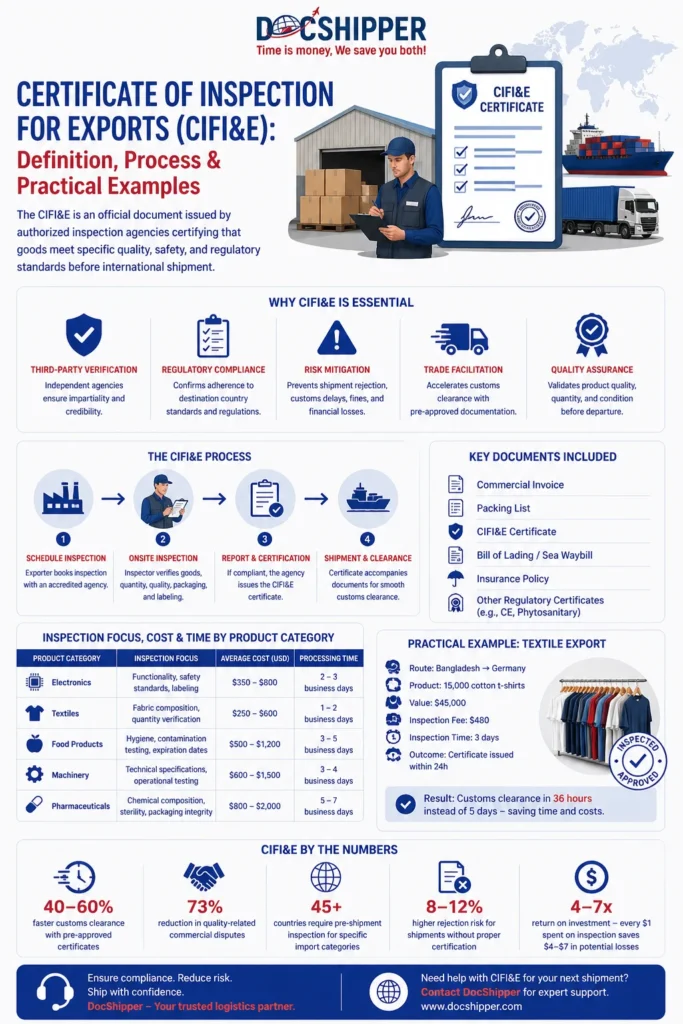
The Certificate of Inspection for Imports and Exports (CIFI&E) is an official document issued by authorized inspection agencies certifying that goods meet specific quality, safety, and regulatory standards before international shipment. This certificate verifies compliance with importing country requirements, preventing customs delays and ensuring product conformity throughout the supply chain.
Introduction
International trade transactions frequently encounter delays due to non-compliant documentation or substandard products. The Certificate of Inspection for Imports and Exports addresses this critical challenge by providing independent verification before goods cross borders.
This certification serves as a quality assurance mechanism that protects both exporters and importers from commercial disputes, regulatory penalties, and reputational damage. Understanding its application is essential for businesses engaged in cross-border commerce.
- Third-party verification: Independent agencies conduct inspections to ensure impartiality and credibility.
- Regulatory compliance: Confirms adherence to destination country standards, including safety and technical specifications.
- Risk mitigation: Reduces the likelihood of shipment rejection, customs detention, or financial losses.
- Trade facilitation: Accelerates customs clearance by providing pre-approved documentation.
- Quality assurance: Validates product specifications, quantity, and condition before departure.
In-Depth Analysis & Regulatory Framework
The CIFI&E operates within a complex regulatory ecosystem governed by international trade agreements, national import regulations, and industry-specific standards. Authorized inspection bodies must hold accreditation from recognized international organizations such as ISO/IEC 17020 or equivalent national authorities.
The inspection process typically encompasses several verification stages. Pre-shipment inspection (PSI) examines goods at the manufacturer’s facility or loading port, verifying quantities, quality specifications, and packaging integrity. Inspectors reference the commercial invoice, packing list, and purchase order to ensure consistency across documentation.
Regulatory mandates vary significantly by destination country and product category. Many developing nations require mandatory PSI programs for imports to prevent fraud, ensure tax compliance, and protect consumers. The World Trade Organization’s Agreement on Preshipment Inspection establishes minimum standards while allowing member states flexibility in implementation.
Certain product categories face heightened scrutiny. Controlled substances, pharmaceuticals, food products, and hazardous materials require specialized certification demonstrating compliance with health, safety, and environmental regulations. For example, the European Union’s CE marking requirements necessitate third-party conformity assessment for specific goods.
At DocShipper, we coordinate directly with accredited inspection agencies to schedule timely verifications, ensuring your shipments meet all regulatory requirements before departure. Our expertise prevents costly delays and facilitates smooth customs clearance.
The legal implications of CIFI&E extend beyond customs compliance. This certificate often serves as evidence in commercial disputes, insurance claims, and quality disagreements. Courts and arbitration panels recognize properly issued certificates as credible documentation of goods’ condition at shipment time.
For authoritative guidance on international inspection standards, consult the World Trade Organization’s Preshipment Inspection Agreement, which establishes transparency principles and dispute resolution mechanisms for member countries.
Practical Examples & Industry Data
Understanding CIFI&E application through real-world scenarios clarifies its practical value in international logistics operations. The following examples demonstrate how this certification functions across different trade contexts.
Comparative Analysis: Inspection Requirements by Product Category
| Product Category | Inspection Focus | Average Cost (USD) | Processing Time |
|---|---|---|---|
| Electronics | Functionality, safety standards, labeling | $350-$800 | 2-3 business days |
| Textiles | Fabric composition, quantity verification | $250-$600 | 1-2 business days |
| Food Products | Hygiene, contamination testing, expiration dates | $500-$1,200 | 3-5 business days |
| Machinery | Technical specifications, operational testing | $600-$1,500 | 3-4 business days |
| Pharmaceuticals | Chemical composition, sterility, packaging integrity | $800-$2,000 | 5-7 business days |
Use Case: Textile Export from Bangladesh to European Union
Scenario: A Dhaka-based garment manufacturer ships 15,000 units of cotton t-shirts valued at $45,000 to a German retailer.
Inspection Process: An SGS inspector visits the factory three days before shipment. The inspection verifies fabric composition (100% cotton as specified), confirms accurate quantity through random sampling (statistical quality control), checks labeling compliance with EU textile regulations, and examines packaging durability for ocean freight.
Documentation: Upon successful inspection, SGS issues the CIFI&E within 24 hours. This certificate accompanies the commercial invoice, bill of lading, and EUR.1 movement certificate. German customs accepts the documentation without additional physical inspection, reducing clearance time from 5 days to 36 hours.
Financial Impact: The $480 inspection fee prevents potential issues that could have resulted in shipment rejection (estimated cost: $8,000 in return shipping, storage, and lost sales), demonstrating a 16:1 return on investment for quality assurance.
Key Statistical Insights
- Customs clearance acceleration: Shipments with pre-approved CIFI&E experience 40-60% faster customs processing compared to non-certified goods.
- Dispute reduction: Independent inspection certificates decrease quality-related commercial disputes by approximately 73% according to International Chamber of Commerce data.
- Mandatory markets: Over 45 countries require some form of pre-shipment inspection for specific import categories, particularly in Africa, Middle East, and Latin America.
- Rejection rates: Products without proper certification face 8-12% higher probability of customs detention or outright rejection.
- Cost-benefit ratio: Every dollar spent on pre-shipment inspection typically saves $4-$7 in potential logistics complications and commercial penalties.
Conclusion
The Certificate of Inspection for Imports and Exports represents an essential risk management tool in international trade, providing independent verification that protects all parties in cross-border transactions. Proper implementation accelerates customs clearance while preventing costly commercial disputes.
Need expert guidance on inspection requirements for your specific shipment? Contact DocShipper for comprehensive support throughout your international logistics process.
📚 Quiz
Certificate of Inspection for Imports & Exports (CIFI&E)
Q1 — What is the primary purpose of a Certificate of Inspection for Imports and Exports (CIFI&E)?
Q2 — A common misconception about CIFI&E is that it is mandatory for all international shipments. What is the correct interpretation?
Q3 — A Dhaka-based exporter ships 15,000 cotton t-shirts to Germany. An SGS inspector issues a CIFI&E after verifying fabric composition, quantity, and labeling. What is the most likely outcome at German customs?
🎯 Your Result
📞 Free Quote in 24hFAQ | Certificate of Inspection for Exports (CIFI&E): Definition, Process & Practical Examples
Accredited third-party inspection agencies such as SGS, Bureau Veritas, Intertek, and national standards organizations issue CIFI&E certificates. These bodies must hold ISO/IEC 17020 accreditation or equivalent recognition from importing country authorities to ensure international acceptance.
No, requirements vary by destination country and product type. Many nations mandate inspection for specific categories like food, pharmaceuticals, electronics, or high-value goods. Exporters should verify destination country regulations before shipment to determine if certification is compulsory.
Inspection fees range from $250 to $2,000 depending on product complexity, shipment value, inspection location, and required testing. Standard container inspections average $400-$600, while specialized technical products or laboratory testing increase costs proportionally to verification complexity.
Standard inspections require 1-3 business days for scheduling and execution, with certificate issuance within 24-48 hours post-inspection. Complex products requiring laboratory analysis may extend timelines to 5-7 business days. Advance scheduling 7-10 days before shipment ensures timely completion.
Failed inspections result in non-issuance of the certificate. Exporters must address identified deficiencies through product corrections, re-packaging, or documentation amendments before requesting re-inspection. Some agencies offer conditional certificates allowing minor corrections post-shipment with buyer agreement.
No, the inspection certificate complements but does not replace standard export documents like commercial invoices, packing lists, bills of lading, or certificates of origin. It serves as additional verification supporting customs clearance and contractual compliance rather than substituting mandatory shipping documentation.
While major inspection agencies enjoy broad international recognition, some countries require specific accredited bodies or national inspection programs. Exporters should confirm which inspection agencies the destination country's customs authority accepts to avoid certificate rejection at import.
Standard certificates include exporter/importer details, product description and specifications, quantity and weight verification, inspection date and location, compliance statement with referenced standards, inspector identification, unique certificate number, and official agency stamp. Some include photographic evidence of inspected goods.
Inspections typically occur at the manufacturer's facility, warehouse, or port of loading before shipment. Some agencies offer destination inspections upon arrival, though pre-shipment verification is more common and effective for preventing logistics complications. Location flexibility depends on agency capabilities and client requirements.
Pre-shipment inspection certificates strengthen insurance claims by documenting goods' condition before transit. If damage occurs during transportation, the certificate proves the product's initial quality, facilitating carrier liability determination and claim settlement. Insurers often reduce premiums for certified shipments.
Yes, electronic CIFI&E certificates with digital signatures and secure authentication increasingly gain acceptance alongside traditional paper versions. Many customs authorities now accept PDF certificates with verification codes, though some jurisdictions still require original stamped documents. Verify destination country digital documentation policies before relying exclusively on electronic formats.
CIFI&E verifies general quality, quantity, and compliance with contractual specifications. Certificate of Conformity specifically attests that products meet technical regulations, safety standards, or mandatory certification schemes of the destination market. Some shipments require both documents serving complementary verification purposes.
Need Help with
Logistics or Sourcing ?
First, we secure the right products from the right suppliers at the right price by managing the sourcing process from start to finish. Then, we simplify your shipping experience - from pickup to final delivery - ensuring any product, anywhere, is delivered at highly competitive prices.


Fill the Form
Prefer email? Send us your inquiry, and we’ll get back to you as soon as possible.
Contact us




