


In short ⚡
Coastwise shipping refers to the maritime transportation of goods or passengers between ports located within the same country's territorial waters. This domestic shipping activity is governed by specific national regulations, most notably cabotage laws, which typically restrict such operations to vessels registered under the country's flag to protect domestic maritime industries and employment.Introduction
Many international shippers mistakenly assume that moving cargo between two domestic ports follows the same rules as cross-border transport. This confusion can lead to costly compliance issues, vessel seizures, or shipment delays when cabotage restrictions apply.
In global logistics, coastwise shipping represents a critical component of domestic supply chains. It connects remote coastal regions, supports island economies, and provides cost-effective alternatives to land transport for bulk commodities and containers.
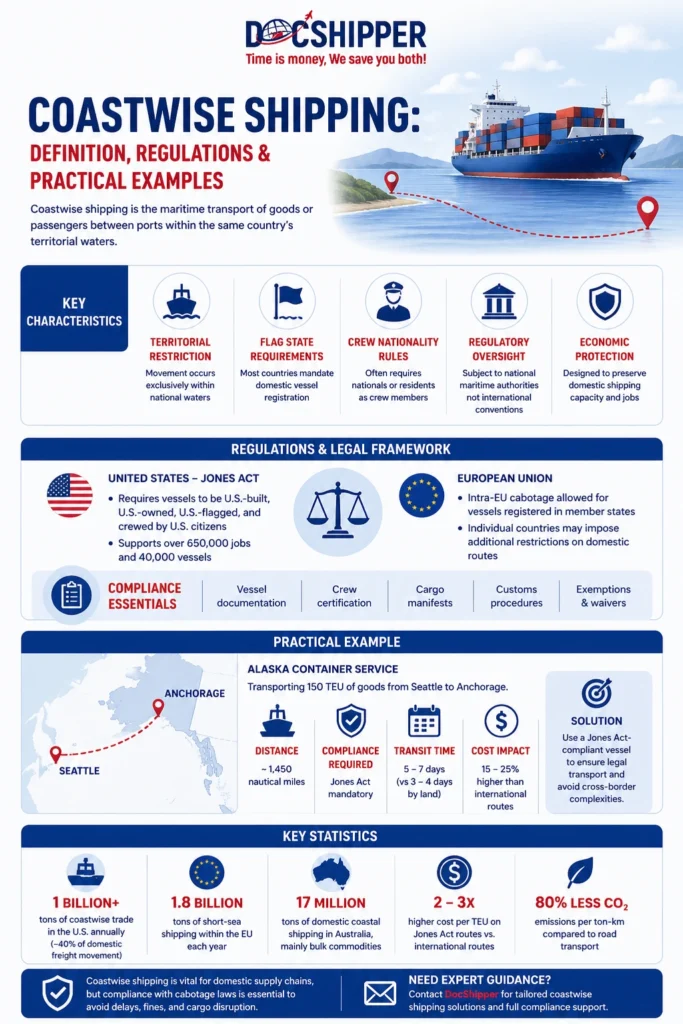
Key characteristics of coastwise operations include:
- Territorial restriction: Movement occurs exclusively within national waters
- Flag state requirements: Most countries mandate domestic vessel registration
- Crew nationality rules: Often requires nationals or residents as crew members
- Regulatory oversight: Subject to national maritime authorities rather than international conventions
- Economic protection: Designed to preserve domestic shipping capacity and employment
Regulations & Legal Framework
Coastwise shipping regulations vary significantly across jurisdictions, but most maritime nations enforce some form of cabotage law. These protectionist measures reserve domestic maritime trade for nationally-flagged vessels, creating barriers to entry for foreign operators.
In the United States, the Jones Act (Merchant Marine Act of 1920) represents one of the world’s strictest cabotage regimes. It requires vessels engaged in coastwise trade to be U.S.-built, U.S.-owned, U.S.-flagged, and crewed by U.S. citizens. According to the U.S. Maritime Administration, approximately 40,000 vessels operate under these provisions, supporting over 650,000 jobs.
The European Union maintains a different approach. While EU regulations permit intra-EU cabotage for vessels registered in member states, individual countries may impose additional restrictions for purely domestic routes. This creates a layered regulatory environment requiring careful navigation.
At DocShipper, we systematically verify vessel eligibility for coastwise movements during the planning phase, ensuring compliance with national cabotage requirements and avoiding regulatory complications that could delay your shipments.
Critical compliance elements include:
- Vessel documentation: Proper registration certificates and compliance declarations
- Crew certification: Verification of nationality requirements and maritime qualifications
- Cargo manifests: Accurate declaration of domestic origin and destination points
- Customs procedures: Specific documentation for goods moving between domestic ports
- Exemptions and waivers: Understanding temporary relief provisions during emergencies or capacity shortages
Practical Examples & Data
Understanding coastwise shipping becomes clearer through real-world applications and comparative analysis. Different industries leverage domestic maritime transport in distinct ways, each facing unique regulatory and operational considerations.
Comparative Analysis: Coastwise vs. International Shipping
| Criteria | Coastwise Shipping | International Shipping |
|---|---|---|
| Vessel Flag Requirements | Must match country of operation | Any internationally recognized flag |
| Customs Clearance | Simplified or exempt | Full import/export procedures |
| Crew Nationality | Often restricted to nationals | International crew permitted |
| Regulatory Authority | National maritime agencies | International conventions (SOLAS, MARPOL) |
| Cost Structure | Higher labor costs, limited competition | Competitive international market rates |
Use Case: Alaska Container Service
A logistics company needs to transport 150 TEU of consumer goods from Seattle, Washington to Anchorage, Alaska—both U.S. ports separated by Canadian territory.
Scenario constraints:
- Distance: Approximately 1,450 nautical miles
- Jones Act compliance mandatory
- Limited vessel availability due to U.S.-build requirement
- Transit time: 5-7 days versus 3-4 days for land transport through Canada
- Cost premium: 15-25% higher than comparable international routes
Solution: The company contracts a Jones Act-compliant container vessel, accepting the cost premium to avoid complex cross-border trucking through Canadian customs, which would require international documentation, duty calculations, and potential delays at two border crossings.
Key Industry Data Points
- U.S. coastwise trade volume: Over 1 billion tons annually, representing approximately 40% of domestic freight movement
- European short-sea shipping: Handles 1.8 billion tons yearly within EU waters, reducing road congestion
- Australia coastal shipping: Transports 17 million tons domestically, primarily bulk commodities like iron ore and coal
- Cost differential: Jones Act routes average 2-3 times higher per TEU than comparable international distances
- Environmental benefit: Coastal shipping produces 80% less CO₂ per ton-kilometer compared to road transport
Conclusion
Coastwise shipping remains an essential yet complex component of domestic logistics, governed by protective regulations that vary significantly across jurisdictions. Understanding cabotage laws and compliance requirements is crucial for efficient supply chain planning.
Need expert guidance navigating coastwise shipping regulations for your domestic routes? Contact DocShipper for tailored logistics solutions that ensure full compliance and operational efficiency.
📚 Quiz
Test Your Knowledge: Coastwise Shipping
Q1 — What does "coastwise shipping" specifically refer to?
Q2 — A foreign-flagged vessel wants to transport cargo between two U.S. ports. Under the Jones Act, is this permitted?
Q3 — A logistics company ships 150 TEU from Seattle to Anchorage via a Jones Act-compliant vessel instead of cross-border trucking through Canada. What is the primary regulatory reason for this choice?
🎯 Your Result
📞 Free Quote in 24hFAQ | Coastwise Shipping: Definition, Regulations & Practical Examples
Coastwise shipping describes the activity of transporting goods between domestic ports, while cabotage refers to the legal restrictions reserving this trade for nationally-flagged vessels. Cabotage laws regulate who can perform coastwise operations.
Generally no, but some countries grant temporary waivers during emergencies, capacity shortages, or for specialized vessels unavailable in the domestic fleet. Each waiver requires specific government approval and documentation.
The Jones Act typically increases U.S. coastwise shipping costs by 15-300% compared to international routes due to higher vessel construction costs, limited fleet availability, and elevated crew wages. The exact premium varies by route and cargo type.
Yes. Penalties include substantial fines (often 100-200% of cargo value), vessel seizure, cargo confiscation, and potential criminal charges against vessel operators. Compliance verification is essential before commencing any domestic maritime movement.
Typically no, since goods remain within the same country's jurisdiction. However, vessels must file domestic cargo manifests with maritime authorities, and certain regulated commodities may require additional documentation regardless of domestic status.
Island nations like Indonesia, the Philippines, and Japan maintain strict cabotage regimes to protect inter-island connectivity and domestic maritime industries. These countries often have extensive domestic shipping networks critical to national supply chains.
Short-sea shipping refers to maritime transport over relatively short distances, often along coastlines. Within a single country, it constitutes coastwise trade; between neighboring countries, it becomes international shipping subject to different regulations.
This creates regulatory complexity. If cargo physically enters a foreign port between two domestic destinations, it may lose coastwise status and require international customs procedures. Direct routing is generally required to maintain domestic shipping classification.
Coastwise vessels must comply with national environmental standards, which may be stricter or more lenient than international IMO conventions. Emission control areas, ballast water management, and fuel sulfur content regulations apply based on domestic law.
Yes. Passenger ferries operating between domestic ports must comply with cabotage laws regarding vessel registration and crew nationality. Many countries apply even stricter safety and certification requirements for passenger-carrying coastwise vessels.
Essential documents include vessel registration certificates, crew certifications proving nationality compliance, domestic cargo manifests, bills of lading specifying domestic ports, and declarations confirming goods originated within the country or were previously imported and cleared.
Post-Brexit, UK-flagged vessels lost automatic cabotage rights within EU waters and vice versa. Movements between UK ports remain UK coastwise trade, while movements between EU ports require EU-flagged vessels, creating new operational barriers for previously integrated services.
Need Help with
Logistics or Sourcing ?
First, we secure the right products from the right suppliers at the right price by managing the sourcing process from start to finish. Then, we simplify your shipping experience - from pickup to final delivery - ensuring any product, anywhere, is delivered at highly competitive prices.


Fill the Form
Prefer email? Send us your inquiry, and we’ll get back to you as soon as possible.
Contact us




