


In short ⚡
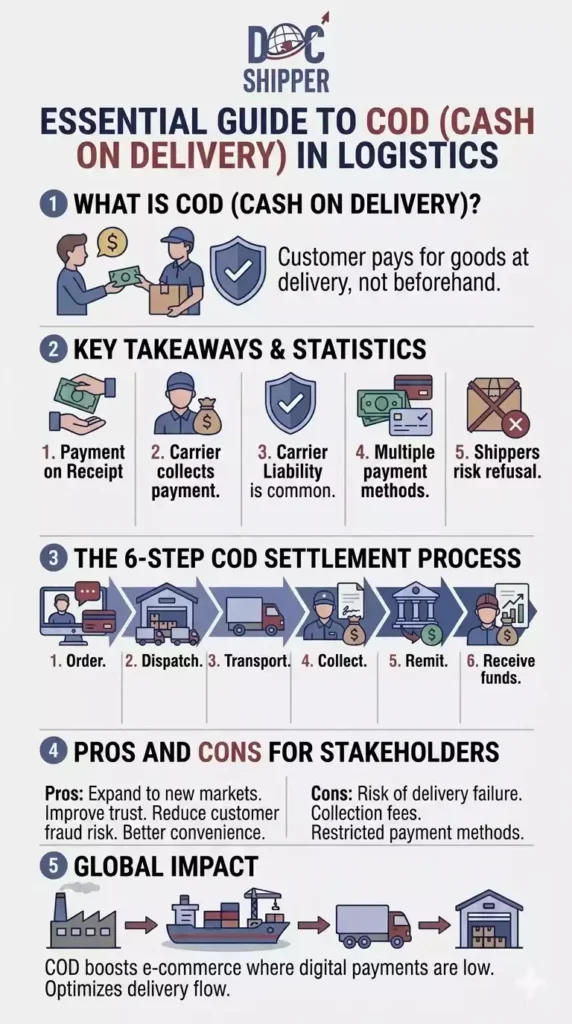
Cash on Delivery (COD) is a payment method where the buyer pays for goods at the moment of delivery rather than in advance. This transaction model transfers payment risk from buyer to seller, requiring logistics providers to collect funds and remit them to merchants, making it essential in markets with low digital payment adoption.Introduction
Many international sellers lose sales because buyers don’t trust online payment systems. This hesitation creates a fundamental barrier in cross-border e-commerce, particularly in emerging markets.
Cash on Delivery (COD) solves this trust gap by allowing customers to inspect goods before payment. This model has become indispensable in regions where credit card penetration remains low and cash remains king.
Understanding COD mechanics is crucial for import/export operations because:
- Risk management: Logistics partners assume financial responsibility for collection
- Return rates: COD orders show 15-30% higher refusal rates than prepaid orders
- Cash flow impact: Payment cycles extend 7-21 days versus instant online transactions
- Geographic necessity: Markets like India, Middle East, and Southeast Asia demand COD options
- Operational complexity: Requires reverse logistics infrastructure and cash handling protocols
COD Mechanisms & Operational Expertise
The COD process involves multiple stakeholders coordinating financial and physical flows. The seller ships goods through a logistics provider who collects payment and remits funds after deducting service fees.
Payment collection protocols vary by carrier and jurisdiction. Couriers must verify amounts, accept only designated payment methods (cash, card terminals, digital wallets), and issue receipts. Documentation requirements include proof of delivery signatures linked to payment confirmation.
Fee structures typically include a percentage-based commission (2-5% of order value) plus fixed handling charges. High-value shipments may incur additional insurance costs. At DocShipper, we negotiate volume-based COD rates with carriers to reduce merchant costs while maintaining service quality.
Settlement cycles determine when sellers receive collected funds. Standard remittance occurs weekly or bi-weekly, though some carriers offer expedited settlement for premium fees. Reconciliation reports must match delivery confirmations with payment records to identify discrepancies.
Regulatory compliance becomes critical when COD crosses borders. Countries like Saudi Arabia require customs pre-clearance with declared values matching COD amounts. The European Union mandates VAT collection at point of sale for imports under €150, complicating COD implementations.
Fraud prevention measures include address verification, phone confirmation calls, and order value limits. Repeated refusals from the same customer trigger blacklisting. Biometric delivery confirmation and geofencing technologies help reduce false delivery claims.
Practical Examples & Market Data
COD adoption varies dramatically by region and product category. Analyzing real-world scenarios reveals operational implications for international merchants.
Regional COD Penetration Rates
| Region | COD Share of E-commerce | Average Order Value | Return Rate |
|---|---|---|---|
| Middle East | 65-75% | $85 | 25-30% |
| India | 50-60% | $45 | 20-25% |
| Southeast Asia | 40-50% | $35 | 18-22% |
| Eastern Europe | 30-40% | $60 | 15-18% |
| Western Europe | 5-10% | $95 | 8-12% |
Cost Calculation Example
A fashion retailer shipping 1,000 units monthly to Dubai faces these COD economics:
- Average order value: $120
- COD service fee: 3.5% + $2 fixed = $6.20 per order
- Successful deliveries: 750 orders (25% refusal rate)
- Total COD fees: 750 × $6.20 = $4,650
- Return shipping costs: 250 × $15 = $3,750
- Monthly COD overhead: $8,400 (7% of gross revenue)
Switching to prepaid payment would eliminate $4,650 in collection fees but could reduce conversion rates by 40-50% in COD-dependent markets, resulting in net revenue loss.
Sector-Specific Performance
Electronics: COD works well for items $50-$300. Higher values trigger buyer hesitation and fraud concerns. Refusal rates average 18%.
Fashion and apparel: Highest COD adoption (70% in emerging markets) but suffers 28% return rates due to sizing issues and “try before buy” mentality.
Health and beauty: Moderate COD usage (45%) with lower returns (12%) due to consumable nature and brand loyalty factors.
At DocShipper, we implement tiered COD strategies based on product categories and destination markets, optimizing payment mix to balance conversion rates against operational costs.
Conclusion
Cash on Delivery remains a strategic necessity in markets where digital payment infrastructure lags consumer demand. While operationally complex and costlier than prepaid models, COD unlocks significant revenue opportunities in high-growth regions.
Need expert guidance on implementing COD in your international logistics strategy? Contact DocShipper for customized solutions that balance market access with cost efficiency.
📚 Quiz
Test Your Knowledge: Cash on Delivery (COD)
Q1 — What does Cash on Delivery (COD) fundamentally mean for the buyer?
Q2 — A merchant is considering switching all COD orders to prepaid payment in the Middle East. What is the most likely consequence?
Q3 — A fashion retailer ships 1,000 COD orders to Dubai at $120 average order value, with a 3.5% + $2 fixed fee and a 25% refusal rate. What is the total monthly COD overhead?
🎯 Your Result
📞 Free Quote in 24hFAQ | COD (Cash on Delivery): Definition, Calculation & Practical Examples
COD specifically refers to cash payment, while payment on delivery can include card terminals or digital wallets at the doorstep. Modern interpretations often use COD as an umbrella term for all delivery-time payment methods.
If a customer refuses delivery, no payment occurs, eliminating refund needs. For accepted deliveries with subsequent returns, merchants issue refunds directly to customers through original payment channels or bank transfers.
Yes, but with restrictions. Customs regulations require declared values, and cross-border COD adds complexity in currency conversion, extended settlement times, and higher service fees (typically 5-8% versus 2-4% domestic).
Most carriers cap COD at $500-$1,500 to manage cash handling risks. High-value items require prepayment or specialized secure delivery services with insurance coverage.
Standard remittance occurs 7-14 days after delivery. Express settlement options reduce this to 3-5 days for additional fees. Settlement speed depends on carrier policies and transaction volumes.
Customers face no financial commitment until delivery, reducing purchase consideration. The ability to inspect goods before payment encourages impulse orders and "try-at-home" behavior, increasing refusal likelihood.
Hybrid models include partial prepayment (30-50% upfront, remainder on delivery) and escrow services where payment is held until delivery confirmation. Digital COD uses mobile wallets at delivery instead of cash.
Duties and taxes must be prepaid or collected separately from COD amounts. DDP (Delivered Duty Paid) terms require sellers to cover all fees, while DDU (Delivered Duty Unpaid) passes costs to buyers, complicating COD transactions.
Essential documents include commercial invoice matching COD amount, delivery receipt with payment confirmation, proof of identity verification, and remittance reconciliation reports for accounting purposes.
Emerging models allow first installment collection on delivery with subsequent payments via digital channels. This requires integration between logistics providers and fintech platforms, currently limited to specific markets.
Strategies include phone verification before dispatch, address validation against databases, order value limits for new customers, and blacklisting repeat refusers. Some platforms use machine learning to score order legitimacy.
Couriers are trained to verify exact amounts before releasing goods. Overpayments require refund processing, while underpayments result in delivery refusal. Clear amount communication and digital payment terminals minimize discrepancies.
Need Help with
Logistics or Sourcing ?
First, we secure the right products from the right suppliers at the right price by managing the sourcing process from start to finish. Then, we simplify your shipping experience - from pickup to final delivery - ensuring any product, anywhere, is delivered at highly competitive prices.


Fill the Form
Prefer email? Send us your inquiry, and we’ll get back to you as soon as possible.
Contact us




:%20Definition,%20Calculation%20&%20Practical%20Examples)