


In short ⚡
The Company Security Officer (CSO) is the designated person responsible for implementing and maintaining a shipping company's security measures in compliance with the International Ship and Port Facility Security (ISPS) Code. This maritime security role ensures that vessels and port operations meet international safety standards, coordinate with port facilities, and manage security assessments and training for crew members.
Introduction
In international maritime trade, security breaches can halt operations, trigger massive fines, and jeopardize entire supply chains. Yet many shipping companies struggle to understand who actually bears responsibility for security compliance.
The Company Security Officer serves as the critical link between shore-based management and vessel operations. This role became mandatory following the 2004 implementation of the ISPS Code, which revolutionized maritime security after 9/11.
Key characteristics of the CSO position include:
- Regulatory compliance: Ensures adherence to ISPS Code and national maritime security regulations
- Risk assessment: Conducts security evaluations for vessels and company operations
- Coordination function: Serves as liaison between ship security officers, port facilities, and authorities
- Training oversight: Develops and implements security training programs for maritime personnel
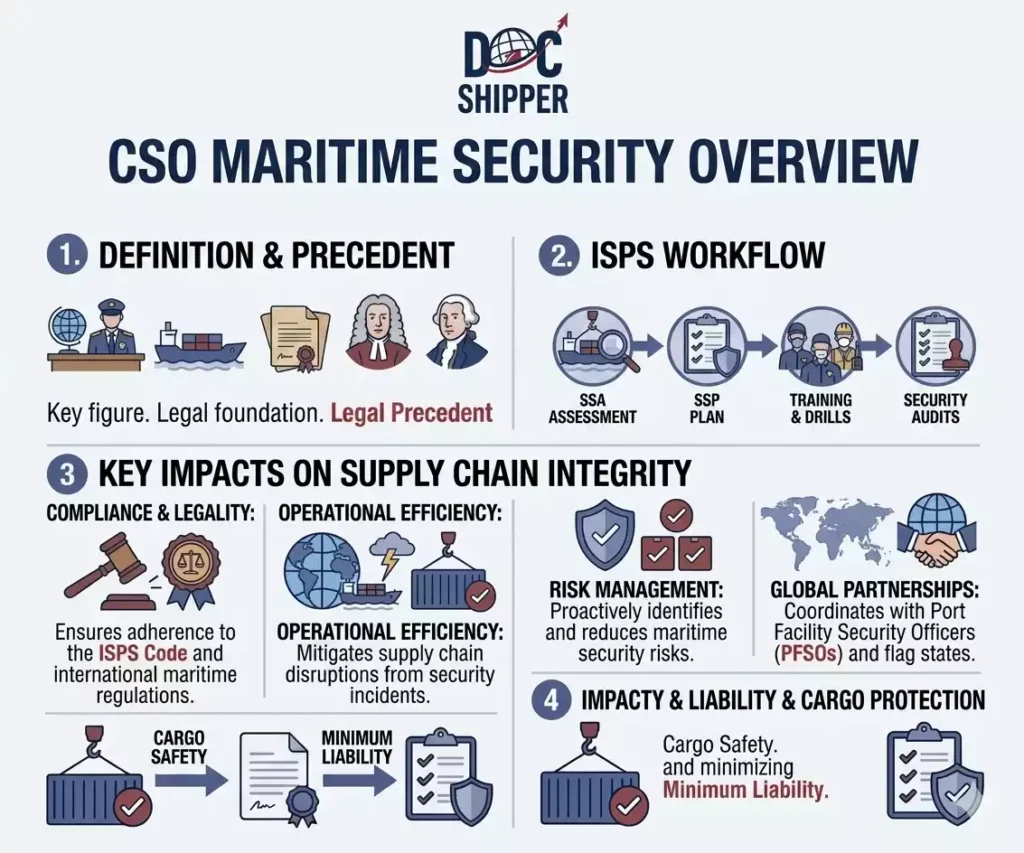
- Documentation management: Maintains Ship Security Plans (SSP) and security-related records
CSO Expertise & Core Responsibilities
The Company Security Officer operates at the strategic level of maritime security management. Unlike the Ship Security Officer who works aboard vessels, the CSO manages security from the company’s shore-based offices.
The position requires comprehensive knowledge of international maritime law, particularly Chapter XI-2 of SOLAS (Safety of Life at Sea) and the ISPS Code. The CSO must understand how these regulations translate into operational procedures across different flag states and port jurisdictions.
A fundamental responsibility involves developing and maintaining Ship Security Plans for each vessel in the company fleet. These plans must address three security levels defined by the ISPS Code, outlining specific measures for routine operations, heightened threats, and imminent security incidents.
The CSO conducts regular security audits and inspections to verify that vessels comply with approved security plans. This includes reviewing access control systems, surveillance equipment, security drills, and crew training records. At DocShipper, we coordinate with CSOs during pre-shipment planning to ensure security documentation aligns with cargo requirements and port facility protocols.
Interface with port facility security officers represents another critical function. The CSO must establish communication protocols, coordinate security level changes, and resolve security concerns that arise during port calls. This coordination becomes especially important when vessels operate in high-risk regions or handle sensitive cargo.
The role also encompasses incident management and reporting. When security breaches occur, the CSO investigates root causes, implements corrective actions, and submits required reports to flag state authorities and the International Maritime Organization (IMO). According to IMO guidelines, proper incident documentation protects companies from liability and helps improve industry-wide security practices.
Practical Implementation & Industry Examples
Understanding CSO responsibilities through real-world scenarios clarifies how this role functions within international logistics operations.
Use Case: Container Shipping Company Fleet Management
A mid-sized container shipping company operates 15 vessels across European and Asian routes. Their CSO manages security for the entire fleet from Hamburg headquarters.
| CSO Activity | Frequency | Impact |
|---|---|---|
| Ship Security Plan updates | Annual review + route changes | Ensures regulatory compliance across jurisdictions |
| Security training coordination | Quarterly for new crew | Maintains crew competency standards |
| Port facility liaison | Before each port call | Prevents delays from security mismatches |
| Security equipment audits | Semi-annual | Identifies equipment failures before inspections |
| Incident investigation | As needed | Mitigates liability and improves procedures |
This company avoided $180,000 in potential fines last year because their CSO identified outdated security procedures before a Port State Control inspection in Singapore.
Key Performance Indicators for CSO Effectiveness
Measuring CSO performance helps companies optimize their security investment:
- Zero security-related port detentions: Indicates proper preparation and documentation
- 100% crew training completion: Demonstrates effective training program management
- Average response time under 4 hours: For security level changes or incident notifications
- Annual security drill completion rate: Should maintain 100% across all vessels
- Security equipment uptime above 98%: Reflects proactive maintenance oversight
At DocShipper, we work closely with CSOs during cargo booking to verify that security requirements align with vessel capabilities, particularly for high-value shipments or regulated commodities that require enhanced security measures.
Conclusion
The Company Security Officer serves as the cornerstone of maritime security compliance, translating international regulations into operational reality while protecting both vessels and cargo from security threats. This role demands continuous vigilance, regulatory expertise, and effective coordination across the entire maritime supply chain.
Need guidance on maritime security requirements for your international shipments? Contact DocShipper for expert assistance with security documentation and compliance coordination.
📚 Quiz
Test Your Knowledge: Company Security Officer (CSO)
Q1 — What is the primary role of a Company Security Officer (CSO) in maritime logistics?
Q2 — A common misconception is that the CSO and the Ship Security Officer (SSO) perform the same job. What is the key difference?
Q3 — A shipping company's vessel is about to call at a port in a high-risk region. Which action falls under the CSO's responsibility?
🎯 Your Result
📞 Free Quote in 24hFAQ | Company Security Officer (CSO): Definition, Role & Responsibilities in International Logistics
CSOs must complete approved ISPS Code training, possess knowledge of ship operations and port facility security, and understand relevant international conventions. Many hold maritime officer certificates or security management certifications.
Yes, ISPS regulations permit one individual to serve as CSO for multiple companies, provided they can effectively fulfill responsibilities for all assigned vessels and maintain required communication channels.
The CSO works shore-side managing company-wide security policy and compliance, while the Ship Security Officer implements security measures aboard a specific vessel and reports to the CSO.
Operating without a CSO violates ISPS Code requirements, potentially resulting in vessel detention, port access denial, substantial fines, and loss of insurance coverage for security-related incidents.
SSPs require formal review at least annually, but CSOs must update them immediately when operational changes occur, new threats emerge, or regulatory requirements change.
ISPS Code requirements apply to passenger ships and cargo vessels over 500 gross tonnage engaged in international voyages. Smaller vessels and domestic-only operations may have different requirements.
CSOs implement measures for Security Level 1 (normal operations), Level 2 (heightened risk), and Level 3 (imminent threat), adjusting procedures based on government advisories and threat assessments.
While CSOs may delegate specific tasks, they retain ultimate accountability for security compliance. Delegation must be documented with clear assignment of duties and reporting lines.
CSOs establish communication protocols with Port Facility Security Officers, exchange security-relevant information, coordinate Declaration of Security when required, and resolve security concerns before vessel arrival.
Required records include Ship Security Plans, training certificates, security drill logs, incident reports, security equipment maintenance records, and correspondence with authorities and port facilities.
Standard CSO training courses run 3-5 days and cover ISPS Code requirements, security assessment methodology, plan development, and coordination procedures. Recertification typically occurs every five years.
CSOs frequently manage varying security requirements across different ports, balance security costs with operational efficiency, maintain crew engagement with security procedures, and adapt to evolving cyber security threats in maritime operations.
Need Help with
Logistics or Sourcing ?
First, we secure the right products from the right suppliers at the right price by managing the sourcing process from start to finish. Then, we simplify your shipping experience - from pickup to final delivery - ensuring any product, anywhere, is delivered at highly competitive prices.


Fill the Form
Prefer email? Send us your inquiry, and we’ll get back to you as soon as possible.
Contact us




:%20Definition,%20Role%20&%20Responsibilities%20in%20International%20Logistics)