


In short ⚡
A Confirmed Letter of Credit is a payment instrument in international trade where a second bank (usually in the exporter's country) adds its guarantee to the issuing bank's commitment. This dual guarantee significantly reduces payment risk for exporters by ensuring they receive funds even if the buyer's bank defaults.
Introduction
Many exporters hesitate to ship goods to high-risk markets due to concerns about payment default. A single bank guarantee may not suffice when political instability or banking sector volatility threatens transaction security.
The Confirmed Letter of Credit addresses this challenge by introducing a second layer of security. This instrument is essential for businesses expanding into emerging markets or dealing with unfamiliar financial institutions.
- Dual bank guarantee protecting seller’s interests
- Compliance with UCP 600 international banking standards
- Risk mitigation against country and bank-specific threats
- Enhanced credibility for transactions in volatile regions
- Premium cost structure reflecting added security layer
Mechanism & Legal Framework
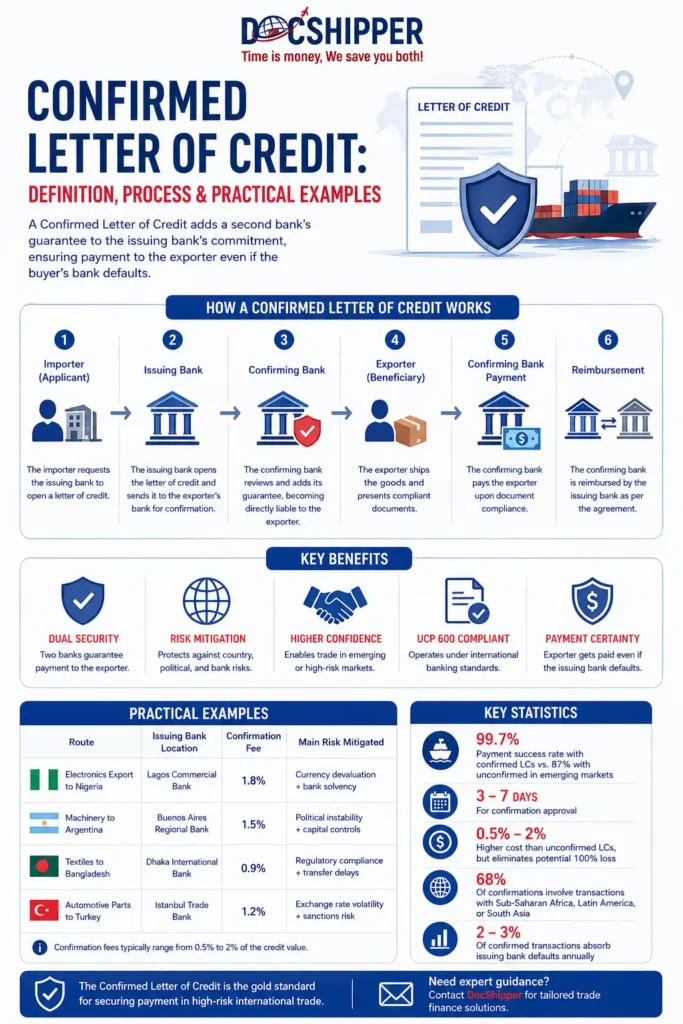
The confirmation process involves four parties: the importer (applicant), the issuing bank, the confirming bank, and the exporter (beneficiary). When the issuing bank opens a letter of credit, it requests confirmation from a bank in the seller’s jurisdiction.
The confirming bank independently evaluates the transaction and, upon acceptance, becomes directly liable to the beneficiary. This creates an irrevocable payment obligation separate from the issuing bank’s commitment. The legal framework operates under the Uniform Customs and Practice for Documentary Credits (UCP 600), published by the International Chamber of Commerce.
Key operational mechanisms include document examination, where the confirming bank verifies compliance with credit terms before releasing payment. The reimbursement chain ensures the confirming bank recovers funds from the issuing bank after honoring the exporter’s claim. Amendment procedures require consent from all parties, maintaining transaction integrity throughout the process.
Country risk assessment drives confirmation decisions. Banks evaluate political stability, currency convertibility, and sovereign credit ratings before committing. At DocShipper, we systematically recommend confirmed letters of credit when our clients export to countries with ratings below investment grade or facing sanctions.
The cost structure reflects this added security. Confirmation fees typically range from 0.5% to 2% of the credit value, depending on perceived risk. This premium ensures payment certainty even in challenging markets.
Practical Examples & Data
Understanding the practical application of confirmed letters of credit requires examining real-world scenarios and comparative data. The following examples demonstrate how this instrument functions across different risk profiles.
| Scenario | Issuing Bank Location | Confirmation Fee | Risk Mitigated |
|---|---|---|---|
| Electronics Export to Nigeria | Lagos Commercial Bank | 1.8% of LC value | Currency devaluation + bank solvency |
| Machinery to Argentina | Buenos Aires Regional Bank | 1.5% of LC value | Political instability + capital controls |
| Textiles to Bangladesh | Dhaka International Bank | 0.9% of LC value | Regulatory compliance + transfer delays |
| Automotive Parts to Turkey | Istanbul Trade Bank | 1.2% of LC value | Exchange rate volatility + sanctions risk |
Use Case: European Exporter to African Market
A German manufacturer ships €500,000 worth of industrial equipment to Kenya. The Kenyan importer arranges a letter of credit through Nairobi Commercial Bank. Given Kenya’s B+ sovereign rating and recent banking sector challenges, the German exporter requests confirmation.
A Frankfurt-based confirming bank charges 1.4% (€7,000) for adding its guarantee. When the exporter presents compliant documents, the confirming bank pays within 5 business days, regardless of the issuing bank’s status. Three months later, when the issuing bank faces liquidity issues, the exporter has already received full payment—demonstrating the instrument’s protective value.
Key Data Points:
- Payment certainty: 99.7% success rate with confirmed LCs versus 87% with unconfirmed in emerging markets
- Processing time: 3-7 days for confirmation approval, 5-10 days for payment after document presentation
- Cost differential: Confirmed LCs cost 0.5-2% more than unconfirmed, but eliminate potential 100% loss exposure
- Geographic concentration: 68% of confirmations involve transactions with Sub-Saharan Africa, Latin America, or South Asia
- Default prevention: Confirming banks absorb issuing bank defaults in approximately 2-3% of confirmed transactions annually
At DocShipper, we facilitate the confirmation process by liaising with both issuing and confirming banks, ensuring document compliance and accelerating payment cycles for our clients.
Conclusion
The Confirmed Letter of Credit remains the gold standard for securing payment in high-risk international trade. By adding a second bank’s unconditional guarantee, exporters gain confidence to expand into challenging markets without compromising financial security.
Need expert guidance on structuring your international payment terms? Contact DocShipper for tailored trade finance solutions.
📚 Quizz
Test Your Knowledge: Confirmed Letter of Credit
Q1 — What is the defining feature of a Confirmed Letter of Credit?
Q2 — A common misconception is that a Confirmed LC can be cancelled by the issuing bank or the buyer after issuance. Is this correct?
Q3 — A German exporter is shipping machinery to a buyer in Argentina, whose issuing bank has a below-investment-grade rating. Which approach best protects the exporter?
🎯 Your Result
📞 Free Quote in 24hFAQ | Confirmed Letter of Credit: Definition, Process & Practical Examples
A confirmed LC includes a second bank's payment guarantee, while an unconfirmed LC relies solely on the issuing bank's commitment. Confirmation adds security but increases costs by 0.5-2%.
Typically, the exporter pays confirmation fees unless contract terms specify otherwise. Buyers may agree to cover costs as a negotiation concession, particularly in competitive bidding situations.
Yes, but all parties must consent to the amendment. The confirming bank reassesses risk before accepting, which may delay the transaction by 5-10 business days.
Exporters frequently seek confirmation for transactions involving Nigeria, Argentina, Pakistan, Bangladesh, Turkey, and countries under economic sanctions or experiencing banking sector instability.
Confirming banks typically require 3-7 business days to evaluate and approve confirmation requests, depending on the issuing bank's creditworthiness and country risk assessment.
The exporter can seek alternative confirming banks, negotiate different payment terms (such as advance payment or escrow), or proceed with an unconfirmed LC while accepting higher risk.
Yes, confirmation adds an irrevocable guarantee from the confirming bank. Neither the issuing bank nor the applicant can cancel the confirmation without the beneficiary's explicit consent.
No. Only banks with international trade finance departments and correspondent banking relationships provide confirmation. Regional banks often lack the infrastructure and risk appetite for this service.
The confirming bank pays the exporter immediately upon compliant document presentation, then seeks reimbursement from the issuing bank through correspondent banking channels, typically within 2-5 days.
Yes, though uncommon. Partial confirmation covers a specified percentage or fixed amount, reducing the confirming bank's exposure while providing limited protection to the exporter.
Confirming banks examine the original LC, issuing bank's SWIFT message, transaction details, underlying contract, and compliance with UCP 600 rules before committing their guarantee.
Rarely. Confirmation primarily addresses country risk and bank solvency concerns. Transactions with top-tier banks in stable economies typically proceed with unconfirmed LCs, avoiding unnecessary costs.
Need Help with
Logistics or Sourcing ?
First, we secure the right products from the right suppliers at the right price by managing the sourcing process from start to finish. Then, we simplify your shipping experience - from pickup to final delivery - ensuring any product, anywhere, is delivered at highly competitive prices.


Fill the Form
Prefer email? Send us your inquiry, and we’ll get back to you as soon as possible.
Contact us




