


In short ⚡
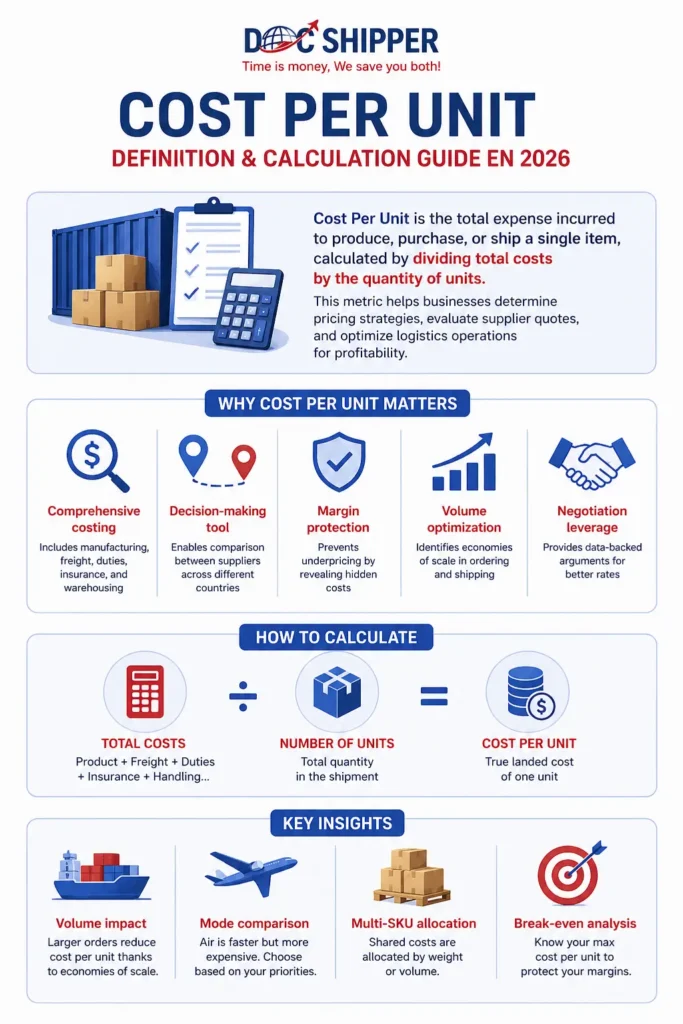
Cost Per Unit is the total expense incurred to produce, purchase, or ship a single item, calculated by dividing total costs by the quantity of units. This metric helps businesses determine pricing strategies, evaluate supplier quotes, and optimize logistics operations for profitability.Introduction
Many importers struggle to determine the true cost of their products once shipping, customs duties, and handling fees are included. Without accurate cost per unit calculations, pricing decisions become guesswork, margins shrink unexpectedly, and competitive positioning suffers.
In international trade, understanding this metric is essential for evaluating supplier proposals, comparing transportation modes, and ensuring each shipment remains profitable. It transforms abstract expenses into actionable data.
- Comprehensive costing: Includes manufacturing, freight, duties, insurance, and warehousing
- Decision-making tool: Enables comparison between suppliers across different countries
- Margin protection: Prevents underpricing by revealing hidden costs
- Volume optimization: Identifies economies of scale in ordering and shipping
- Negotiation leverage: Provides data-backed arguments for better rates
Understanding Cost Per Unit in Logistics
The cost per unit extends beyond the factory gate price. In logistics, it encompasses every expense from production through final delivery. This includes freight charges, customs clearance fees, insurance premiums, and warehousing costs.
The formula appears simple: Total Costs ÷ Number of Units = Cost Per Unit. However, complexity arises when allocating shared expenses like container shipping across multiple SKUs or accounting for variable costs that change with order volume.
Fixed costs remain constant regardless of quantity—mold fees, quality inspections, or minimum freight charges. Variable costs scale with volume—raw materials, per-unit customs duties, or pick-and-pack fees. Understanding this distinction prevents miscalculation when projecting costs for different order sizes.
International trade introduces additional layers. Incoterms determine which party bears specific costs. Under EXW (Ex Works), the buyer assumes all transportation expenses. Under DDP (Delivered Duty Paid), the seller covers everything. Each term dramatically alters the cost per unit calculation.
At DocShipper, we systematically break down every cost component during quotation to ensure clients understand their true landed cost per unit before committing to orders. This transparency prevents budget overruns and enables informed purchasing decisions.
Currency fluctuations add another variable. A product quoted at $5 per unit may cost $5.30 after exchange rate shifts between order placement and payment. Hedging strategies or fixed-rate agreements mitigate this risk but must be factored into the final calculation.
For regulatory compliance, accurate cost per unit documentation is critical. Customs authorities like U.S. Customs and Border Protection require precise valuations for duty assessment. Underreporting triggers penalties; overreporting inflates unnecessary costs.
Calculation Methods & Practical Examples
Consider an importer ordering 1,000 units of electronics from China to the United States. The supplier quotes $8,000 FOB Shanghai. The complete cost breakdown reveals the true cost per unit:
| Cost Component | Total Amount | Per Unit |
|---|---|---|
| Product Cost (FOB) | $8,000 | $8.00 |
| Ocean Freight | $1,200 | $1.20 |
| Customs Duties (6.5%) | $520 | $0.52 |
| Customs Clearance | $350 | $0.35 |
| Inland Transport | $450 | $0.45 |
| Insurance | $180 | $0.18 |
| Total Landed Cost | $10,700 | $10.70 |
The landed cost per unit of $10.70 is 34% higher than the initial factory price. Retailers who budgeted based solely on the $8 FOB quote would face unexpected margin erosion.
Volume impact analysis: Ordering 2,000 units instead of 1,000 demonstrates economies of scale. Fixed costs like customs clearance ($350) remain unchanged, reducing the per-unit allocation. Ocean freight might increase to $1,800 (not double), yielding a new cost per unit of approximately $9.85—an 8% savings.
Transportation mode comparison: Air freight for the same shipment costs $6,500 but delivers in 5 days versus 30 days by sea. The cost per unit becomes $15.25. However, faster inventory turnover and reduced warehousing may justify the premium for high-demand products.
Multi-SKU allocation: When shipping three products in one container, shared costs must be distributed. A common method allocates freight proportionally by weight or cubic volume. A 500kg product line bears more freight cost than a 200kg line sharing the same container.
Break-even analysis: If retail price is $25 per unit with a target 40% margin, the maximum allowable cost per unit is $15. The current $10.70 provides $4.30 buffer for marketing, storage, and unforeseen expenses. This calculation guides minimum order quantities and pricing strategies.
Conclusion
Mastering cost per unit calculations transforms logistics from a cost center into a strategic advantage. Accurate costing enables competitive pricing, protects margins, and informs every supply chain decision from supplier selection to order quantities.
Need expert assistance calculating your true landed costs? Contact DocShipper for a comprehensive cost analysis tailored to your specific import requirements.
📚 Quiz
Test Your Knowledge: Cost Per Unit
Q1 — What does "Cost Per Unit" represent in international logistics?
Q2 — An importer orders 1,000 electronics units at $8 FOB and pays $2,700 in additional logistics costs. What is the landed cost per unit?
Q3 — A retailer targets a 40% margin on a $25 retail price. Their current landed cost per unit is $10.70. Which statement correctly describes their situation?
🎯 Your Result
📞 Free Quote in 24hFAQ | Cost Per Unit: Definition, Calculation & Real-World Examples
Cost per unit represents your total expense to acquire and deliver the product, while price per unit is what you charge customers. The difference between these figures determines your gross margin.
Allocate shared costs like freight and customs clearance proportionally based on weight, volume, or value of each SKU. The most accurate method depends on how carriers charge for your specific products.
For logistics purposes, focus on landed costs—production through delivery. Marketing belongs in separate margin calculations. However, total cost per unit for profitability analysis should include all expenses.
Minimum Order Quantities spread fixed costs across more units, reducing per-unit expense. Suppliers often offer volume discounts, further lowering costs. Calculate break-even points to determine optimal order sizes.
Common omissions include quality inspection fees, bank transfer charges, storage before shipment, packaging upgrades, documentation fees, and destination port handling. Always request itemized quotations.
Incoterms define cost responsibility boundaries. Under FOB, you calculate from port of loading. Under CIF, freight and insurance are included. DDP includes all costs to final destination. Choose terms matching your calculation needs.
Yes. Freight rates fluctuate seasonally, currency exchange rates shift, and customs duties may change. Fuel surcharges and port congestion also create variability. Lock rates contractually when possible.
Calculate defect rate from historical data, then divide total costs by expected sellable units rather than total shipped. A 5% defect rate on 1,000 units means dividing costs by 950 units.
Standard retail markup is 2x to 2.5x cost per unit (50-60% margin). Luxury goods may reach 5x. B2B typically runs 1.3x to 1.5x. Your ratio depends on industry, competition, and positioning strategy.
Review quarterly at minimum, or whenever significant variables change—new freight contracts, supplier price adjustments, tariff modifications, or major order size changes. Dynamic markets require monthly reviews.
Duties typically apply to CIF value (Cost, Insurance, Freight), meaning freight and insurance are included in the dutiable amount. This increases your effective duty rate beyond the published percentage.
Consolidate shipments to maximize container utilization, negotiate volume discounts, optimize packaging to reduce dimensional weight, use slower shipping during off-peak seasons, and leverage free trade agreements for duty reductions.
Need Help with
Logistics or Sourcing ?
First, we secure the right products from the right suppliers at the right price by managing the sourcing process from start to finish. Then, we simplify your shipping experience - from pickup to final delivery - ensuring any product, anywhere, is delivered at highly competitive prices.


Fill the Form
Prefer email? Send us your inquiry, and we’ll get back to you as soon as possible.
Contact us




