


In short ⚡
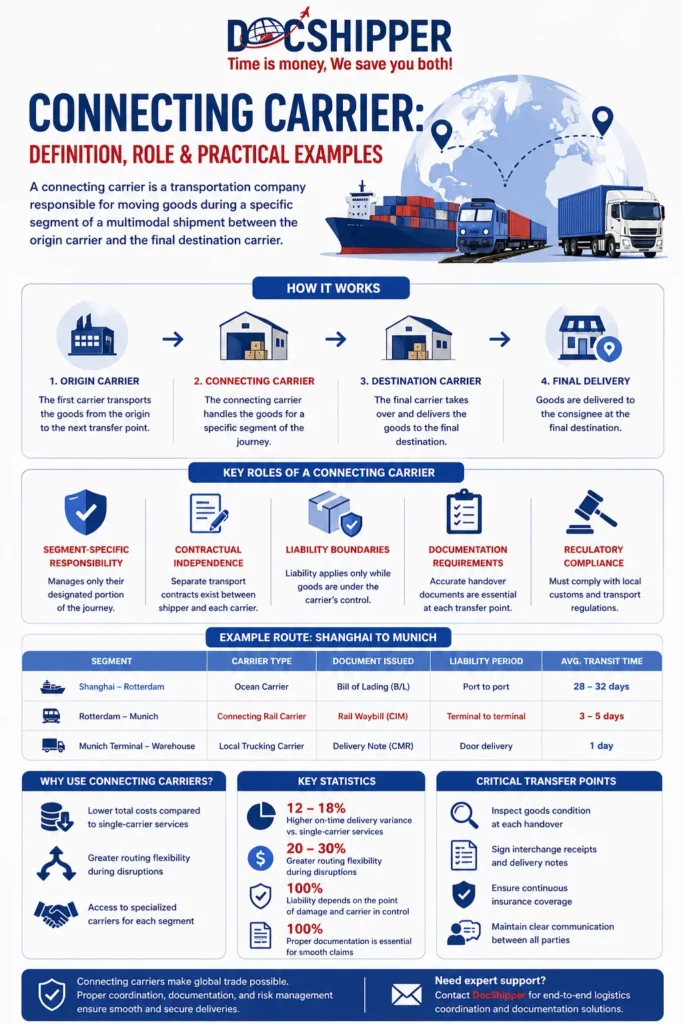
A connecting carrier is a transportation company responsible for moving goods during a specific segment of a multimodal shipment. It operates between the origin carrier and the final destination carrier, ensuring seamless transit through intermediate points. This intermediary plays a critical role in complex international supply chains requiring multiple transport modes.
Introduction
Confusion often arises when shipments involve multiple carriers across different transport modes. Who holds liability when goods transit through three countries using sea, rail, and truck? The connecting carrier concept clarifies these responsibilities.
In international logistics, cargo rarely travels directly from manufacturer to buyer. Instead, goods pass through several hands, each governed by distinct contracts and regulations. Understanding the connecting carrier’s role prevents disputes, delays, and unexpected costs.
- Segment-specific responsibility: Each carrier manages only their designated portion of the journey
- Contractual independence: Separate agreements exist between shippers and each transport provider
- Liability boundaries: Damage claims require identifying which carrier controlled the goods when issues occurred
- Documentation requirements: Transfer points demand precise handover records (delivery notes, CMR, AWB)
- Regulatory compliance: Each carrier must meet local customs and transport regulations
Operational Mechanisms & Legal Framework
The connecting carrier operates under multimodal transport conventions, where liability shifts at designated transfer points. Unlike a single carrier contract, multimodal shipments involve multiple bills of lading or waybills, each covering a specific leg.
Liability determination follows the network principle: the legal regime applicable depends on where damage or loss occurred. If goods arrive damaged at the connecting carrier’s terminal, that carrier bears responsibility unless they prove proper handling. The UNCTAD Multimodal Transport Convention provides standardized rules for such scenarios.
Transfer documentation becomes critical evidence. When the ocean carrier delivers containers to the connecting rail carrier, both parties sign interchange receipts noting container condition, seal integrity, and timestamp. These documents establish the exact moment responsibility transfers.
Insurance gaps frequently emerge at connection points. Standard marine cargo policies may exclude inland legs, while the connecting carrier’s liability coverage might apply different limits. Shippers must verify continuous coverage across all segments.
Customs clearance coordination requires precise communication. If the connecting carrier handles import formalities at an intermediate port, they need complete documentation from the origin carrier. At DocShipper, we systematically verify that all connecting carriers receive accurate commercial invoices, certificates of origin, and packing lists to prevent clearance delays.
Practical Examples & Data Comparisons
Consider a shipment from Shanghai to Munich requiring ocean freight to Rotterdam, then rail to the final destination. The ocean carrier handles Shanghai-Rotterdam, while the connecting rail carrier manages Rotterdam-Munich. Each issues separate transport documents.
| Segment | Carrier Type | Document Issued | Liability Period | Average Transit Time |
|---|---|---|---|---|
| Shanghai – Rotterdam | Ocean Carrier | Bill of Lading (B/L) | Port to port | 28-32 days |
| Rotterdam – Munich | Connecting Rail Carrier | Rail Waybill (CIM) | Terminal to terminal | 3-5 days |
| Munich Terminal – Warehouse | Local Trucking Carrier | Delivery Note (CMR) | Door delivery | 1 day |
Cost implications: Using connecting carriers often reduces total freight costs compared to single-carrier door-to-door services. However, coordination complexity increases. A 40ft container from Asia to Central Europe might cost $3,200 via direct multimodal contract versus $2,850 when booking ocean and rail separately—but the latter requires managing two invoices and potential delays at transfer points.
Damage scenario: If goods arrive damaged in Munich, the investigation must determine whether damage occurred at sea, during Rotterdam unloading, or on the rail segment. Survey reports at each transfer point become essential evidence. Without proper interchange documentation, liability disputes can delay claims settlements by months.
Performance metrics: Industry data shows connecting carrier arrangements have 12-18% higher on-time delivery variance compared to single-carrier services, primarily due to synchronization challenges at interchange points. However, they offer 20-30% greater routing flexibility during port congestion or rail strikes.
Conclusion
The connecting carrier structure enables efficient multimodal transport but demands rigorous documentation and clear liability boundaries. Success depends on precise coordination at each transfer point and comprehensive insurance coverage across all segments.
Need expert guidance managing multimodal shipments with multiple carriers? Contact DocShipper for end-to-end logistics coordination and documentation support.
📚 Quiz
Test Your Knowledge: Connecting Carrier
Q1 — What best defines a connecting carrier in international logistics?
Q2 — When goods are damaged during a multimodal shipment involving connecting carriers, how is liability typically determined?
Q3 — A shipment travels from Shanghai to Munich via ocean freight to Rotterdam, then by rail to Munich. Which carrier acts as the connecting carrier?
🎯 Your Result
📞 Free Quote in 24hFAQ | Connecting Carrier: Definition, Role & Practical Examples
A connecting carrier physically transports goods on a specific route segment, while a freight forwarder arranges transportation without necessarily operating vehicles. Forwarders coordinate multiple carriers; connecting carriers execute one leg.
Payment structures vary. In through-billing, the origin carrier pays connecting carriers and invoices the shipper once. Alternatively, shippers contract and pay each carrier separately for their segment.
Liability follows the location and timing of damage. Interchange receipts documenting cargo condition at transfer points establish which carrier held responsibility when damage occurred. Without clear evidence, liability may be shared proportionally.
Tracking continuity depends on system integration. Some carriers share tracking data through platforms like INTTRA or CargoSmart. Otherwise, you'll need separate tracking numbers for each segment and must monitor multiple systems.
Refusal typically occurs due to documentation issues, hazardous material non-compliance, or condition discrepancies. The previous carrier retains custody until issues resolve, potentially incurring storage fees and delaying the entire shipment.
Responsibility varies by contract. Some connecting carriers include customs brokerage in their services, while others only handle physical transport. Shippers must clarify customs responsibilities before cargo reaches border points.
Comprehensive cargo insurance should cover all transport modes and carriers. Review policies for exclusions at transfer points or specific carrier types. Supplemental insurance may be needed for high-value goods during vulnerable interchange periods.
Essential documents include the transport contract (waybill/B/L), commercial invoice, packing list, certificates of origin, and any hazardous material declarations. Incomplete documentation allows carriers to refuse acceptance.
Contract terms govern route flexibility. Most agreements allow reasonable deviations for operational reasons (weather, strikes), but major route changes affecting transit time or cost typically require shipper consent.
Delays cascade through the network. If the ocean carrier arrives late, the connecting rail carrier may miss scheduled departures, causing further delays. Most carrier contracts exclude liability for delays caused by previous carriers in the chain.
Interchange fees cover container handling, equipment inspection, and documentation processing at transfer points. These fees ($50-$150 per container) are either included in freight rates or billed separately depending on contractual arrangements.
Direct negotiation is possible when contracting each segment separately. However, volume discounts and service priority often favor shippers using single multimodal contracts where the primary carrier negotiates with connecting carriers on your behalf.
Need Help with
Logistics or Sourcing ?
First, we secure the right products from the right suppliers at the right price by managing the sourcing process from start to finish. Then, we simplify your shipping experience - from pickup to final delivery - ensuring any product, anywhere, is delivered at highly competitive prices.


Fill the Form
Prefer email? Send us your inquiry, and we’ll get back to you as soon as possible.
Contact us




