


In short ⚡
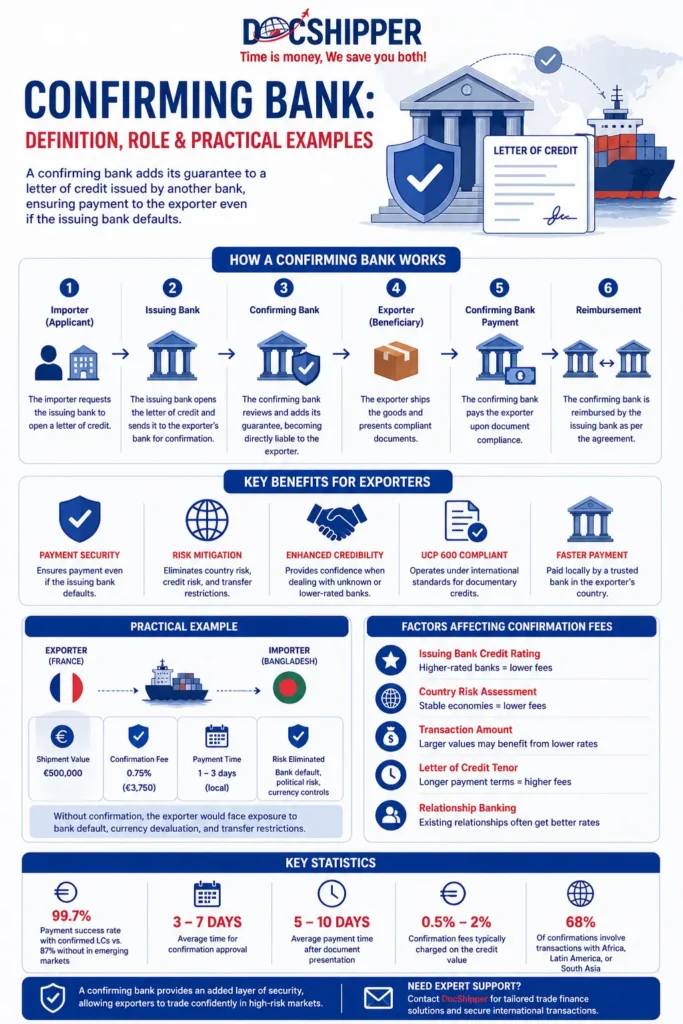
A confirming bank is a financial institution that adds its guarantee to a letter of credit issued by another bank, ensuring payment to the exporter even if the issuing bank defaults. This additional security mechanism protects sellers in international transactions against credit and country risks.
Introduction
International trade involves significant payment risks. Exporters often face uncertainty about whether foreign buyers will honor their commitments. This concern intensifies when dealing with banks in politically unstable regions or emerging markets.
The confirming bank addresses this challenge by providing an additional layer of financial security. In documentary credit operations, this institution transforms a foreign bank’s promise into a domestic guarantee.
Key characteristics of confirming banks include:
- Independent payment obligation: The confirming bank commits to pay regardless of the issuing bank’s performance
- Risk mitigation: Eliminates country risk and issuing bank credit risk for exporters
- Enhanced credibility: Provides comfort when dealing with unknown or lower-rated financial institutions
- Documentary compliance: Verifies that all letter of credit terms are met before payment
- Fee-based service: Charges a confirmation fee reflecting the risk assumed
Role and Mechanisms of Confirming Banks
The confirming bank operates within the documentary credit framework established by the International Chamber of Commerce’s Uniform Customs and Practice for Documentary Credits (UCP 600). This standardized system governs letter of credit operations worldwide.
When an issuing bank in the buyer’s country opens a letter of credit, it may request a bank in the seller’s country to add confirmation. The advising bank typically becomes the confirming bank, though this is not mandatory. Once confirmation is added, the exporter gains a direct payment commitment from a local, trusted institution.
The payment mechanism follows strict documentary compliance rules. The exporter presents shipping documents (bill of lading, commercial invoice, packing list, certificates) to the confirming bank. If documents match letter of credit terms exactly, the confirming bank must pay—even if the issuing bank faces financial difficulties or political restrictions prevent payment.
Three critical risk elements are transferred to the confirming bank:
- Credit risk: Protection against issuing bank insolvency or default
- Country risk: Shield from foreign exchange controls, political instability, or transfer restrictions
- Performance risk: Guarantee of payment upon compliant document presentation
According to ICC Banking Commission guidelines, the confirming bank’s obligation is autonomous and irrevocable. This means the commitment cannot be withdrawn once established, providing absolute certainty to exporters.
At DocShipper, we systematically verify letter of credit terms and confirmation status before shipment, ensuring our clients avoid payment complications that could jeopardize their cash flow.
Practical Examples & Comparative Data
Consider a French machinery exporter shipping €500,000 worth of equipment to a buyer in Bangladesh. The Bangladeshi bank issues a letter of credit, but the French exporter has concerns about that bank’s creditworthiness and potential currency transfer restrictions.
The exporter requests confirmation from their French bank. After assessing risk, the French bank agrees to confirm for a 0.75% fee (€3,750). This confirmation transforms the transaction security profile completely.
| Scenario | Without Confirmation | With Confirmation |
|---|---|---|
| Payment guarantee | Bangladeshi bank only | French bank guarantee |
| Country risk exposure | Full exposure to Bangladesh political/economic conditions | Eliminated—payment in France |
| Payment timeline | Dependent on international transfers (5-10 days) | Local payment (1-3 days) |
| Cost | Lower fees (~0.15%) | Additional 0.75% confirmation fee |
| Financing options | Limited—foreign bank guarantee | Enhanced—domestic bank relationship |
Real-world case study: A German automotive parts supplier experienced this firsthand in 2022. They shipped €2 million in components to Turkey under an unconfirmed letter of credit. When the Turkish lira collapsed and capital controls were imposed, payment was delayed by 94 days despite compliant documents. The financial impact included currency losses of €47,000 and working capital strain requiring bridge financing.
In contrast, a similar supplier using confirmed letters of credit for Egyptian transactions received payment within 48 hours of document presentation, despite the Egyptian pound’s volatility and the issuing bank’s subsequent downgrade by rating agencies.
Five critical factors determine confirmation fees:
- Issuing bank credit rating: Higher-rated banks command lower confirmation fees (0.25-0.50% vs. 1.00-2.00% for lower-rated institutions)
- Country risk assessment: Stable economies reduce fees; emerging markets increase costs
- Transaction amount: Larger values may benefit from economies of scale in fee structures
- Letter of credit tenor: Longer payment terms increase risk exposure and fees
- Relationship banking: Established clients often negotiate preferential confirmation rates
Conclusion
The confirming bank serves as a critical risk management tool in international trade, transforming foreign payment promises into domestic guarantees. This mechanism enables exporters to confidently pursue global opportunities while maintaining financial security.
Need guidance on letter of credit structures or payment security for your international shipments? Contact DocShipper for expert support tailored to your trade requirements.
📚 Quiz
Test Your Knowledge: Confirming Bank
Q1. What is the primary role of a confirming bank in a letter of credit transaction?
Q2. A confirmed letter of credit guarantees the exporter payment under all circumstances, including documentary discrepancies. Is this correct?
Q3. A French exporter is shipping goods to a buyer in a politically unstable country. The issuing bank has a low credit rating and the local currency is volatile. Which approach best protects the exporter?
🎯 Your Result
📞 Free Quote in 24hFAQ | Confirming Bank: Definition, Role & Practical Examples
An advising bank simply notifies the exporter about the letter of credit without assuming payment obligation. A confirming bank adds its independent guarantee to pay, creating a direct commitment to the beneficiary regardless of the issuing bank's performance.
No, confirmation is optional and must be specifically requested by either the applicant (buyer) or beneficiary (seller). Many letters of credit remain unconfirmed when the issuing bank has strong creditworthiness or when country risk is minimal.
Typically, the beneficiary (exporter) bears the confirmation cost unless the letter of credit specifically states that the applicant (importer) will cover this expense. This should be negotiated during sales contract discussions.
Yes, confirming banks assess risk independently and may decline confirmation if they consider the issuing bank's credit risk or country risk too high. They may also impose restrictive conditions or demand higher fees for elevated risk profiles.
The confirming bank will reject non-compliant documents and refuse payment until discrepancies are corrected. The exporter must either amend documents or obtain a waiver from the applicant. The confirmation guarantee only applies to compliant presentations.
Confirmation remains valid through the letter of credit's expiry date and any authorized extensions. Once the confirming bank adds its guarantee, this commitment cannot be unilaterally withdrawn during the letter of credit's validity period.
While theoretically possible, multiple confirmations are extremely rare in practice. Typically, one bank in the beneficiary's country provides confirmation. Multiple confirmations would create complex liability structures and unnecessary cost duplication.
Silent confirmation is an unofficial arrangement where a bank provides payment guarantee without the issuing bank's knowledge or authorization. This creates legal ambiguities and is generally discouraged under UCP 600 rules, though some banks offer this as a risk mitigation product.
Confirmation eliminates issuing bank credit risk and country risk but does not protect against documentary discrepancies, fraud, or force majeure events. Exporters must still ensure strict compliance with letter of credit terms and maintain proper documentation.
Confirmed letters of credit significantly enhance financing availability. Banks readily provide pre-shipment and post-shipment financing against confirmed credits at favorable rates, as the domestic bank's guarantee reduces lending risk substantially compared to unconfirmed instruments.
Yes, confirmation can be added post-issuance through an amendment, provided the confirming bank agrees and the issuing bank authorizes the addition. However, this process requires coordination among all parties and may delay transaction timelines.
Confirming banks operate primarily under ICC's UCP 600 rules, which provide standardized international practices. Additionally, they must comply with domestic banking regulations, anti-money laundering requirements, and sanctions screening protocols in their respective jurisdictions.
Need Help with
Logistics or Sourcing ?
First, we secure the right products from the right suppliers at the right price by managing the sourcing process from start to finish. Then, we simplify your shipping experience - from pickup to final delivery - ensuring any product, anywhere, is delivered at highly competitive prices.


Fill the Form
Prefer email? Send us your inquiry, and we’ll get back to you as soon as possible.
Contact us




