


In short ⚡
CARICOM (Caribbean Community) is a regional integration organization comprising 15 Caribbean member states, established to promote economic cooperation, coordinate foreign policy, and facilitate trade through reduced tariffs and harmonized customs procedures. It operates as both a common market and a political alliance.Introduction
Many importers and exporters overlook CARICOM when planning Caribbean trade routes, missing substantial duty savings and streamlined customs clearance. Understanding this regional bloc is essential for cost-effective logistics in the Americas.
CARICOM directly impacts freight forwarding, customs compliance, and market access across 15 nations spanning from Belize to Suriname. Its regulatory framework governs tariff elimination, rules of origin, and cross-border movement of goods.
- Established in 1973 through the Treaty of Chaguaramas to replace CARIFTA
- 15 full member states plus 5 associate members with varied participation levels
- CARICOM Single Market and Economy (CSME) allows free movement of goods, services, and skilled labor
- Common External Tariff (CET) standardizes duties on imports from non-member countries
- Rules of Origin requirements determine eligibility for preferential tariff treatment within the bloc
CARICOM Framework & Trade Mechanisms
CARICOM operates through a four-pillar structure: economic integration, functional cooperation, foreign policy coordination, and security collaboration. The economic dimension dominates logistics considerations.
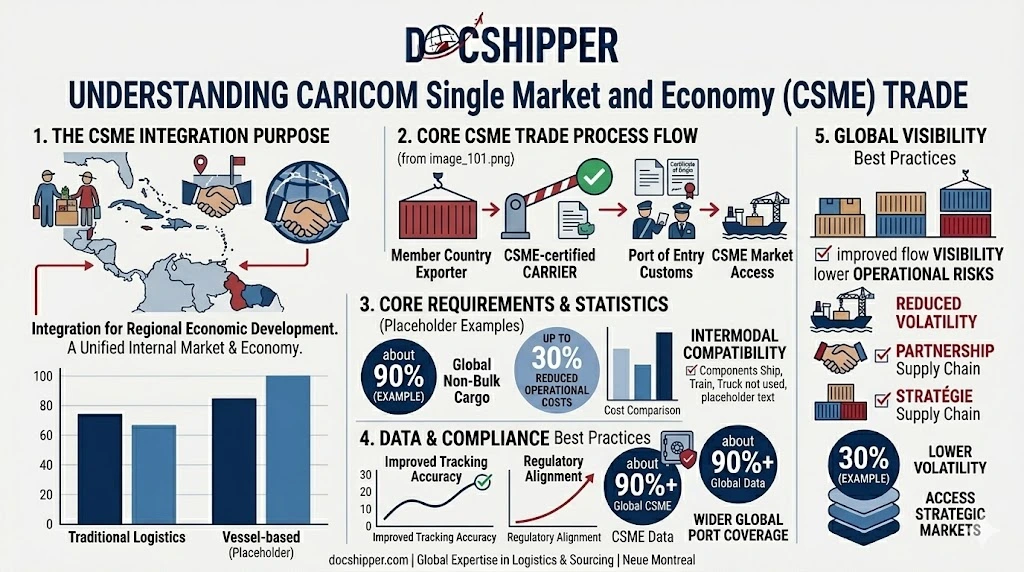
The CARICOM Single Market and Economy (CSME) represents the most advanced integration phase. It eliminates internal tariffs on qualifying goods and harmonizes standards, making intra-regional trade significantly more efficient than traditional bilateral arrangements.
Common External Tariff (CET) rates range from 0% to 20% depending on product classification. Member states apply identical duties to imports from third countries, creating predictable cost structures for international shippers entering the Caribbean market.
Rules of Origin require that goods contain at least 50% regional value-added content to qualify for duty-free treatment. This calculation includes materials, labor, and manufacturing costs incurred within CARICOM territory. At DocShipper, we systematically verify origin documentation to ensure clients maximize these tariff benefits while maintaining full customs compliance.
The CARICOM Customs Code standardizes procedures across member states, though implementation varies. Jamaica, Trinidad and Tobago, and Barbados maintain the most advanced electronic customs systems, while smaller nations still process declarations manually.
Legal authority derives from the Revised Treaty of Chaguaramas (2001), which established the CSME legal framework. Member states must transpose CARICOM directives into national law, creating occasional discrepancies that experienced freight forwarders navigate routinely. Reference: Official CARICOM Secretariat.
Trade Data & Practical Examples
Intra-CARICOM trade totaled approximately $2.8 billion USD in 2022, representing roughly 15% of total Caribbean trade volume. Trinidad and Tobago accounts for 40% of regional exports, primarily petroleum products and manufactured goods.
| Member State | Main Exports to CARICOM | Customs Processing Time |
|---|---|---|
| Trinidad & Tobago | Petroleum products, chemicals, food | 24-48 hours |
| Jamaica | Beverages, alumina, agricultural products | 48-72 hours |
| Barbados | Rum, chemicals, electronics | 24-36 hours |
| Guyana | Rice, timber, gold | 72-96 hours |
Use Case: Electronics Import from China to Jamaica via CARICOM
A U.S. company imports consumer electronics manufactured in China. Direct shipment to Miami attracts standard U.S. duties (2.5-6%). By routing through Jamaica (a CARICOM member), paying the CET (5-10%), then re-exporting to other Caribbean markets duty-free under CARICOM preferences, total landed costs decrease by 18-22% for regional distribution.
Key operational considerations:
- Certificate of Origin (Form A) must accompany all intra-CARICOM shipments claiming preferential treatment
- Harmonized Commodity Description (HCD) classification determines applicable CET rates and origin requirements
- Phytosanitary certificates required for agricultural products, issued by national authorities but recognized regionally
- Transit procedures allow sealed containers to move through member states without customs examination at intermediate borders
- CARICOM Invoice replaces commercial invoice for intra-regional trade, containing specific declaration fields
Average duty savings range from 8% to 35% depending on product category when utilizing CARICOM preferences versus third-country MFN rates. Manufacturing sectors like food processing, textiles, and light assembly benefit most significantly.
Conclusion
CARICOM membership creates tangible cost advantages and operational efficiencies for companies trading within the Caribbean basin. Proper documentation and origin compliance unlock these benefits while avoiding costly customs delays.
Need assistance navigating CARICOM regulations for your shipments? Contact DocShipper for expert guidance on Caribbean trade compliance and logistics optimization.
📚 Quiz
Test Your Knowledge: CARICOM
Q1 — What is CARICOM primarily defined as?
Q2 — To qualify for duty-free treatment under CARICOM's Rules of Origin, goods must contain at least what percentage of regional value-added content?
Q3 — A European exporter ships finished consumer goods into the CARICOM market. Which Common External Tariff (CET) rate band should they expect to apply?
🎯 Your Result
📞 Free Quote in 24hFAQ | CARICOM: Definition, Trade Benefits & Practical Examples
The 15 full members are: Antigua and Barbuda, Bahamas, Barbados, Belize, Dominica, Grenada, Guyana, Haiti, Jamaica, Montserrat, Saint Kitts and Nevis, Saint Lucia, Saint Vincent and the Grenadines, Suriname, and Trinidad and Tobago.
CET rates span 0% to 20% across four bands: raw materials (0-5%), capital goods (5%), intermediate goods (10-15%), and finished consumer goods (15-20%). Specific rates depend on HS code classification.
Apply through your country's designated issuing authority (typically Chamber of Commerce or Customs). Provide commercial invoice, manufacturing declaration, and proof of regional value content exceeding 50%.
No. CARICOM preferences apply only to intra-regional trade. Goods re-exported to third countries face standard export duties and destination country import tariffs without CARICOM benefits.
Essential documents include: CARICOM Invoice, Certificate of Origin (Form A), Bill of Lading/Air Waybill, packing list, and product-specific certificates (phytosanitary, health, etc.).
Yes. The CSME includes provisions for free movement of services and skilled labor, though implementation remains incomplete. Professional services, tourism, and IT sectors see the most practical benefits currently.
CARICOM maintains agreements with the EU (Economic Partnership Agreement), Canada (CARIBCAN), and participates in negotiations for broader hemispheric integration. These agreements stack with CARICOM benefits.
Infrastructure limitations, inconsistent customs automation, varying interpretation of rules of origin, limited intra-regional shipping connections, and non-tariff barriers like licensing requirements present operational challenges.
Partially. The CSME eliminates internal tariffs on qualifying goods, but some sensitive products (agriculture, certain manufactures) retain restrictions. Member states also maintain individual import licensing regimes.
Processing times vary by port: major hubs like Kingston (Jamaica) and Port of Spain (Trinidad) clear in 24-48 hours, while smaller territories may require 72-96 hours for complete clearance.
Yes, provided goods remain under customs seal and transit documentation proves no manipulation occurred. Direct shipment is preferred but not mandatory if proper transit procedures are followed.
Penalties include duty recovery at full MFN rates, fines ranging from 25-200% of evaded duties, potential criminal prosecution for fraudulent declarations, and blacklisting from preferential programs.
Need Help with
Logistics or Sourcing ?
First, we secure the right products from the right suppliers at the right price by managing the sourcing process from start to finish. Then, we simplify your shipping experience - from pickup to final delivery - ensuring any product, anywhere, is delivered at highly competitive prices.


Fill the Form
Prefer email? Send us your inquiry, and we’ll get back to you as soon as possible.
Contact us




