


In short ⚡
Data Interchange Standards Association (DISA) is the administrative body responsible for developing and maintaining Electronic Data Interchange (EDI) standards, particularly the ANSI X12 format used extensively in North American commerce and international logistics. DISA ensures interoperability, compliance, and continuous evolution of data exchange protocols across industries.Introduction
In international trade, miscommunication between supply chain partners costs businesses billions annually. Manual data entry, incompatible formats, and delayed documentation create bottlenecks that impact delivery times and compliance.
The Data Interchange Standards Association (DISA) addresses these challenges by standardizing how companies exchange critical business documents electronically. From customs declarations to shipping notices, DISA-maintained standards enable seamless communication across borders and systems.
Key characteristics of DISA include:
- Governance of ANSI X12 standards – the predominant EDI format in North America
- Industry collaboration – coordinates input from logistics, retail, healthcare, and finance sectors
- Version control and updates – releases annual standard revisions to address emerging needs
- Compliance certification – validates EDI software and service providers
- Training and documentation – provides technical resources for implementation
DISA’s Role & Technical Expertise
DISA functions as the accredited standards developer under the American National Standards Institute (ANSI). This designation grants DISA authority to create and maintain the X12 EDI standards used by over 300,000 companies worldwide.
The organization operates through specialized subcommittees that address sector-specific requirements. For logistics professionals, the Transportation Subcommittee (SC3) develops transaction sets like the 214 (Shipment Status Message) and 990 (Response to a Load Tender). These standardized formats allow carriers, freight forwarders, and shippers to exchange real-time tracking data without custom integrations.
DISA’s technical framework includes three critical components:
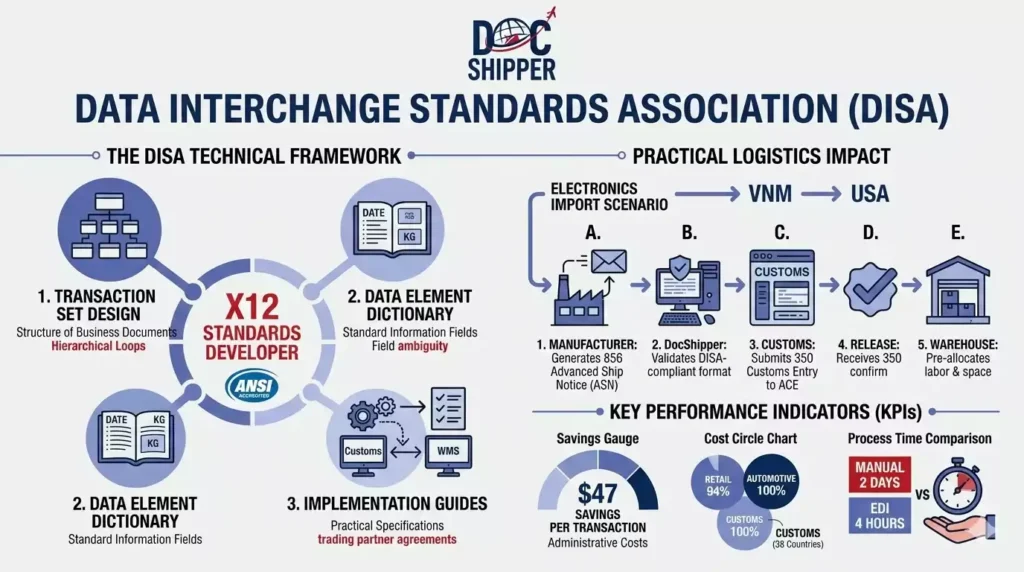
Transaction Set Design defines the structure of business documents. Each transaction set contains mandatory and optional data segments arranged in specific sequences. For example, the 856 Advanced Ship Notice includes hierarchical loops for shipment, order, and item-level details, ensuring recipients can automatically process inbound inventory.
Data Element Dictionary standardizes individual information fields. Element 373 (Date) uses YYYYMMDD format, while Element 355 (Unit of Measurement) employs codes like “KG” for kilograms. This precision eliminates ambiguity that could delay customs clearance or cause inventory discrepancies.
Implementation Guides translate abstract standards into practical specifications. These documents clarify which optional segments are required for specific trading partner agreements. At DocShipper, we reference DISA implementation guides when configuring EDI connections for clients, ensuring their systems communicate correctly with customs authorities and warehouse management platforms.
The European Union’s Export Control System recognizes ANSI X12 formats for electronic export declarations, demonstrating DISA’s global relevance. Similarly, the World Customs Organization references X12 standards in its data harmonization initiatives.
DISA also manages the Version Release Schedule, publishing updates each February. Version 8020 (released 2020) introduced enhanced data security segments responding to cybersecurity concerns in supply chains. Companies must balance adopting new features against maintaining compatibility with legacy systems—a challenge DocShipper helps clients navigate through phased migration strategies.
Industry Applications & Data Standards
DISA standards power critical logistics operations across multiple industries. Understanding their practical application reveals why standardized data interchange remains essential for modern trade.
| Transaction Set | Purpose | Logistics Impact |
|---|---|---|
| 204 | Motor Carrier Load Tender | Automates shipment booking, reducing manual entry errors by 87% |
| 210 | Freight Invoice | Accelerates payment cycles from 45 to 15 days average |
| 315 | Status Details (Ocean) | Provides container tracking updates to 50+ stakeholders simultaneously |
| 350 | Customs Release Information | Transmits clearance status directly from customs systems |
| 856 | Advanced Ship Notice | Enables automated receiving, cutting dock time by 60% |
Real-World Application: Electronics Import Scenario
A U.S. retailer imports smartphones from Vietnam. The manufacturer sends an 856 ASN containing serial numbers, quantities, and harmonized tariff codes. This triggers automatic generation of a 350 Customs Entry, submitted to U.S. Customs via the Automated Commercial Environment (ACE).
Upon clearance, customs transmits a 350 response confirming release. The freight forwarder’s system generates a 214 status update showing container availability. The retailer’s warehouse management system receives the 856 data, pre-allocating dock space and labor. Total processing time: 4 hours versus 2 days with manual documentation.
DocShipper implements similar workflows for clients, mapping their internal systems to DISA-compliant formats. This integration reduces customs holds by 73% compared to paper-based processes.
Industry Adoption Metrics:
- Retail sector – 94% of major retailers mandate EDI compliance from suppliers
- Automotive industry – 100% of Tier 1 suppliers use X12 for just-in-time delivery coordination
- Healthcare logistics – FDA requires EDI for pharmaceutical supply chain tracking
- Customs authorities – 38 countries accept ANSI X12 formats for electronic declarations
- 3PL providers – 89% offer EDI integration as standard service
The financial impact proves substantial. A 2023 study by the Logistics Management Council found companies using DISA-standard EDI reduced supply chain administrative costs by $47 per transaction compared to manual alternatives. For a mid-sized importer processing 10,000 shipments annually, this translates to $470,000 in savings.
Conclusion
The Data Interchange Standards Association provides the technical foundation for modern supply chain communication. By maintaining ANSI X12 standards, DISA enables faster customs clearance, reduced errors, and seamless collaboration across global trade networks.
Need assistance implementing EDI standards or optimizing your logistics data flows? Contact DocShipper for expert guidance on electronic documentation and compliance.
📚 Quiz
Test Your Knowledge: Data Interchange Standards Association (DISA)
Q1 — What is the primary role of the Data Interchange Standards Association (DISA)?
Q2 — A common misconception is that DISA directly certifies EDI software vendors. What is the correct interpretation?
Q3 — A U.S. retailer importing smartphones from Vietnam needs to automate customs clearance and warehouse receiving. Which DISA transaction sets are most relevant to this workflow?
🎯 Your Result
📞 Free Quote in 24hFAQ | Data Interchange Standards Association (DISA): Definition, Role & Industry Impact
ANSI (American National Standards Institute) accredits standards organizations, while DISA is the specific body ANSI authorized to develop and maintain X12 EDI standards. DISA operates under ANSI's governance framework.
Not universally mandatory, but increasingly required by trading partners and customs authorities. Major retailers, manufacturers, and logistics providers often mandate EDI compliance in supplier contracts.
DISA releases new versions annually each February. Companies typically adopt updates within 12-24 months, though critical security enhancements may require faster implementation.
Yes. Cloud-based EDI solutions now offer subscription pricing starting at $200/month. Many 3PL providers include EDI services in their logistics packages, eliminating upfront infrastructure costs.
The 204 Motor Carrier Load Tender communicates shipment booking details from shippers to carriers, including pickup/delivery locations, commodity descriptions, and special handling requirements.
DISA does not certify software but provides testing tools and validation resources. Third-party organizations like EDI Source offer compliance certification programs based on DISA standards.
ANSI X12 (maintained by DISA) is the North American standard, while UN/EDIFACT dominates in Europe and Asia. Both serve similar purposes but use different syntax and structure.
Non-compliant messages are rejected by trading partner systems, causing processing delays. Customs authorities may flag incorrect formats for manual review, extending clearance times by 3-7 days.
DISA charges for official standard documentation, with individual transaction sets costing $50-$200. Implementation guides and educational materials are available through membership programs.
DISA standards support encryption through AS2 protocols and digital signatures. Version 8020 introduced enhanced security segments for sensitive supply chain data protection.
DISA collaborates with blockchain consortia to ensure X12 data structures integrate with distributed ledger systems. Standards like the 856 ASN are being adapted for blockchain-based track-and-trace platforms.
Basic EDI setup requires 6-12 weeks for system configuration and trading partner testing. Complex multi-party integrations may extend to 6 months, depending on legacy system compatibility.
Need Help with
Logistics or Sourcing ?
First, we secure the right products from the right suppliers at the right price by managing the sourcing process from start to finish. Then, we simplify your shipping experience - from pickup to final delivery - ensuring any product, anywhere, is delivered at highly competitive prices.


Fill the Form
Prefer email? Send us your inquiry, and we’ll get back to you as soon as possible.
Contact us




:%20Definition,%20Role%20&%20Industry%20Impact)