


In short ⚡
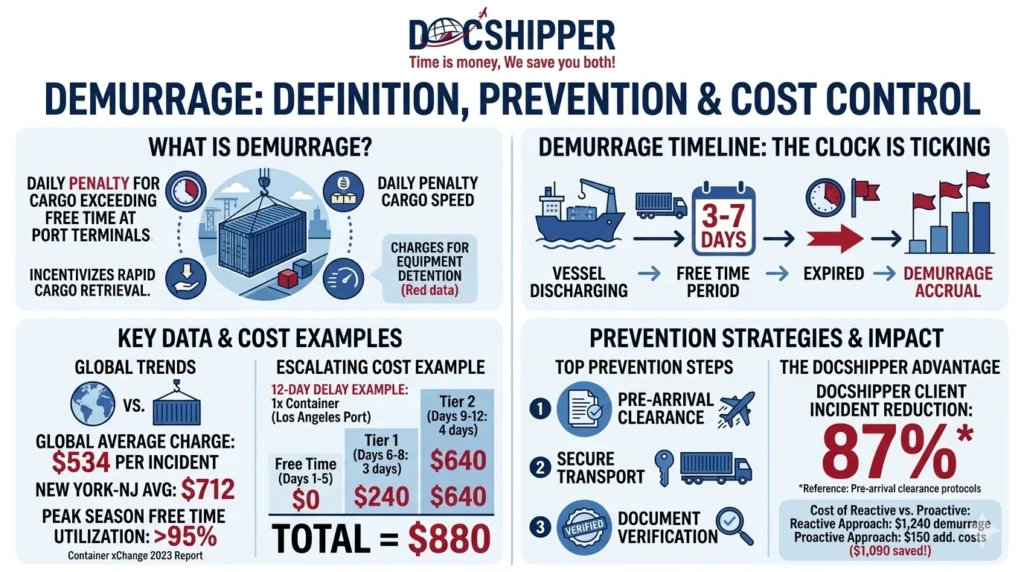
Demurrage is a penalty charge imposed by shipping lines or terminal operators when cargo containers exceed the allocated free time at port facilities. This fee compensates carriers for equipment detention and incentivizes rapid cargo movement through logistics chains.Introduction
One of the most costly surprises in international trade is receiving an unexpected demurrage invoice. Many importers confuse free time allowances with storage periods, leading to penalties that can exceed the cargo’s value in extreme cases.
Demurrage represents a critical cost control point in supply chain management. It directly impacts cash flow, inventory planning, and carrier relationships. Understanding this mechanism is essential for any business engaged in containerized shipping.
Key characteristics of demurrage charges:
- Time-based penalty: Accrues daily after free time expires
- Contractual obligation: Defined in carrier tariffs and booking terms
- Equipment-specific: Applies separately to each container
- Compounding structure: Rates typically increase in tiers
- Non-negotiable once incurred: Rarely waived without documented force majeure
Mechanisms & Regulatory Framework
Demurrage operates within a structured timeline that begins when containers are discharged from vessels. Shipping lines grant a free time period (typically 3-7 days) for cargo retrieval before charges commence. This grace period varies by trade lane, carrier policy, and contractual agreements.
The legal foundation for demurrage stems from maritime commercial law, which recognizes carriers’ rights to compensation for equipment detention. The Federal Maritime Commission in the United States and similar regulatory bodies worldwide oversee fairness in demurrage practices, though enforcement remains inconsistent.
Three distinct phases define the demurrage lifecycle:
Pre-arrival preparation: Importers must secure customs clearance documentation, arrange inland transportation, and confirm warehouse capacity before vessel discharge. At DocShipper, we coordinate these elements simultaneously to minimize port dwell time and eliminate avoidable demurrage exposure.
Free time utilization: The clock starts when containers become available for pickup, not when vessels dock. Terminal congestion, customs holds, or documentation errors consume this buffer rapidly. Effective communication between freight forwarders, customs brokers, and trucking companies is critical.
Penalty accumulation: Once free time expires, demurrage accrues in tiered rate structures. Days 1-3 might cost $75 per container daily, days 4-7 escalate to $150, and subsequent days can reach $300 or more. These rates compound quickly, transforming minor delays into substantial financial burdens.
Regulatory disputes often arise around force majeure events. Port strikes, natural disasters, or government-imposed restrictions may justify demurrage waivers, but carriers require extensive documentation. The COVID-19 pandemic highlighted inconsistencies in how shipping lines applied relief policies, prompting calls for standardized industry protocols.
Container detention differs from demurrage but is equally important. Detention charges apply when containers leave port facilities but aren’t returned within the allowed timeframe. While demurrage focuses on port congestion, detention addresses equipment circulation in inland logistics networks.
Calculation Methods & Real-World Scenarios
Demurrage calculations follow standardized formulas, yet variations in carrier tariffs create complexity. The basic structure multiplies daily rates by the number of days exceeding free time, but tiered pricing and special circumstances require careful analysis.
Standard calculation example: An importer receives a 40-foot container at Los Angeles port with 5 days free time. Due to customs examination, the container remains at the terminal for 12 days. The carrier’s tariff specifies:
| Period | Days | Daily Rate | Subtotal |
|---|---|---|---|
| Free Time | Days 1-5 | $0 | $0 |
| Tier 1 | Days 6-8 (3 days) | $80 | $240 |
| Tier 2 | Days 9-12 (4 days) | $160 | $640 |
| Total Demurrage | $880 |
This $880 charge for a single container demonstrates how quickly costs escalate. For shipments involving 10 containers with similar delays, demurrage alone would reach $8,800—often exceeding the freight charges themselves.
Comparative scenario analysis: Consider two importers shipping identical goods from Shanghai to Rotterdam:
Importer A (proactive approach): Completes pre-clearance documentation, arranges pickup within 3 days of discharge. Total demurrage: $0. Additional costs: $150 for expedited customs broker services.
Importer B (reactive approach): Waits for container availability notification before initiating customs clearance. Experiences 8-day delay due to missing commercial invoice details. Total demurrage: $1,240. Additional costs: $200 for rushed document amendments plus demurrage penalties.
The $1,090 cost differential ($1,440 vs. $150) illustrates the financial advantage of proactive logistics management. DocShipper’s pre-arrival clearance protocols have reduced client demurrage incidents by 87% through systematic documentation verification and carrier coordination.
Industry data insights: According to Container xChange’s 2023 Demurrage and Detention Report, global demurrage charges averaged $534 per container across major trade lanes. North American ports recorded the highest rates, with New York-New Jersey averaging $712 per incident due to chronic congestion.
Peak season amplifies demurrage risks. During Q4 holiday shipping periods, free time utilization rates exceed 95% at major gateways. Importers without reserved warehouse capacity or pre-arranged trucking face near-certain penalty exposure during these windows.
Conclusion
Demurrage represents a controllable cost that rewards logistics planning and penalizes reactive approaches. Mastering free time management, documentation workflows, and carrier communication transforms this potential liability into a competitive advantage.
Need expert guidance on minimizing demurrage exposure? Contact DocShipper for customized logistics solutions that protect your bottom line.
📚 Quiz
Test Your Knowledge: Demurrage
Q1. What is demurrage?
Q2. A customs examination delays container pickup by 6 days beyond free time. Does this automatically extend the free time period and suspend demurrage charges?
Q3. An importer's container arrives at Los Angeles port with 5 days free time. The container stays at the terminal for 9 days. The carrier's tariff is: Days 6–8 at $80/day, Days 9+ at $160/day. What is the total demurrage charge?
🎯 Your Result
📞 Free Quote in 24hFAQ | Demurrage: Definition, Calculation & Practical Examples
Demurrage begins when containers are available for pickup after discharge and the carrier's free time expires. Availability notifications are sent electronically, making timestamp documentation critical for dispute resolution.
Carriers rarely waive demurrage unless force majeure is documented with official evidence. Negotiation success rates improve when systemic terminal issues or carrier operational failures are demonstrable through timestamped records.
Demurrage applies while containers remain within port terminals beyond free time. Detention charges accrue when containers leave the terminal but aren't returned to the carrier within the allowed period for unpacking and return.
Standard free time ranges from 3-7 days depending on trade lane and carrier. Asian ports typically offer 5 days, European ports 4-6 days, and North American ports 3-5 days, though contractual terms may extend these periods.
Most major shipping lines employ tiered pricing where daily rates increase after specific thresholds. Some regional carriers use flat daily rates, but tiered structures dominate international container shipping to incentivize rapid cargo movement.
Customs examinations do not automatically extend free time unless carriers grant specific waivers. Importers must request extensions with supporting documentation, though approval is discretionary and often denied for routine inspections.
Most carriers include weekends and holidays in demurrage calculations unless terminals are completely closed. Calendar days, not business days, typically apply, making holiday periods particularly costly for delayed cargo.
Effective disputes require container availability notifications, terminal gate records, customs hold documentation, and timestamped communication logs. Photographic evidence of terminal congestion or equipment unavailability strengthens claims significantly.
Regulatory oversight varies by jurisdiction. The U.S. Federal Maritime Commission reviews demurrage practices for reasonableness but doesn't set rates. European Union competition law monitors excessive charges, though enforcement remains limited.
During equipment shortages, carriers may relax demurrage enforcement to encourage container returns. Conversely, when container availability is high, stricter enforcement and reduced free time become common as carriers optimize asset utilization.
Liability depends on contractual terms and negligence. If forwarders fail to notify clients of container availability or miss critical deadlines due to operational errors, they may bear financial responsibility through service failure clauses.
Real-time container tracking platforms, automated customs clearance systems, and predictive analytics tools identify potential delays before free time expires. Integration between terminal operating systems and freight management software enables proactive intervention.
Need Help with
Logistics or Sourcing ?
First, we secure the right products from the right suppliers at the right price by managing the sourcing process from start to finish. Then, we simplify your shipping experience - from pickup to final delivery - ensuring any product, anywhere, is delivered at highly competitive prices.


Fill the Form
Prefer email? Send us your inquiry, and we’ll get back to you as soon as possible.
Contact us




